%22%2F%3E%0A%20%20%3Ccircle%20cx%3D%22220%22%20cy%3D%22150%22%20r%3D%22180%22%20fill%3D%22%2322d3ee%22%20fill-opacity%3D%220.12%22%2F%3E%0A%20%20%3Ccircle%20cx%3D%221010%22%20cy%3D%22130%22%20r%3D%22220%22%20fill%3D%22%2338bdf8%22%20fill-opacity%3D%220.08%22%2F%3E%0A%20%20%3Ccircle%20cx%3D%22920%22%20cy%3D%22520%22%20r%3D%22170%22%20fill%3D%22%2322d3ee%22%20fill-opacity%3D%220.06%22%2F%3E%0A%20%20%3Cpath%20d%3D%22M140%20430h920%22%20stroke%3D%22url(%23line)%22%20stroke-width%3D%2212%22%20stroke-linecap%3D%22round%22%2F%3E%0A%20%20%3Cpath%20d%3D%22M220%20360c120-150%20260-220%20380-220s260%2070%20380%20220%22%20fill%3D%22none%22%20stroke%3D%22%2367e8f9%22%20stroke-opacity%3D%220.5%22%20stroke-width%3D%2216%22%20stroke-linecap%3D%22round%22%20stroke-linejoin%3D%22round%22%2F%3E%0A%20%20%3Cpath%20d%3D%22M300%20398h600%22%20stroke%3D%22%2394a3b8%22%20stroke-opacity%3D%220.24%22%20stroke-width%3D%228%22%20stroke-linecap%3D%22round%22%2F%3E%0A%20%20%3Ctext%20x%3D%22220%22%20y%3D%22510%22%20fill%3D%22%23e2e8f0%22%20fill-opacity%3D%220.7%22%20font-family%3D%22Arial%2C%20Helvetica%2C%20sans-serif%22%20font-size%3D%2238%22%20letter-spacing%3D%228%22%3EINSIGHTS%3C%2Ftext%3E%0A%3C%2Fsvg%3E)
Earnings • Semiconductors • AI infrastructure
The headline beat landed—then the guide broke the story the market was buying
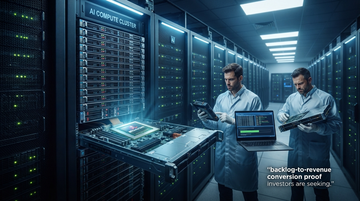
Broadcom’s Sep 2 print delivered strong momentum in AI, yet the stock still fell sharply the same day—because the outlook did not remove uncertainty about when custom silicon backlog becomes revenue.
In other words: a beat on AI revenue didn’t prove backlog conversion into the next quarter. Investors can tolerate a slower quarter; they can’t tolerate a timeline mismatch between AI server buildouts and custom-ASIC deliveries.
AI semiconductor revenue (Q3 FY2026)
$16.7B
Q3 FY2026 (ended Aug 2, 2026), reported Sep 2, 2026
AI semiconductor revenue guide (Q4 FY2026)
$21.7B
Q4 FY2026 expectation (guide issued with Q3 results), reported Sep 2, 2026
Broadcom’s Q4 FY2026 consolidated revenue guide
$34.8B
Q4 FY2026 guidance, reported Sep 2, 2026
Q3 AI growth rate
+221%
AI semiconductor revenue YoY growth in Q3 FY2026
What Broadcom actually guided
AI is still growing fast—so why did the guide worry the AI trade?
The simplest way to miss this story is to treat Broadcom’s guide as “good” or “bad” on magnitude alone. The more decision-relevant question is whether the guidance shape matches investors’ expectations for when hyperscalers ramp custom ASICs across AI racks.
Broadcom guided AI semiconductor revenue to $21.7B in Q4 FY2026 (+236% YoY). That’s enormous growth, but it still can look light if the street was modeling a faster backlog conversion from the prior quarters’ booked custom-silicon demand.
| Metric | Q3 FY2026 result | Q4 FY2026 guide |
|---|---|---|
| AI semiconductor revenue | $16.7B | $21.7B |
| Consolidated revenue | Not disclosed in the captured guidance excerpt | $34.8B |
Because the captured primary-source excerpt did not include the specific custom-silicon backlog conversion line-item the market was focused on, the safest conclusion is timing, not demand.
Investors are discounting the custom-silicon delivery schedule—i.e., how quickly backlog turns into shipments that land inside AI rack builds—rather than discounting the existence of demand.
Supply-chain lens
Why “custom-silicon backlog” behaves like a timeline trade, not a demand trade
- Custom AI accelerators require tight coordination across tape-out schedules, packaging/assembly slots, and board-level integration—so backlog can be real while near-term revenue slips.
- Even when demand is strong, hyperscalers may re-phase deployments across rack generations; Broadcom can keep booking while shipments bunch later.
- Networking+custom silicon tie together rack-level systems (server compute + fabric), so a one-quarter mismatch can pull forward or push out customer acceptance and therefore revenue recognition.
Read-across to the AI complex
What this likely means for Nvidia, Marvell, and hyperscaler ASIC spend narratives
Broadcom is a signal for the AI rack ecosystem because it sits at the intersection of custom compute ASICs and AI networking. If investors believe backlog is not converting into near-term shipments on schedule, they will typically reassess the timing of AI infrastructure revenue for multiple adjacent exposures.
That’s why this matters beyond Broadcom: the same hyperscaler procurement cadence that drives Broadcom’s custom-silicon timelines can also shift (a) AI networking demand patterns and (b) the share of spend allocated to custom accelerators versus merchant GPUs.
| Affected link in the chain | What changes when backlog conversion slips | Typical market reaction |
|---|---|---|
| Rack-level shipment timing | Customer acceptance/revenue recognition shifts later | Near-term AI infrastructure multiples compress |
| Networking and interconnect demand | Systems integration windows re-phase by quarter | Staggered buildouts can cap sequential growth |
| Compute mix (custom vs. merchant) | If custom silicon delivery lags, spend may temporarily favor alternate paths | GPU-related narratives can look comparatively safer short-term |
What to watch next
The next “conversion check” won’t be about bookings—it will be about sequential AI revenue quality
- Wait for management to quantify custom silicon backlog conversion dynamics explicitly; if they tighten the guide rather than broaden it, expect reduced timeline risk.
- Track the sequential profile of AI semiconductor revenue versus the guided YoY rates; the market punished uncertainty about quarter-to-quarter delivery, not long-run demand.
- Watch for commentary tying AI revenue to specific customer ramp phases; lack of customer-specific milestones increases perceived timing risk.
Listed stocks with the clearest, evidence-backed read-across
- If custom-ASIC delivery slips, Nvidia’s merchant GPU ramps can look comparatively faster short-term (timeline relief beats backlog risk).
- If customers re-phase rack deployments, Nvidia’s sequential results can still face quarter-to-quarter noise (timing volatility rises).
- A Broadcom guide disappointment supports the view that AI networking systems are being timed in phases (sequential growth becomes harder to underwrite).
- If hyperscalers continue pulling forward AI spending into later quarters, Marvell can still benefit from the same rack buildout tailwind (longer visibility remains).
- If hyperscaler AI infrastructure purchases re-phase, it can change procurement timing for racks supporting Azure AI workloads (watch for next-quarter infra signals).
- Microsoft’s net effect is likely routed through capex timing, not demand destruction (direction depends on schedule).
- If custom-silicon conversion delays extend, AWS AI compute/network buildouts may show quarter-to-quarter variability (watch for sequential AWS infra indicators).
- If backlog conversion catches up quickly, AWS can re-accelerate and offset near-term timing noise (catalyst is schedule reconciliation).