%22%2F%3E%0A%20%20%3Ccircle%20cx%3D%22220%22%20cy%3D%22150%22%20r%3D%22180%22%20fill%3D%22%2322d3ee%22%20fill-opacity%3D%220.12%22%2F%3E%0A%20%20%3Ccircle%20cx%3D%221010%22%20cy%3D%22130%22%20r%3D%22220%22%20fill%3D%22%2338bdf8%22%20fill-opacity%3D%220.08%22%2F%3E%0A%20%20%3Ccircle%20cx%3D%22920%22%20cy%3D%22520%22%20r%3D%22170%22%20fill%3D%22%2322d3ee%22%20fill-opacity%3D%220.06%22%2F%3E%0A%20%20%3Cpath%20d%3D%22M140%20430h920%22%20stroke%3D%22url(%23line)%22%20stroke-width%3D%2212%22%20stroke-linecap%3D%22round%22%2F%3E%0A%20%20%3Cpath%20d%3D%22M220%20360c120-150%20260-220%20380-220s260%2070%20380%20220%22%20fill%3D%22none%22%20stroke%3D%22%2367e8f9%22%20stroke-opacity%3D%220.5%22%20stroke-width%3D%2216%22%20stroke-linecap%3D%22round%22%20stroke-linejoin%3D%22round%22%2F%3E%0A%20%20%3Cpath%20d%3D%22M300%20398h600%22%20stroke%3D%22%2394a3b8%22%20stroke-opacity%3D%220.24%22%20stroke-width%3D%228%22%20stroke-linecap%3D%22round%22%2F%3E%0A%20%20%3Ctext%20x%3D%22220%22%20y%3D%22510%22%20fill%3D%22%23e2e8f0%22%20fill-opacity%3D%220.7%22%20font-family%3D%22Arial%2C%20Helvetica%2C%20sans-serif%22%20font-size%3D%2238%22%20letter-spacing%3D%228%22%3EINSIGHTS%3C%2Ftext%3E%0A%3C%2Fsvg%3E)
Caterpillar is trying to move industrial AI from “cool demo” to repeatable deployment.
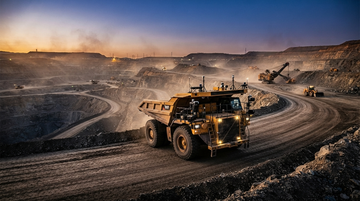
In a recent update on scaling its autonomy learnings, Cat frames its advantage as physical-domain experience: it has spent decades automating mining equipment, and it wants to transplant those workflows into construction, quarries, and industrial operations. The technical center of gravity is edge compute (so machines can act fast on-site), plus digital twins and scanning software that tie operations data back into how work gets planned and executed.
The investor debate is not whether Caterpillar can deploy AI. It’s whether it can monetize the deployment layer as a toll booth—or remain a buyer of the same compute/software stack that benefits the rest of the AI ecosystem.
What Caterpillar just expanded
Cat is taking autonomy from “mines” to “dynamic jobsites,” and it’s tying the software to edge inference
Caterpillar’s message is consistent across its announcements: autonomy at scale is less about a single AI model and more about integrating AI into customer jobsite workflows.
Two load-bearing elements show up repeatedly: (1) edge real-time inference enabled by NVIDIA’s hardware/software platform, and (2) software layers that scan sites and generate digital twins to analyze and improve operations.
- Caterpillar says it is applying autonomy learnings from mining to “much more dynamic environments” such as jobsites, quarries, and construction sites.
- Caterpillar states its machines can process “billions of data points in milliseconds” to handle variable jobsite conditions.
- Caterpillar describes using AI to power scanning and digital-twin generation in manufacturing to analyze operations.
- Caterpillar ties the on-equipment AI stack to NVIDIA Jetson Thor for real-time inference at the edge.
Evidence-based investor lens
The value-capture test: toll-booth monetization vs. commodity AI spending
Most heavy-industry AI rollouts look similar on the outside: companies buy compute, integrate sensors, and run models to optimize specific steps.
Caterpillar’s differentiator claim is that it already knows how to deploy AI where conditions are chaotic, operations are safety-constrained, and outcomes matter. That’s a workflow moat—if Cat can package it as something customers pay for beyond the initial machine purchase (for example, as recurring software/service contracts, performance-based pricing, or fleet optimization subscriptions).
What matters for investors now is whether Cat’s financials and disclosures show incremental recurring monetization signals, rather than only engineering spend.
| Layer in the stack | Who typically gets paid | Where Cat can monetize | What to watch next |
|---|---|---|---|
| On-device AI / edge inference | NVIDIA and semiconductor/compute suppliers | If Cat sells an integrated “machine + autonomy workflow” offer with attach revenue | Evidence of productized, recurring packages rather than one-off hardware installs |
| Fleet data + digital twins | Software platforms, systems integrators | If Cat owns the digital-twin workflows end-to-end and supports them post-sale | Customer retention and multi-year services growth indicators |
| Workflow integration (jobsite operations) | OEMs with field data and process ownership, plus systems integrators | If Cat can embed autonomy into day-to-day operator and dispatch processes with measurable productivity | Customer adoption language moving from pilots to scaled deployments |
| Model training and workforce enablement | AI vendors and labor partners | If Cat reduces adoption friction and shortens time-to-value via domain training | Repeatable deployment playbooks that compress implementation cycles |
Supply-chain and competitive transmission
Who wins when autonomy becomes “deployment-native” in heavy industry
If Caterpillar’s approach generalizes, the supply-chain beneficiary story moves from “AI CapEx demand” to “AI deployment demand”—a higher-stakes, more recurring spend profile.
Upstream, edge compute and inference hardware get pulled forward because real-time autonomy needs on-device processing. Downstream, automation reduces labor intensity and can change how contractors plan equipment usage, but it also expands demand for fleet management, machine intelligence, and industrial software that can keep systems tuned over time.
This is where competitors matter: automation platform incumbents can either partner into Cat’s workflow, or compete for workflow ownership themselves.
- Edge compute becomes a product requirement once real-time inference is embedded into equipment-level autonomy.
- Digital twins and site scanning shift from “analysis reports” toward decision loops that must stay aligned with field reality.
- Workflow integration creates stickiness: once autonomy is tuned to a customer’s operating rhythm, switching costs rise.
- The competitive fight is less about raw model access and more about who owns the end-to-end deployment and optimization loop.
Reality check with Caterpillar fundamentals
Cat has the cash generation to fund the transition—but the market will still demand monetization proof
Revenue (TTM)
$74.7B
TTM through Jun 30, 2026, per Caterpillar’s latest quarterly reporting context
Operating income (TTM)
$13.1B
TTM through Jun 30, 2026
Free cash flow (TTM)
$8.99B
TTM through Jun 30, 2026
R&D intensity (TTM)
3.0%
R&D expense as reported for TTM through Jun 30, 2026
The financial base gives Cat room to invest in autonomy-to-AI deployment. But cash generation only gets you so far: investors ultimately want evidence that the company can convert deployment capability into durable, higher-quality earnings—typically through recurring revenue streams.
Here, the key is timing. The announcements point to near-term enablement (edge inference, AI assistants, workforce training), while monetization may lag as customers move from pilots into multi-year rollouts.
Horizons: what changes first, and what matters later
Short-term: adoption friction wins; long-term: recurring autonomy economics
Caterpillar cash generation capacity (annual and trailing context)
Directional context for funding ability; monetization of the AI stack is a separate question.
Unit: USD
FY2023 free cash flow
FY2023 free cash flow
9,793,000,000
FY2024 free cash flow
FY2024 free cash flow
8,820,000,000
FY2025 free cash flow
FY2025 free cash flow
7,453,000,000
TTM through Jun 30, 2026 free cash flow
TTM free cash flow
8,994,000,000
- Days-to-quarters: hardware/edge inference enablement and integration work should show up first in customer rollout activity—not in Cat’s profit statement line items.
- Quarters-to-1 year: workforce training and scaled deployment playbooks should reduce time-to-value, which can accelerate adoption rates.
- 1–3 years: the critical monetization checkpoint is whether Cat can sustain attach revenue (software/services) tied to autonomy outcomes rather than one-time equipment sales.
What to verify next (the practical checklist)
The 6 questions that decide whether this is a toll booth or a cost center
- Does Caterpillar disclose autonomy/software revenue growth or attach rates tied to intelligent machine features?
- Does Caterpillar describe multi-year fleet services contracts that map to digital twin + edge inference deployments?
- Are customers scaling beyond mining into construction/quarries at a measurable pace (not just demos)?
- Does Cat’s risk disclosure show recurring integration risk rather than only R&D/CapEx risk?
- Do partners (like NVIDIA) remain “infrastructure suppliers,” or do they point to revenue-share/standardization that benefits broader ecosystems more than Cat?
- Do competitor OEMs and automation integrators replicate similar edge/digital twin deployment patterns—weakening differentiation?
Listed stocks most exposed to Caterpillar’s “deployment-native” industrial AI push
- Caterpillar’s stated use of Jetson Thor for real-time AI inference at the edge supports continued demand for inference-capable platforms in industrial OEM stacks over 6–18 months.
- The phrase “billions of data points in milliseconds” implies higher on-device compute intensity than remote/cloud-only approaches, which can raise the value of each deployment for semiconductor suppliers over 1–3 years.
- If Cat monetizes the workflow layer, it can shift earnings quality toward recurring software/services within 1–3 years rather than only selling machines.
- If the autonomy stack remains mostly a cost center, Cat risks spending for deployments without recurring attach—a key watch item when adoption scales beyond pilot projects.
- Industrial workflow integration is a battleground: if Cat owns more of the autonomy workflow, ROK may see less share of the end-to-end deployment in routed automation spend over 1–3 years.
- Conversely, if Cat’s edge autonomy increases the need for plant-level orchestration, ROK can gain integration and software touchpoints as systems become more data-connected.
- Site scanning and digital twins can intersect with Trimble’s positioning/build workflow footprint: successful Cat “scanning-to-twin” scaling could compress demand for third-party mapping workflows near term (quarters).
- Alternatively, broader autonomy adoption can expand the addressable market for construction software over 1–3 years if twins become standard inputs.
- If heavy industry scales autonomous operation, Honeywell’s process/industrial automation stack may benefit when autonomy increases instrumentation and control demand over 1–3 years.
- But if OEMs like Cat internalize more workflow layers, Honeywell could face longer sales cycles for high-value autonomy integrations until repeatable deployment packages emerge.