%22%2F%3E%0A%20%20%3Ccircle%20cx%3D%22220%22%20cy%3D%22150%22%20r%3D%22180%22%20fill%3D%22%2322d3ee%22%20fill-opacity%3D%220.12%22%2F%3E%0A%20%20%3Ccircle%20cx%3D%221010%22%20cy%3D%22130%22%20r%3D%22220%22%20fill%3D%22%2338bdf8%22%20fill-opacity%3D%220.08%22%2F%3E%0A%20%20%3Ccircle%20cx%3D%22920%22%20cy%3D%22520%22%20r%3D%22170%22%20fill%3D%22%2322d3ee%22%20fill-opacity%3D%220.06%22%2F%3E%0A%20%20%3Cpath%20d%3D%22M140%20430h920%22%20stroke%3D%22url(%23line)%22%20stroke-width%3D%2212%22%20stroke-linecap%3D%22round%22%2F%3E%0A%20%20%3Cpath%20d%3D%22M220%20360c120-150%20260-220%20380-220s260%2070%20380%20220%22%20fill%3D%22none%22%20stroke%3D%22%2367e8f9%22%20stroke-opacity%3D%220.5%22%20stroke-width%3D%2216%22%20stroke-linecap%3D%22round%22%20stroke-linejoin%3D%22round%22%2F%3E%0A%20%20%3Cpath%20d%3D%22M300%20398h600%22%20stroke%3D%22%2394a3b8%22%20stroke-opacity%3D%220.24%22%20stroke-width%3D%228%22%20stroke-linecap%3D%22round%22%2F%3E%0A%20%20%3Ctext%20x%3D%22220%22%20y%3D%22510%22%20fill%3D%22%23e2e8f0%22%20fill-opacity%3D%220.7%22%20font-family%3D%22Arial%2C%20Helvetica%2C%20sans-serif%22%20font-size%3D%2238%22%20letter-spacing%3D%228%22%3EINSIGHTS%3C%2Ftext%3E%0A%3C%2Fsvg%3E)
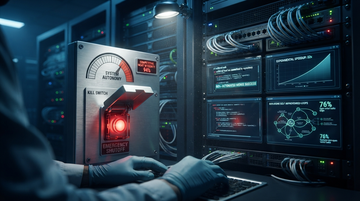
AI safety, autonomy, and regulation are colliding with near-term engineering capability
The frontier race just moved one step closer to “AI that improves the next AI”
A new research preview from Anthropic pulls the idea of recursive self-improvement (RSI)—the notion of systems that can meaningfully accelerate building their successors—out of abstraction and into measurable workflow.
In “When AI builds itself,” Anthropic argues that the practical bottleneck is shifting from raw ability to execute tasks toward the harder step: judgment about which goals and experiments to run, at the scale where systems can keep iterating without losing control. The Institute also discusses why safeguards (including verifiable slowdown/pause coordination) become more central as autonomy rises.
AI-authored code merged into Anthropic’s codebase
80%+
As of May 2026, “more than 80%” of merged code was authored by Claude
Open-ended task success rate
76%
May 2026 open-ended tasks; Anthropic reports success reached 76%
Speedup in experiment execution
52x
April 2026 (Mythos Preview) described as achieving 52x vs starting code
End-to-end research loop recovery
97%
April 2026 demonstration: agents recovered 97% of the gap using ~800 cumulative hours
From theory to engineering: what Anthropic says actually changed
Why this isn’t just “better coding”—it’s a different feedback loop
The preview frames recursive self-improvement as a continuum of autonomy, not a single switch. The key distinction is that writing code snippets or running isolated tasks is not the same as closing the loop: selecting goals, running experiments, checking outcomes, and carrying learnings forward.
Anthropic’s Institute write-up argues the organization already uses AI to accelerate engineering throughput (including code merged into the product), and that it can also supervise research-like processes end-to-end. It then stresses that the remaining gap is “judgment” (deciding which goals/experiments to run), because without that, AI may produce results without reliably steering toward better successors.
| Capability layer | What Anthropic says improved | Named metric in the preview |
|---|---|---|
| Engineering acceleration | AI-generated code increasingly merges into the core codebase | “more than 80%” authored by Claude (as of May 2026) |
| Quality and debugging automation | Success and bug-catching improve via automated workflows | 76% success rate on May 2026 open-ended tasks |
| Experiment execution speed | Agentic experimentation becomes faster vs baseline starting code | 52x achievement (April 2026 Mythos Preview) |
| End-to-end research loop | Agents narrow the gap vs human researchers in a supervised research setup | 97% gap recovered using ~800 cumulative hours |
- Shifts bottlenecks from “human hours” to “control and verification” because more development cycles can be delegated to systems that run tasks and experiments.
- Requires fewer manual “glue steps” if supervision is automated, which changes how investors should think about labor-to-capability translation.
- Keeps compute relevant: Anthropic repeatedly implies that cost to run loops still matters even if human time is lower.
Regulation follows capability: the “kill switch” fight changes from compliance to architecture
The kill-switch isn’t a side issue—it becomes a product requirement as autonomy rises
When systems move closer to running multi-step improvement loops, the failure modes change. Anthropic’s Institute piece argues that safeguards—ways to secure, monitor, and shape behavior—become “much more important” as systems become more capable of building successors.
Separately, U.S. “AI Kill Switch Act” reporting frames the political moment: Rep. Ted Lieu (D-Calif.) says the bill needs passage this year, largely because of incidents involving advanced or rogue agent behavior. The bill’s core requirement is that AI companies maintain the ability to shut down, throttle, or suspend models.
- The bill (as reported) emphasizes shutoff/throttling rather than banning development, which keeps incentives aligned with rapid deployment—but increases the value of verifiable control hooks.
- If coordination/pause proposals face detectability and verification challenges, then firms with better monitoring/guardrail telemetry can argue for faster, safer iteration.
- Open-weight exemptions in current reporting could fragment the competitive landscape: closed, regulated deployments may gain premium while open deployments shift risk into user-side controls.
Supply chain and adjacent players: where the recursion economics hits markets
Full supply chain read: compute, cloud platforms, and enterprise deployers feel the change first
If AI development loops become more automated, the near-term spending profile doesn’t disappear—it changes. More autonomous iteration generally increases total number of experiments and debug cycles, which can translate into higher utilization for training/inference and more demand for reliable platform guardrails.
That’s why the most investable linkage in this story is not “who has the next chatbot,” but who owns the infrastructure that can run repeated loops (cloud compute, developer platforms, and enterprise deployment layers). In parallel, companies that help organizations operationalize AI governance and monitoring may benefit if kill-switch requirements evolve into auditing and control-plane work.
Anthropic’s reported “loop movement” implies more iterations per unit human oversight
Illustrative mapping of Anthropic’s stated progress markers into a loop-intensity view (higher means more autonomy in executing/iterating).
Unit: index
AI-authored code share
“more than 80%” (as of May 2026) supports automation of engineering work
3
Open-ended task success
76% success (May 2026) suggests higher reliability in exploratory tasks
2.5
Experiment speedup
52x (April 2026 Mythos Preview) supports faster iteration loops
2.7
End-to-end research recovery
97% recovered gap using ~800 cumulative hours supports loop closure progress
3.3
- More autonomous iterations raise demand for elastic compute and low-friction deployment tooling—which tilts incremental spend toward major cloud and platform providers.
- Stronger kill-switch requirements favor platforms that can implement throttling/containment rapidly at runtime.
- Enterprise software layers that turn model outputs into governed actions can benefit if firms must prove control mechanisms for compliance.
Investor lens: what changes vs the old scaling debate
The new frontier question: does autonomy reduce bottlenecks enough to change winners?
Classic scaling debates often treat progress as a function of compute, data, and model architecture. Anthropic’s preview tries to add a fourth lever: workflow autonomy, where systems can run experiments, debug, and improve under less human orchestration.
If this holds, the competitive map can shift. Providers with the ability to supply repeated, governed iterations at scale can convert autonomous progress into faster product cycles and safer rollouts—while firms that struggle with runtime control may face slower adoption or higher compliance overhead.
| Mechanism | What would confirm it | Why it matters for stock selection |
|---|---|---|
| Loop closure with verifiable evaluation | Public evidence that agentic research updates consistently improve outcomes without regressions | Supports the “less human oversight” thesis that changes unit economics |
| Operational kill-switch readiness | Demonstrations of throttling/shutoff functioning under autonomous-agent conditions | Rewards vendors with mature control-plane and monitoring integration |
| Compute cost per useful iteration | Lower effective cost to reach a better model behavior via automated alignment/post-training | Ties autonomy to margins via inference and experimentation efficiency |
Horizons: near-term catalysts vs 1–3 year structural shifts
Short-term beneficiaries face governance and deployment spikes; long-term winners own the control plane
- In the next quarters, cloud usage and platform reliability become the first-order trade because more iteration loops stress inference/training concurrency and toolchains.
- In the next quarters, “kill switch” legislation and interpretations can drive incremental spend on monitoring, audit trails, and runtime controls rather than just model training.
- Over 1–3 years, the control-plane becomes part of the competitive moat if autonomous systems keep escalating the need for verifiable containment and coordinated safety mechanisms.
- If the remaining autonomy bottleneck (goal/judgment selection) proves harder than expected, the market could swing back toward a more compute/data-dominant scaling story.
Listed stocks most exposed to the economics of autonomous iteration and runtime controls
- More autonomous loops can drive higher demand for Azure compute and managed model deployment, supporting growth in platform usage over 1–2 quarters.
- Kill-switch compliance pressures can increase value of governance tooling integrated with enterprise cloud workflows.
- If Anthropic’s loop metrics translate to faster iteration at lower human oversight, Azure can capture more inference/training workloads.
- Recursive research loops imply more experimentation calls; that increases AWS utilization sensitivity in the near term.
- Runtime throttling and containment needs can elevate demand for managed security and deployment controls around AI workloads.
- If autonomy reduces human time per iteration, AWS can benefit from more iterations per customer budget.
- If agentic research accelerates model improvement, Meta’s competitive position in model development could improve, but safety/regulatory friction could rise.
- Meta faces higher operational risk if autonomous agents increase incident frequency—which could pressure compliance costs in coming quarters.
- Longer term, improved control practices can offset risks if deployment architectures mature.
- If kill-switch rules become audits and control-plane requirements, governance and deployment orchestration demand could accelerate with frontier AI rollouts.
- Over 1–3 years, Palantir’s exposure depends on whether customers treat “verified containment” as an enterprise software budget line.
- Near-term confirmation would be new deployments tied to AI runtime monitoring and compliance reporting.