%22%2F%3E%0A%20%20%3Ccircle%20cx%3D%22220%22%20cy%3D%22150%22%20r%3D%22180%22%20fill%3D%22%2322d3ee%22%20fill-opacity%3D%220.12%22%2F%3E%0A%20%20%3Ccircle%20cx%3D%221010%22%20cy%3D%22130%22%20r%3D%22220%22%20fill%3D%22%2338bdf8%22%20fill-opacity%3D%220.08%22%2F%3E%0A%20%20%3Ccircle%20cx%3D%22920%22%20cy%3D%22520%22%20r%3D%22170%22%20fill%3D%22%2322d3ee%22%20fill-opacity%3D%220.06%22%2F%3E%0A%20%20%3Cpath%20d%3D%22M140%20430h920%22%20stroke%3D%22url(%23line)%22%20stroke-width%3D%2212%22%20stroke-linecap%3D%22round%22%2F%3E%0A%20%20%3Cpath%20d%3D%22M220%20360c120-150%20260-220%20380-220s260%2070%20380%20220%22%20fill%3D%22none%22%20stroke%3D%22%2367e8f9%22%20stroke-opacity%3D%220.5%22%20stroke-width%3D%2216%22%20stroke-linecap%3D%22round%22%20stroke-linejoin%3D%22round%22%2F%3E%0A%20%20%3Cpath%20d%3D%22M300%20398h600%22%20stroke%3D%22%2394a3b8%22%20stroke-opacity%3D%220.24%22%20stroke-width%3D%228%22%20stroke-linecap%3D%22round%22%2F%3E%0A%20%20%3Ctext%20x%3D%22220%22%20y%3D%22510%22%20fill%3D%22%23e2e8f0%22%20fill-opacity%3D%220.7%22%20font-family%3D%22Arial%2C%20Helvetica%2C%20sans-serif%22%20font-size%3D%2238%22%20letter-spacing%3D%228%22%3EINSIGHTS%3C%2Ftext%3E%0A%3C%2Fsvg%3E)
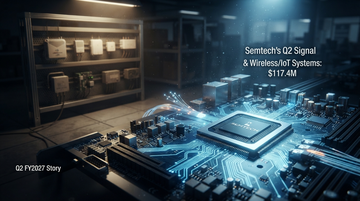
Earnings read-through (Q2 FY2027)
The “non-optical layer” is doing the heavy lifting—Signal Integrity outgrows the rest of Semtech’s book
Q2 FY2027 net sales
$341.9M
Quarter ended Jul 26, 2026; reported Aug 25, 2026
Q2 FY2027 Signal Integrity sales
$126.2M
Quarter ended Jul 26, 2026; reported Aug 25, 2026
Q2 FY2027 Analog Mixed Signal & Wireless (IoT Systems) sales
$117.4M
Quarter ended Jul 26, 2026; reported Aug 25, 2026
Q2 FY2027 IoT Systems & Connectivity (connectivity pocket)
$98.3M
Quarter ended Jul 26, 2026; reported Aug 25, 2026
Semtech’s Q2 FY2027 mix is the tell. Signal Integrity (the company’s analog/mixed-signal semiconductor block tied to optical and copper data transport signal quality) grows into the lead, while the IoT connectivity line—Semtech’s more industrial-weighted demand component—does not show the same acceleration in this quarter’s segment snapshots.
That’s important because in real AI clusters, optics can look “plug-and-play” at the narrative level, but it’s usually the link budget and eye-diagram reality that decides whether the deployed system hits its target BER and telemetry requirements. When that becomes the constraint, retimer/SerDes-class signal conditioning demand tends to rise even if the market is simultaneously excited about optical bandwidth.
- Signal Integrity posts $126.2M in Q2 FY2027, above Analog Mixed Signal & Wireless at $117.4M.
- Semtech consolidates $341.9M total net sales in the quarter, giving the company enough scale to fund backlog conversion.
- The IoT Systems & Connectivity line sits at $98.3M, below the data-center-heavy Signal Integrity contribution in this print.
Profitability and cash conversion
Margins and free cash flow validate that growth is not “just revenue”—it’s converting
Q2 FY2027 free cash flow
$61.4M
Quarter ended Jul 26, 2026; reported Aug 25, 2026
Q2 FY2027 net income (GAAP)
$160.1M
Quarter ended Jul 26, 2026; reported Aug 25, 2026
Q2 FY2027 diluted EPS
$1.59
Quarter ended Jul 26, 2026; reported Aug 25, 2026
A common failure mode in “AI connectivity” narratives is revenue growth without durable conversion—working-capital swings, margin pressure, or one-time offsets that don’t stick. Semtech’s Q2 FY2027 free cash flow of $61.4M reduces that risk and makes it more plausible that the Signal Integrity acceleration is tied to sustainable system build cycles rather than short-term inventory rebalancing.
Forward visibility
Guidance supports backlog translation—enough confidence to argue the AI interconnect constraint is spreading
Q3 FY2027 net sales outlook (midpoint)
$410.0M
Guidance provided with Q2 FY2027 results; for quarter ending Oct 2026
Semtech guided Q3 FY2027 net sales of $410.0M ± $5.0M. That kind of confidence typically reflects more than “orders on the books”—it usually indicates that customers are continuing to progress design-through-production and that the relevant supply chain steps are not the limiting factor.
For the thesis you care about—signal integrity vs. optics hype—the key is where the incremental demand is most likely to show up first. In systems where equalization/retiming and host-side signal quality determine whether optics modules can operate inside spec, the first measurable wins often appear on the non-optical semiconductor layer.
- Semtech’s Q3 FY2027 net sales outlook centers on $410.0M ± $5.0M.
- That guidance framing supports the view that the Signal Integrity-led AI momentum is not isolated to one quarter’s volatility.
- The IoT connectivity component remains visible, but the quarter’s growth leadership sits with Signal Integrity.
Supply-chain mapping (what this quarter implies)
Why Signal Integrity acceleration reads like retimer/SerDes demand (even without naming them)
Semtech does not need to say “retimer” or “SerDes” in the earnings headlines for the causal link to hold. Its Signal Integrity portfolio is positioned around high-performance analog/mixed-signal semiconductor solutions for optical and copper data transport and infrastructure.
In practice, when AI rack-to-rack and cluster-wide links migrate from “comfort zone” margins to tighter link budgets, the limiting factor becomes signal integrity under real channel conditions—loss, crosstalk, and jitter tolerance. That drives demand for semiconductor layers that condition, detect, and preserve the quality of high-speed signals—functionally aligned with the retimer/SerDes neighborhood.
At the same time, industrial IoT systems tend to refresh more slowly and with different procurement gates (coverage, reliability, field-deployment schedules). That’s consistent with this quarter’s emphasis: Signal Integrity leads; the industrial connectivity pocket lags enough to read as the drag.
Investor implications
What should move next (days–quarters) vs. what to watch (1–3 years)
- Watch for Signal Integrity to sustain share-of-sales gains over the next 1–2 quarters, because the Q2 FY2027 mix already tilted that way.
- Expect the market to re-rate the non-optical portion of the AI interconnect chain when Semtech’s high-speed analog segment remains the growth driver.
- If IoT connectivity starts to re-accelerate, it would likely show up as less mix drag in future quarter segment snapshots.
Over 1–3 years, the bigger question is whether AI cluster build-outs force a structurally higher spend per link on signal-quality layers (equalization, conditioning, detection) rather than only on optics throughput. If that happens, Semtech’s positioning in Signal Integrity becomes a compounding story—especially if backlog conversion keeps turning into cash flow.
The risk is that optical platform cycles could still dominate in later stages of the deployment curve, compressing the incremental economics available to the non-optical layer. That’s why sustained segment leadership (not one-quarter strength) matters.
Listed names that are plausibly tied to the “non-optical signal-quality” AI connectivity layer
- If Semtech’s Signal Integrity outperformance reflects signal-quality constraints, Marvell’s networking silicon should capture more AI link-module content as systems add conditioning complexity over coming quarters.
- Sustained AI Ethernet/advanced connectivity build cycles tend to drive higher throughput needs that can lift Marvell’s revenue mix toward datacenter-facing platforms in the 6–12 month window.
- A mismatch would show up if optics cycles outpace electronics; then Marvell’s implied leverage would compress even while Semtech’s analog segment stays strong.
- As signal integrity becomes the bottleneck, lab validation demand rises; Keysight should benefit from increased high-speed characterization intensity over the next 1–2 quarters.
- Semtech’s cash conversion suggests customers are funding ramp; that supports steady utilization in test/measurement workflows through the next reporting cycles.
- The risk is that validation shifts to in-house setups; if so, Keysight’s growth rate could trail even when AI link deployments expand.
- NVIDIA’s AI platform demand can pull the whole connectivity chain; however, if optics throughput is the dominant incremental lever, NVIDIA’s signal-integrity upside becomes indirect in days–quarters.
- In 1–3 years, a structurally higher spend per link on signal-quality layers would support broader AI infrastructure economics—but magnitude depends on link-design outcomes that NVIDIA doesn’t control.
- If industrial IoT demand lags continues to weigh on Semtech-like analog suppliers, NVIDIA’s overall datacenter growth could mask a connectivity softness at the edge.
- If link integrity becomes the limiter, connectors/cabling that preserve high-speed performance can see share gains; Amphenol should benefit from higher-value signal-path requirements over the next 6–12 months.
- Semtech’s mix leadership supports the view that end-systems are being tuned; that usually raises installation and qualification intensity for interconnects.
- If supply tightness eases or system BOM optimizes away quality extras, Amphenol’s incremental headwind could appear even while AI volumes rise.