%22%2F%3E%0A%20%20%3Ccircle%20cx%3D%22220%22%20cy%3D%22150%22%20r%3D%22180%22%20fill%3D%22%2322d3ee%22%20fill-opacity%3D%220.12%22%2F%3E%0A%20%20%3Ccircle%20cx%3D%221010%22%20cy%3D%22130%22%20r%3D%22220%22%20fill%3D%22%2338bdf8%22%20fill-opacity%3D%220.08%22%2F%3E%0A%20%20%3Ccircle%20cx%3D%22920%22%20cy%3D%22520%22%20r%3D%22170%22%20fill%3D%22%2322d3ee%22%20fill-opacity%3D%220.06%22%2F%3E%0A%20%20%3Cpath%20d%3D%22M140%20430h920%22%20stroke%3D%22url(%23line)%22%20stroke-width%3D%2212%22%20stroke-linecap%3D%22round%22%2F%3E%0A%20%20%3Cpath%20d%3D%22M220%20360c120-150%20260-220%20380-220s260%2070%20380%20220%22%20fill%3D%22none%22%20stroke%3D%22%2367e8f9%22%20stroke-opacity%3D%220.5%22%20stroke-width%3D%2216%22%20stroke-linecap%3D%22round%22%20stroke-linejoin%3D%22round%22%2F%3E%0A%20%20%3Cpath%20d%3D%22M300%20398h600%22%20stroke%3D%22%2394a3b8%22%20stroke-opacity%3D%220.24%22%20stroke-width%3D%228%22%20stroke-linecap%3D%22round%22%2F%3E%0A%20%20%3Ctext%20x%3D%22220%22%20y%3D%22510%22%20fill%3D%22%23e2e8f0%22%20fill-opacity%3D%220.7%22%20font-family%3D%22Arial%2C%20Helvetica%2C%20sans-serif%22%20font-size%3D%2238%22%20letter-spacing%3D%228%22%3EINSIGHTS%3C%2Ftext%3E%0A%3C%2Fsvg%3E)
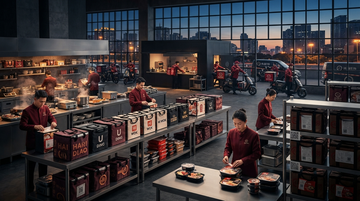
Channel mix + portfolio expansion, not just new-store growth
Haidilao is reframing restaurant margins around delivery economics
What matters in China’s casual-dining cycle right now is not whether operators can open new restaurants—it’s whether they can protect margins when traffic is price-sensitive.
In its interim results for the six months ended June 30, 2026, Haidilao International Holding showed delivery moving from a minor contributor to a fast-growing revenue stream: delivery revenue surged to RMB 2,051.4 million (+121.2%). Delivery’s share of group revenue rose from 4.5% to 9.2%, which changes the way investors should think about “margin playbooks” under deflation-era conditions.
What the numbers say about the pivot
Delivery and “other restaurant operations” are growing faster than the core brand
Delivery business revenue
RMB 2,051.4m
Six months ended Jun 30, 2026; +121.2% period-on-period
Delivery revenue share of group
9.2%
Six months ended Jun 30, 2026 vs 4.5% in the corresponding 2025 period
Other restaurant operations revenue
RMB 1,271.4m
Six months ended Jun 30, 2026; +113.1% period-on-period
Other restaurant operations share of group
5.7%
Six months ended Jun 30, 2026
| Line item | 6M ended Jun 30, 2026 revenue | YoY / period change | Share of group revenue (6M ended Jun 30, 2026) |
|---|---|---|---|
| Delivery business | RMB 2,051.4m | +121.2% | 9.2% |
| Other restaurant operations | RMB 1,271.4m | +113.1% | 5.7% |
Margins and the discretionary-spending debate
Flattening same-store sales alongside fast delivery growth points to a value-led “replacement” of trips
Delivery growth that happens while the core’s same-store sales are not expanding strongly is usually a sign of behavior change rather than broad traffic expansion.
In the same interim disclosure, Haidilao reported that same-store sales (self-operated Haidilao restaurants) were effectively flat: the document shows same store sales of RMB 16,348,861k for the six months ended June 30, 2026 versus RMB 16,571,065k in the prior comparable period, while average same-store table turnover stayed at 3.9 times/day. Put simply: delivery is scaling without needing the core brand to re-accelerate on dine-in demand.
Multi-brand scale: a distribution moat disguised as portfolio discipline
The multi-brand push matters because it spreads customer demand across formats
Haidilao’s second lever is not only “more delivery,” but “more ways to buy.” The interim filing describes a structured approach to replication within non-core formats.
It discloses 21 other catering brands with a total of 183 restaurants as of June 30, 2026. That is the scale background behind the “other restaurant operations” revenue line of RMB 1,271.4 million (+113.1%). From an investor lens, multi-brand restaurant revenue jumped in lockstep with delivery—suggesting demand is being re-routed, not just created.
Full supply-chain view: what changes for suppliers and downstream channels
Delivery-heavy growth changes ordering patterns across ingredients, packaging, and platform economics
- Delivery mix increases reliance on standardized dish throughput, which tends to raise the importance of stable ingredient supply and kitchen-process consistency versus bespoke in-restaurant variability.
- Multi-brand expansion diversifies SKUs while leveraging shared procurement, which can reduce per-unit input volatility if purchasing is centralized.
- More orders flow through delivery platforms, making demand less dependent on local footfall but more sensitive to commission and promo intensity.
Fundamentals check (listed proxy): where profitability sits
The pivot shows up in results, but the quality of margins still depends on delivery cost-to-serve
The interim filing provides net profit and core operating profit figures, which helps investors gauge whether the pivot is only “revenue optics” or whether it supports earnings quality.
For the six months ended June 30, 2026, Haidilao reported profit attributable to owners of RMB 1,766,871k (2025: RMB 1,758,525k). Core operating profit (non-IFRS) was RMB 2,513,490k (2025: RMB 2,408,104k). Even though the filing excerpt does not give a single summarized delivery gross margin percentage, the earnings direction is consistent with the idea that core operating profit rose while same-store sales were not expanding.
What to watch next (short-term vs. 1–3 year horizon)
The next catalyst is whether delivery growth slows—or becomes durable margin support
- Near-term (days–quarters): watch whether Haidilao continues to grow delivery and other restaurant operations faster than the base brand, and whether core operating profit tracks that mix.
- Near-term: monitor any guidance language tied to delivery cost-to-serve (promotions, platform commissions, and packaging), because that is the lever that can quickly erode “delivery-led margin defense.”
- 1–3 years: evaluate whether the multi-brand replication model expands restaurant footprint without diluting unit economics—especially if delivery remains a larger share of the revenue mix.
- 1–3 years: discretionary-spending implication—if same-store table turnover remains stable but conversion improves via delivery, it suggests customers are still choosing “occasion meals,” not eliminating them entirely.
Investor takeaway
Haidilao is turning a weak traffic environment into a channel-and-portfolio advantage
The market reaction to Haidilao’s interim update is understandable—but the actionable question is whether this is a one-period mix bounce or a durable new operating model.
Based on the filing, delivery’s share rising to 9.2% and other restaurant operations rising to 5.7% are concrete shifts in where revenue is coming from. Meanwhile, same-store sales are not booming in tandem. That combination supports a more nuanced thesis: China discretionary spending may be bottoming in the “value and convenience” lane even if dine-in demand stays restrained.
Listed market linkages to delivery-heavy restaurant economics
- Improves mix-driven growth by pushing delivery to 9.2% of revenue, which should support earnings even if same-store sales stay flat in the near term.
- Expands the growth surface via 21 other catering brands (183 restaurants), potentially reducing dependence on the core brand’s dine-in traffic.
- Rises core operating profit to RMB 2,513.5m, but durability hinges on whether delivery cost-to-serve stays controlled.
- Stays a primary storefront for restaurant delivery demand, but competitive pricing can pressure platform contribution in weak discretionary periods.
- Benefits if delivery share rises across operators, yet takes the hit if promotional intensity increases faster than order monetization.
- Remains sensitive to consumer rebound timing, which will determine whether delivery volumes stabilize or surge then fade.
- Gets indirect demand support if value-led occasions replace dine-in, but format-level delivery economics can differ by brand.
- Faces margin volatility if promotions intensify to defend delivery orders, which can offset traffic gains.
- Should show directional confirmation via comparable sales mix once next quarterly disclosures break out delivery/digital contribution.
- Can benefit if meal occasions shift toward “at-home” consumption, which can support packaged beverage throughput through delivery channels.
- Is exposed if restaurants cut beverage attach rates during value-led promos, which can dilute per-check revenue.
- Acts as a secondary signal for discretionary stability because beverage demand often responds faster than broader spending.