%22%2F%3E%0A%20%20%3Ccircle%20cx%3D%22220%22%20cy%3D%22150%22%20r%3D%22180%22%20fill%3D%22%2322d3ee%22%20fill-opacity%3D%220.12%22%2F%3E%0A%20%20%3Ccircle%20cx%3D%221010%22%20cy%3D%22130%22%20r%3D%22220%22%20fill%3D%22%2338bdf8%22%20fill-opacity%3D%220.08%22%2F%3E%0A%20%20%3Ccircle%20cx%3D%22920%22%20cy%3D%22520%22%20r%3D%22170%22%20fill%3D%22%2322d3ee%22%20fill-opacity%3D%220.06%22%2F%3E%0A%20%20%3Cpath%20d%3D%22M140%20430h920%22%20stroke%3D%22url(%23line)%22%20stroke-width%3D%2212%22%20stroke-linecap%3D%22round%22%2F%3E%0A%20%20%3Cpath%20d%3D%22M220%20360c120-150%20260-220%20380-220s260%2070%20380%20220%22%20fill%3D%22none%22%20stroke%3D%22%2367e8f9%22%20stroke-opacity%3D%220.5%22%20stroke-width%3D%2216%22%20stroke-linecap%3D%22round%22%20stroke-linejoin%3D%22round%22%2F%3E%0A%20%20%3Cpath%20d%3D%22M300%20398h600%22%20stroke%3D%22%2394a3b8%22%20stroke-opacity%3D%220.24%22%20stroke-width%3D%228%22%20stroke-linecap%3D%22round%22%2F%3E%0A%20%20%3Ctext%20x%3D%22220%22%20y%3D%22510%22%20fill%3D%22%23e2e8f0%22%20fill-opacity%3D%220.7%22%20font-family%3D%22Arial%2C%20Helvetica%2C%20sans-serif%22%20font-size%3D%2238%22%20letter-spacing%3D%228%22%3EINSIGHTS%3C%2Ftext%3E%0A%3C%2Fsvg%3E)
Earnings
TJX’s headline beat was real—but Marmaxx softness changes how you interpret “clearance strength”
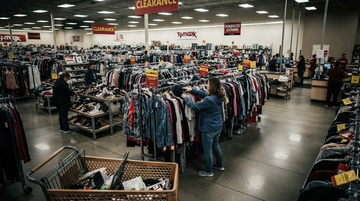
Q2 FY2027 confirmed TJX can still outperform on margin and earnings, even as the apparel complex gets choppier. The market reaction hinges on the mix story inside Marmaxx: management said consolidated results were above-plan, yet Marmaxx sales were below expectations due to “self-inflicted” merchandising execution shortcomings.
Q2 FY2027 net sales
$15.18B
Second quarter of Fiscal 2027, reported Aug 19, 2026
Q2 FY2027 diluted EPS
$1.36
Second quarter of Fiscal 2027, reported Aug 19, 2026
Q2 FY2027 Marmaxx comparable sales
+1%
Second quarter of Fiscal 2027, reported Aug 19, 2026
Q2 FY2027 Marmaxx (U.S.) comparable sales
+1%
Second quarter of Fiscal 2027, reported Aug 19, 2026
What happened in the quarter
Marmaxx’s comp slowdown was explicitly framed as internal—so the market had a choice: execution fix or demand signal
Management’s framing matters because it assigns causality. In plain terms: the miss wasn’t blamed on broad competition or macro demand alone; it was tied to merchandising execution and product mix shortcomings at Marmaxx (T.J. Maxx / Marshalls / Sierra). Meanwhile, other parts of TJX’s footprint—such as HomeGoods—continued to post stronger comp growth, which keeps the story from looking like a company-wide demand collapse.
- Management said overall Q2 comparable sales increased 4% and were above plan, even while Marmaxx was below expectations.
- Marmaxx (U.S.) comparable sales grew 1% in Q2 FY2027, versus 3% a year earlier.
- Management stated Marmaxx softness reflected “self-inflicted” merchandising execution issues rather than the absence of branded inventory.
- HomeGoods and TJX international posted stronger comp gains (6%–7% range in management commentary), which supports a mix/merchandising rather than staffing or category-wide demand failure.
“I am very pleased with our above-plan consolidated results in the second quarter… While sales at Marmaxx were below our expectations… [other divisions delivered] terrific comp sales increases of 6% to 7%…”
Supply-chain and category mechanics
Why a clearance-channel slowdown can be “self-inflicted” and still imply less excess inventory upstream
Off-price retailers don’t just sell demand—they convert the apparel system’s excess into cash. When Marmaxx under-delivers at the clearance-like channel, two forces can be true at once: (1) execution errors can reduce the ability to monetize what arrives, and (2) the amount (or mix) of excess entering the off-price pipeline can be shrinking if upstream brands learned to order less, discount later, or hold tighter assortments.
| Interpretation | What must be true | What changes first | How TJX’s report supports or strains it |
|---|---|---|---|
| Execution fix | Marmaxx has the right inventory but shipped/merchandised the wrong mix or presentation | Next 1–2 quarters comp should re-accelerate without needing broader category clearance | Supported by management explicitly pointing to “self-inflicted” merchandising execution issues and by other TJX divisions performing. |
| Clearance valve reading | Less excess is arriving (or fewer categories are being handed to off-price buyers at attractive depths) | Higher gross-margin resilience can coexist with softer comps if assortment becomes leaner and less “bargain-rich” | Tension arises because Marmaxx is supposed to be the clearance valve; if it stalls while HomeGoods and consolidated results remain strong, investors question whether the valve is still getting the same flow. |
Financial durability
TJX’s earnings power strengthened even as Marmaxx lagged—because the company could still improve pricing and keep costs tight
Q2 FY2027 pretax profit margin
13.3%
Second quarter of Fiscal 2027, reported Aug 19, 2026 (up 1.9 pp vs. last year)
Q2 FY2027 operating cash flow
$2.2B
Second quarter of Fiscal 2027, reported Aug 19, 2026
Q2 FY2027 cash balance
$6.0B
Second quarter of Fiscal 2027, reported Aug 19, 2026
FY2027 diluted EPS outlook (raised)
5.15–5.20
Full-year Fiscal 2027 updated outlook, reported Aug 19, 2026
This matters for the “clearance valve” debate: when margins expand while comps wobble in the largest division, the near-term story can still look healthy. But the longer the gap between consolidated momentum and Marmaxx-specific throughput widens, the more investors start to treat Marmaxx weakness as a structural flow issue rather than a one-time merchandising mistake.
Short-term vs. long-term signals to watch
What to monitor next: speed of Marmaxx recovery (weeks) versus sustainability of off-price inventory flow (quarters)
- Near-term (next earnings): whether Marmaxx comp re-accelerates toward the prior run-rate without further “execution” qualifiers.
- Near-term: inventory levels and cash generation should stay resilient; a deterioration would suggest the merchandising miss became a markdown/working-capital issue.
- Medium-term (next 4–6 quarters): whether off-price categories show less “depth” (fewer bargain-rich assortments arriving), which would cap Marmaxx throughput even if inventory availability remains high.
- Medium-term: the mix divergence—HomeGoods vs. Marmaxx—should narrow if the issue is purely execution, but persist if the clearance pipeline is changing.
Listed companies most exposed to the “off-price clearance valve” signaling channel
- Q2 FY2027 showed Marmaxx comps at +1% while consolidated results beat, so the earnings engine can run ahead of the clearance engine near term.
- Full-year EPS outlook was raised to 5.15–5.20, so investors still price TJX for durable profitability despite Marmaxx softness.
- If Marmaxx remains below expectations beyond one quarter, off-price demand-throughput assumptions get repriced at the next earnings.
- A weaker clearance channel at off-price can mean fewer promotional/discount units appear in the broader value ecosystem, so Target’s discretionary mix may face more “selective consumer” pressure next 1–3 quarters.
- If consumers are still trading down, then Target’s comparable trends should stay supported by value traffic—so the signal is ambiguous until Target’s own margin/markdown data confirms.
- If off-price apparel shows a clearance slowdown driven by less excess entering the bargain flow, it can align with a broader “trade-selective” consumer regime impacting premium beauty promos over 1–3 quarters.
- However, Estée Lauder’s earnings can also be insulated by mix and pricing, so the effect may show up more in category promotions than in top-line immediately.
- Beauty is less directly tied to apparel clearance depth, so Ulta’s response depends on whether the consumer signal is “income protection” or “promo fatigue” over 1–3 quarters.
- If shoppers cut back on discretionary add-ons, Ulta’s traffic and productivity should soften before margins do.
- A clearance pipeline that slows can reduce the overall bargaining environment that supports value retail, so Kohl’s promotional leverage can weaken in 1–3 quarters.
- If Marmaxx weakness is tied to fewer excess units entering off-price, it can translate into fewer deep-discount opportunities for department-store assortments.