%22%2F%3E%0A%20%20%3Ccircle%20cx%3D%22220%22%20cy%3D%22150%22%20r%3D%22180%22%20fill%3D%22%2322d3ee%22%20fill-opacity%3D%220.12%22%2F%3E%0A%20%20%3Ccircle%20cx%3D%221010%22%20cy%3D%22130%22%20r%3D%22220%22%20fill%3D%22%2338bdf8%22%20fill-opacity%3D%220.08%22%2F%3E%0A%20%20%3Ccircle%20cx%3D%22920%22%20cy%3D%22520%22%20r%3D%22170%22%20fill%3D%22%2322d3ee%22%20fill-opacity%3D%220.06%22%2F%3E%0A%20%20%3Cpath%20d%3D%22M140%20430h920%22%20stroke%3D%22url(%23line)%22%20stroke-width%3D%2212%22%20stroke-linecap%3D%22round%22%2F%3E%0A%20%20%3Cpath%20d%3D%22M220%20360c120-150%20260-220%20380-220s260%2070%20380%20220%22%20fill%3D%22none%22%20stroke%3D%22%2367e8f9%22%20stroke-opacity%3D%220.5%22%20stroke-width%3D%2216%22%20stroke-linecap%3D%22round%22%20stroke-linejoin%3D%22round%22%2F%3E%0A%20%20%3Cpath%20d%3D%22M300%20398h600%22%20stroke%3D%22%2394a3b8%22%20stroke-opacity%3D%220.24%22%20stroke-width%3D%228%22%20stroke-linecap%3D%22round%22%2F%3E%0A%20%20%3Ctext%20x%3D%22220%22%20y%3D%22510%22%20fill%3D%22%23e2e8f0%22%20fill-opacity%3D%220.7%22%20font-family%3D%22Arial%2C%20Helvetica%2C%20sans-serif%22%20font-size%3D%2238%22%20letter-spacing%3D%228%22%3EINSIGHTS%3C%2Ftext%3E%0A%3C%2Fsvg%3E)
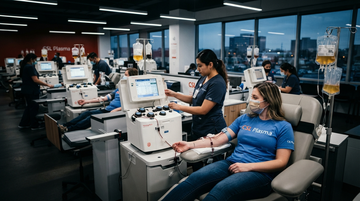
Supply-chain mechanism • plasma collection bottlenecks
The market treated a “non-exclusive” deal like a capacity contract—because the constraint is where donors become plasma
On Aug. 18, 2026, Haemonetics HAE filed a Form 8-K describing a new supply agreement with CSL Plasma Inc. Under the terms, CSL may use Haemonetics’ NexSys PCS® devices with Persona® PLUS technology and purchase related disposables in the U.S.; the agreement is explicitly non-exclusive and has no minimum purchase commitments (so the buyer has flexibility on volume).
The “no minimum” clause didn’t calm investors—it highlighted that the real limiter may be CSL’s ability to convert collection centers to Haemonetics-compatible equipment rather than Haemonetics’ willingness to sell hardware/disposables.
The filing also states that Haemonetics expects CSL to transition a portion of its U.S. plasma collection centers to the Haemonetics devices and disposables, but that the scope and timing are not yet determined, with Haemonetics planning to provide an update around its second fiscal quarter earnings call in November 2026.
What was actually agreed • what changed
What CSL CSLLY can do now (and what Haemonetics HAE won’t promise yet)
Agreement entry date
Aug 14, 2026
Form 8-K describes the agreement as entered into on Aug. 14, 2026.
Commercial scope
U.S.
CSL may use NexSys PCS devices with Persona PLUS and purchase related disposables in the United States.
Exclusivity
Non-exclusive
The supply agreement is non-exclusive.
Volume commitments
None stated
The supply agreement does not contain minimum purchase commitments.
The filing’s investment-relevant “tell” is the adoption framing: Haemonetics anticipates CSL will transition a portion of its U.S. plasma collection centers to Haemonetics’ devices and disposables, but Haemonetics says the scope and timing are not yet determined. That combination is what makes the deal behave like a “shortage-trade”—plasma conversion is capacity-bound, and whoever controls conversion throughput can shift dispenser-level volumes even when exclusivity is absent.
Why the stock moved • and how to read the tape
The catalyst worked as an adoption-probability upgrade, not a guidance upgrade
In the same Aug. 18, 2026 period, media coverage tied the rally to a Wall Street upgrade by BTIG (price target raised, rating maintained). The key point for investors is that the Haemonetics filing itself says the company is not updating previously issued fiscal 2027 guidance immediately; instead, Haemonetics expects to update the anticipated impact on fiscal 2027 results in November 2026 in connection with its second fiscal quarter earnings call.
So the immediate upside case was about perceived likelihood of CSL center transitions—before Haemonetics has to quantify revenue impact.
Fundamentals • does Haemonetics’ model fit recurring disposables?
Haemonetics has the financial profile of a recurring-disposables business—but this deal still matters because adoption is the variable
| Fiscal year | Revenue | Gross profit | Operating income | Net income | Free cash flow |
|---|---|---|---|---|---|
| FY2026 | $1,334.0M | $743.6M | $241.4M | $97.3M | $260.4M |
| FY2025 | $1,360.8M | $778.5M | $221.8M | $167.7M | $142.4M |
| FY2024 | $1,309.1M | $711.9M | $164.9M | $117.6M | $143.6M |
The financial backdrop (FY2024–FY2026) shows Haemonetics generates substantial gross profit and positive free cash flow, which matters for two reasons:
1) device install + disposable replenishment economics usually translate into higher revenue density over time, and 2) the company can invest through adoption cycles.
But the CSL agreement’s “no minimums” structure means the near-term revenue step-up will depend on conversion throughput at CSL’s U.S. centers—precisely where plasma supply can behave like an oligopoly bottleneck.
Supply-chain map • from donors to disposables
Where the power sits in plasma collection: donors → center operations → device compatibility → disposable pull-through
- CSL controls how many U.S. plasma collection centers can be transitioned and run at Haemonetics-compatible throughput (scope and timing are not yet disclosed by Haemonetics).
- Haemonetics controls the device/disposable ecosystem—NexSys PCS with Persona PLUS compatibility and the “related disposables” CSL can buy once centers adopt the system.
- Exclusivity is not required for Haemonetics to monetize adoption; it’s required only to prevent competitors from benefiting from the same center conversion capacity.
- Because CSL’s transition schedule is the unknown, the first leg of the stock thesis is adoption probability, which gets updated when Haemonetics talks in November 2026.
- If CSL’s capacity expansion is slower than expected, the deal can still be strategic but will likely cap near-term revenue acceleration (no minimum purchase commitment).
Non-obvious causality • why this “shortage trade” is made explicit
The deal turns a capacity shortage into a measurable adoption lever—even without exclusivity
Plasma collection is capacity constrained: centers need equipment compatibility, operational ramp time, and donor flow stability. What makes this agreement “explicit” is that it formalizes device compatibility rights—CSL can use Haemonetics’ NexSys PCS with Persona PLUS and buy the associated disposables.
That structure makes the bottleneck testable: investors can track whether CSL’s center transitions happen and how quickly disposables pull-through follows.
The non-exclusive nature matters too: it suggests CSL retains the right to distribute some conversion across vendors. That’s exactly why the market is reading the announcement as an “execution signal” from CSL (and a credibility signal from Haemonetics), not as a legally guaranteed volume ramp.
Horizons • what changes first vs. what matters later
Short-term: adoption-update risk dominates. Long-term: disposable share and installed base compounding dominate
- In days to quarters, the key information will be any incremental disclosures about CSL’s U.S. center transition scope—because the 8-K explicitly says timing is not determined.
- In the near term (through Haemonetics’ November 2026 second fiscal quarter commentary), investors will focus on whether Haemonetics provides a quantitative impact range on fiscal 2027.
- In 1–3 years, the fundamental question becomes whether Haemonetics’ device/disposable installed base expands faster than competitors as CSL’s centers convert.
- If CSL runs multiple vendor-compatible pathways, competition may pressure disposable pricing, but installed-base inertia can still favor the winner over time.
Listed stocks most directly linked to the plasma-collection equipment + workflow adoption theme
- Deal language gives CSL a pathway to adopt NexSys PCS + Persona PLUS, which should increase Haemonetics’ disposable pull-through if CSL transitions centers (scope/timing updates expected in November 2026).
- The agreement has no minimum purchase commitment, so Haemonetics must prove ramp visibility; that sets up a clear catalyst window for fiscal 2027 impact disclosure.
- CSL gains commercial flexibility via a non-exclusive agreement, but the market will still pressure execution because CSL is the entity transitioning U.S. collection centers (scope/timing not determined).
- If CSL transitions slowly, the agreement can be viewed as strategic positioning rather than revenue-yielding adoption—creating uncertainty into fiscal-2027-related narratives.
- If plasma-collection workflows see broader conversion cycles, Terumo’s adjacent transfusion-related systems demand could benefit indirectly via higher donor-processing activity, but linkage strength depends on management commentary.
- Watch for any guidance changes tied to blood/plasma processing volumes over the next 1–3 quarters.
- If U.S. plasma availability improves through additional center conversions, it can support downstream supply reliability for plasma-derived therapies—yet the CSL-Haemonetics deal is non-exclusive so magnitude is uncertain.
- Watch for margin or volume commentary in upcoming quarters that cites U.S. plasma supply conditions.