%22%2F%3E%0A%20%20%3Ccircle%20cx%3D%22220%22%20cy%3D%22150%22%20r%3D%22180%22%20fill%3D%22%2322d3ee%22%20fill-opacity%3D%220.12%22%2F%3E%0A%20%20%3Ccircle%20cx%3D%221010%22%20cy%3D%22130%22%20r%3D%22220%22%20fill%3D%22%2338bdf8%22%20fill-opacity%3D%220.08%22%2F%3E%0A%20%20%3Ccircle%20cx%3D%22920%22%20cy%3D%22520%22%20r%3D%22170%22%20fill%3D%22%2322d3ee%22%20fill-opacity%3D%220.06%22%2F%3E%0A%20%20%3Cpath%20d%3D%22M140%20430h920%22%20stroke%3D%22url(%23line)%22%20stroke-width%3D%2212%22%20stroke-linecap%3D%22round%22%2F%3E%0A%20%20%3Cpath%20d%3D%22M220%20360c120-150%20260-220%20380-220s260%2070%20380%20220%22%20fill%3D%22none%22%20stroke%3D%22%2367e8f9%22%20stroke-opacity%3D%220.5%22%20stroke-width%3D%2216%22%20stroke-linecap%3D%22round%22%20stroke-linejoin%3D%22round%22%2F%3E%0A%20%20%3Cpath%20d%3D%22M300%20398h600%22%20stroke%3D%22%2394a3b8%22%20stroke-opacity%3D%220.24%22%20stroke-width%3D%228%22%20stroke-linecap%3D%22round%22%2F%3E%0A%20%20%3Ctext%20x%3D%22220%22%20y%3D%22510%22%20fill%3D%22%23e2e8f0%22%20fill-opacity%3D%220.7%22%20font-family%3D%22Arial%2C%20Helvetica%2C%20sans-serif%22%20font-size%3D%2238%22%20letter-spacing%3D%228%22%3EINSIGHTS%3C%2Ftext%3E%0A%3C%2Fsvg%3E)
Aug. 17, 2026 — OpenAI Global Affairs
What was actually announced: a tenant agreement that ties OpenAI’s compute ramp to PORTS-Pike’s power-first campus
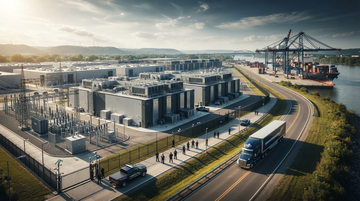
OpenAI’s Aug. 17, 2026 announcement says it “has entered into an agreement to secure approximately 8 gigawatts-IT” at the PORTS-Pike Technology Campus in Pike County, Ohio. The agreement is structured around SB Energy building, owning, and operating the data center, with OpenAI as the long-term customer. OpenAI also describes the campus as a “next generation supercomputer design,” emphasizing resilient infrastructure choices and an approach to workload management that targets fewer interruptions at scale.
IT capacity secured
≈8 GW-IT
OpenAI “agreement to secure approximately 8 gigawatts-IT,” reported in its Aug 17, 2026 announcement
Customer structure
20-year lease
SB Energy “build, own, and operate” under a “20-year lease to OpenAI,” stated in the Aug 17, 2026 announcement
Phased availability
2028 start
First capacity expected to become available in 2028, described in the project materials and NVIDIA/tenant-linked updates
Security posture (explicit)
Not disclosed
The announcement and project materials emphasize reliability/resilience but do not spell out a specific cybersecurity stack
PORTS-Pike ecosystem
The compute stack centerpiece is NVIDIA—meaning “AI reliability” becomes an infrastructure procurement surface
The OpenAI announcement and NVIDIA’s companion coverage frame NVIDIA as the exclusive AI compute infrastructure provider for the PORTS-Pike campus. NVIDIA also ties itself directly to financing/credit support for initial land/power/shell buildout, which matters because it links the capital pipeline for compute deployment to the durability and qualification of the supporting infrastructure—not just model training schedules.
- OpenAI’s announcement pairs tenant commitments with resiliency-focused design and qualified components to support higher cluster availability
- NVIDIA’s role as the exclusive AI compute provider concentrates both performance and operational reliability expectations in one vendor relationship
- SB Energy’s ownership and operations role means uptime and failure-mode management land on the infrastructure operator (and contract definitions), not only on software teams
Why ports and critical infrastructure matter to this move
Port operators already have a cyber-planning playbook—Coast Guard guidance ties cyber risk work to structured assessments and annexes
U.S. port cyber work is not purely “incident response.” The Coast Guard’s Maritime Cybersecurity Assessment & Annex Guide (MCAAG) is a voluntary guide designed to help Maritime Transportation Security Act (MTSA)-regulated facilities and other Marine Transportation System (MTS) stakeholders address cyber risks through baseline cybersecurity assessments and planning artifacts like Facility Security Assessments (FSA) and Facility Security Plans (FSP), including cyber annexes.
That structure creates an obvious fit for the PORTS-Pike messaging: when a facility’s AI workloads are framed as needing higher availability and fewer interruptions at cluster scale, it aligns with how operators must justify risk controls inside their assessment-and-plan artifacts. Even though OpenAI doesn’t mention “cybersecurity” in the PORTS-Pike announcement itself, the reliability language overlaps with the compliance outcome that port operators and other critical-infrastructure owners must repeatedly document.
Cause chain: what this suggests about frontier AI’s next government-contract wedge
From “chat” to “critical systems”: the contractable unit is shifting to reliability, qualification, and audit-ready documentation
The mechanism looks like this: (1) critical infrastructure buyers need cyber risk programs that can be written into FSAs/FSPs and annexes; (2) AI systems deployed into those environments must be able to run without frequent interruptions and must be supported by a resilient infrastructure approach; (3) a frontier lab’s differentiation can become less about model capability alone and more about system-level availability, mean-time-between-interruptions goals, and the ability to publish technical explanations about how components and software workload management are qualified.
- OpenAI’s announcement emphasizes resilient infrastructure engineering and component qualification as a path to higher compute availability
- Coast Guard guidance structures cyber risk work into assessment and plan artifacts, which increases demand for explainable reliability controls
- A data-center and compute-provisioning relationship can therefore become a “front door” for government-adjacent security contracts—even if the initial public framing is power, capacity, and reliability
Investor-relevant transmission: who can benefit from the reliability and compliance narrative
Even without explicit port-cyber language, the supply chain points to beneficiaries across compute, infrastructure, and verification-oriented services
Because the PORTS-Pike deal concentrates AI compute provision (NVIDIA) and infrastructure build/operation (SB Energy) around OpenAI’s capacity ramp, the near-term “winners” are the companies tied to physical buildout, compute platform deployment, and (eventually) any reliability/audit work that follows. The challenge for investors is that most of the compliance and cybersecurity “stack” detail is not disclosed in the public PORTS-Pike announcement itself; that means the earnings impact will likely show up first in capex/production and only later in enterprise/government service attachments.
| Signal | What would be stated publicly | Why it matters |
|---|---|---|
| Technical white paper | A published document jointly authored by parties at PORTS-Pike that references cyber risk controls or audit evidence | Would validate that “reliability engineering” is being packaged for regulated cyber planning, not only for uptime |
| Government/port procurement language | RFP/RFIs, MOUs, or contract statements referencing MTSA/FSA/FSP cyber annex compliance | Would confirm the “port” linkage that is currently only inferential |
| Explicit security stack | Named tooling or certifications in connection with resilient operation, workload controls, or incident prevention | Would convert the current resilience narrative into a concrete cybersecurity surface |
Short-term vs. long-term horizons
The near-term catalyst is capacity buildout; the long-term catalyst is whether reliability becomes auditable cyber capability
Short-term, the market should interpret OpenAI’s announcement as a demand signal for GPU/AI compute platform deployment and for the infrastructure financing/buildout that supports it. Long-term, the thesis only strengthens if future disclosures show the reliability/qualification story being translated into procurement-friendly compliance outputs—especially around structured assessment and planning work that ports and other critical-infrastructure owners already conduct.
Listed-market takeaways tied to this supply chain (capacity → compute platforms → infrastructure build)
- NVIDIA is positioned as exclusive AI compute infrastructure at PORTS-Pike, supporting demand visibility through the 2028 capacity ramp
- NVIDIA-backed credit support implies greater near-term deployment certainty for GPUs/networking tied to the initial 4.25 IT-GW scope
- Over 1–3 years, reliability engineering language can help NVIDIA’s platform attach to regulated uptime requirements
- If frontier labs increasingly package “auditable reliability,” cloud AI governance demand can rise, benefiting Microsoft’s enterprise security/compliance tooling
- The immediate financial impact is unclear because OpenAI’s announcement does not name Azure or a specific security product; watch for procurement language in later disclosures
- Within quarters, any spillover should show up first as platform adoption and governance initiatives, not as direct port-cyber revenue