%22%2F%3E%0A%20%20%3Ccircle%20cx%3D%22220%22%20cy%3D%22150%22%20r%3D%22180%22%20fill%3D%22%2322d3ee%22%20fill-opacity%3D%220.12%22%2F%3E%0A%20%20%3Ccircle%20cx%3D%221010%22%20cy%3D%22130%22%20r%3D%22220%22%20fill%3D%22%2338bdf8%22%20fill-opacity%3D%220.08%22%2F%3E%0A%20%20%3Ccircle%20cx%3D%22920%22%20cy%3D%22520%22%20r%3D%22170%22%20fill%3D%22%2322d3ee%22%20fill-opacity%3D%220.06%22%2F%3E%0A%20%20%3Cpath%20d%3D%22M140%20430h920%22%20stroke%3D%22url(%23line)%22%20stroke-width%3D%2212%22%20stroke-linecap%3D%22round%22%2F%3E%0A%20%20%3Cpath%20d%3D%22M220%20360c120-150%20260-220%20380-220s260%2070%20380%20220%22%20fill%3D%22none%22%20stroke%3D%22%2367e8f9%22%20stroke-opacity%3D%220.5%22%20stroke-width%3D%2216%22%20stroke-linecap%3D%22round%22%20stroke-linejoin%3D%22round%22%2F%3E%0A%20%20%3Cpath%20d%3D%22M300%20398h600%22%20stroke%3D%22%2394a3b8%22%20stroke-opacity%3D%220.24%22%20stroke-width%3D%228%22%20stroke-linecap%3D%22round%22%2F%3E%0A%20%20%3Ctext%20x%3D%22220%22%20y%3D%22510%22%20fill%3D%22%23e2e8f0%22%20fill-opacity%3D%220.7%22%20font-family%3D%22Arial%2C%20Helvetica%2C%20sans-serif%22%20font-size%3D%2238%22%20letter-spacing%3D%228%22%3EINSIGHTS%3C%2Ftext%3E%0A%3C%2Fsvg%3E)
What’s changing in the AI supply chain
AI buildout turns international connectivity into a political asset—at the landing station
AI training and inference do not saturate networks uniformly. They concentrate traffic into the cheapest, lowest-latency paths between large “islands” of compute—typically data centers and cloud regions—then expand outward as models, safety, and user demand scale. The transatlantic subsea layer has become the gating step where that traffic first becomes real, because a cable’s designed capacity only helps if it can be terminated, powered, and extended to domestic interconnect points.
In practice, that means the “forgotten bottleneck” is landing-station access and control: who owns/operates the cable system, who secures landing rights, and who gets to place the domestic handoff inside a data-center-like environment where hyperscalers can interconnect quickly.
Verified event / primary sources
Google’s Nuvem push makes landing points a design variable, not an afterthought
A concrete example of the new pattern is Google’s transatlantic Nuvem buildout. Reuters reported that Google’s Nuvem subsea cable system spans roughly 7,000 km and comprises 16 fiber pairs with total design capacity of around 384 terabits per second—then ties the design to specific Atlantic-facing endpoints.
Nuvem design capacity
~384
Design capacity in terabits per second; reported Jul 21, 2026
Fiber-pair count
16
Fiber pairs composing the system; reported Jul 21, 2026
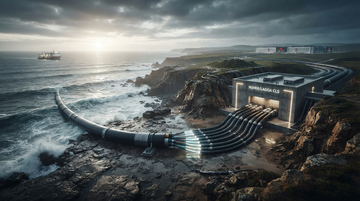
On the landing-station side, Google is also building a dedicated cable landing facility in the Azores. Submarine Networks (via its system page on Google’s landing project) describes a Cable Landing Station (CLS) at Lagoa (São Miguel island), including facility power/size and an expected commissioning timeline, and explicitly frames it as a key connection point for Google’s Nuvem and Sol transatlantic submarine cables.
| Layer | What changed | Verified anchor |
|---|---|---|
| Subsea route capacity | Design capacity scales through multi-pair systems | Nuvem described as 16 fiber pairs totaling ~384 Tbps |
| Landing-station geography | Landing points are chosen to create redundancy and reduce latency | CLS planned in Lagoa (Azores) for Nuvem/Sol |
| Domestic handoff | Onshore routing depends on CLS termination architecture and interconnection location | CLS functions described via Equinix’s CLS architecture explainer |
Mechanism
Cable landing stations decide how fast the subsea capacity becomes usable IT traffic
A cable landing station (CLS) is more than a beach manhole. Equinix’s explainer lays out the internal separation of subsea power and subsea optical data, and it names the core termination subsystems: cable termination equipment (CTE) that separates fiber and power, power feed equipment (PFE) that supplies repeaters for long spans, and submarine line terminal equipment (SLTE) that terminates optical fiber to extend data traffic into domestic networks. It also notes a key operational advantage when the CLS is inside a data center—backhaul can be removed, reducing latency between the subsea termination and interconnection.
This is the supply-chain shift investors should internalize: subsea cable capacity is necessary, but termination location and interconnection proximity determine when that capacity can monetize into cloud traffic and wholesale services.
Policy constraint
In the U.S., licensing turns landing control into a schedule and a gate
In the U.S., landing and operating subsea cables is regulated through FCC licensing. The FCC guide on submarine cable landing licenses states that operators must obtain a cable landing license prior to landing a submarine cable that connects the continental U.S. with a foreign country (or other specified U.S. endpoints). It also notes the basis in the Cable Landing License Act of 1921.
That matters for AI buildout because new cable systems don’t just compete on price and capacity—they compete on time-to-landing approval and which entity can legally control the system and its U.S. endpoints.
FCC-licensed subsea systems
90
Licensed Cables as of March 2026 (operating or planning to enter service)
Supply chain map
Who actually owns the “international backbone”? It’s layered—and often concentrated
Ownership is not one thing. It splits across (1) subsea cable system ownership/financing and (2) cable landing station architecture and (3) the domestic network and interconnect environment where traffic can be exchanged.
In this framework, Google’s Nuvem shows a hyperscaler choosing its subsea route and endpoints; Equinix illustrates a venue model where cable termination architecture can be integrated into data centers; and the CLS architecture explainer shows why the “last hundred meters” can become decisive for latency-sensitive traffic.
For the AI investor, the key is to trace the monetization path: AI traffic can only flow into the compute ecosystem when the ownership/control of each layer aligns.
- Google’s Nuvem build translates AI growth into bespoke route capacity, so planning starts with system design rather than reactive capacity leasing.
- Equinix-style CLS integration can reduce the backhaul step between subsea termination and interconnection, which matters for time-to-usable traffic.
- FCC landing licensing can slow or accelerate when capacity becomes legally usable, making schedule risk part of “capacity economics.”
Fundamentals lens (listed companies)
What to watch financially: landing-adjacent demand and capex sensitivity
The landing-station bottleneck shows up indirectly in listed fundamentals. If AI hyperscalers add capacity in phases, the beneficiaries tend to be (a) firms that build and operate interconnection-rich environments near landing points and (b) firms that can monetize cable-system build cycles.
Below are directionally relevant scale metrics for three major listed equities in this connectivity ecosystem—Equinix (data center interconnection), Alphabet (Google’s cloud and infrastructure engine), and Prysmian (subsea cable manufacturing and systems).
Equinix revenue
$9.26B
FY2025 revenue, reported Feb 11, 2026
Alphabet revenue
$402.84B
FY2025 revenue, reported Feb 5, 2026
Prysmian revenue
$8.75B
FY2024 revenue, reported Feb 12, 2025
Horizons
Short-term and long-term implications for AI connectivity planning
- In the next quarters, licensing and CLS integration can shift who gets first traffic, even before the full subsea build is online.
- Over 1–3 years, hyperscalers may increasingly internalize landing geography, reducing reliance on “third-party” termination paths.
- In parallel, cable landing station ecosystems that sit inside data centers can deepen demand, because they shorten the path from subsea fiber to peering.
Listed stocks most directly tied to the AI-era landing bottleneck
- Equinix can benefit from faster subsea-to-interconnect timing, because CLS architectures integrated into data centers reduce the “backhaul” step.
- As AI traffic grows, Equinix’s data center scale can support additional interconnection capacity without building new coastal sites each time a cable lands.
- Alphabet’s Google is using transatlantic systems like Nuvem with ~384 Tbps design capacity across 16 fiber pairs, signaling that hyperscalers increasingly own key backbone segments.
- By building landing infrastructure such as a CLS in the Azores, Google can improve redundancy and latency paths for AI and cloud services over 1–3 years.
- Prysmian’s scale in telecom cable systems can capture subsea build cycle spending, but margins may be pressured if subsea schedules or funding tighten due to landing risk.
- If AI-driven routes prioritize hyperscaler-owned capacity, Prysmian demand can remain steady but become more project-specified rather than wholesale-and-broad.
- Meta’s likely future transatlantic expansions make it a watch for landing-station and route-access announcements over the next 6–18 months.
- If more AI traffic shifts toward hyperscaler-owned routes, Meta’s connectivity cost and peering strategy can change how quickly new capacity monetizes into usage.