%22%2F%3E%0A%20%20%3Ccircle%20cx%3D%22220%22%20cy%3D%22150%22%20r%3D%22180%22%20fill%3D%22%2322d3ee%22%20fill-opacity%3D%220.12%22%2F%3E%0A%20%20%3Ccircle%20cx%3D%221010%22%20cy%3D%22130%22%20r%3D%22220%22%20fill%3D%22%2338bdf8%22%20fill-opacity%3D%220.08%22%2F%3E%0A%20%20%3Ccircle%20cx%3D%22920%22%20cy%3D%22520%22%20r%3D%22170%22%20fill%3D%22%2322d3ee%22%20fill-opacity%3D%220.06%22%2F%3E%0A%20%20%3Cpath%20d%3D%22M140%20430h920%22%20stroke%3D%22url(%23line)%22%20stroke-width%3D%2212%22%20stroke-linecap%3D%22round%22%2F%3E%0A%20%20%3Cpath%20d%3D%22M220%20360c120-150%20260-220%20380-220s260%2070%20380%20220%22%20fill%3D%22none%22%20stroke%3D%22%2367e8f9%22%20stroke-opacity%3D%220.5%22%20stroke-width%3D%2216%22%20stroke-linecap%3D%22round%22%20stroke-linejoin%3D%22round%22%2F%3E%0A%20%20%3Cpath%20d%3D%22M300%20398h600%22%20stroke%3D%22%2394a3b8%22%20stroke-opacity%3D%220.24%22%20stroke-width%3D%228%22%20stroke-linecap%3D%22round%22%2F%3E%0A%20%20%3Ctext%20x%3D%22220%22%20y%3D%22510%22%20fill%3D%22%23e2e8f0%22%20fill-opacity%3D%220.7%22%20font-family%3D%22Arial%2C%20Helvetica%2C%20sans-serif%22%20font-size%3D%2238%22%20letter-spacing%3D%228%22%3EINSIGHTS%3C%2Ftext%3E%0A%3C%2Fsvg%3E)
A new AI feedstock is emerging inside the enterprise
Startups’ internal threads are turning into model-ready datasets
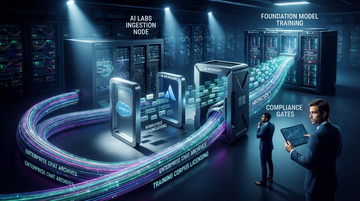
A recent The Information report describes a market shift: AI labs are paying for access to “old Slack, email, video messages” from startups—content that would otherwise remain trapped in enterprise archives. The economic novelty isn’t just that AI wants more data; it’s that enterprise collaboration history becomes a monetizable asset because it captures decisions, workflows, and tacit organizational context.
This reframes the AI value chain. Public web datasets and platform-specific media (like creator streams) are already well explored; what’s newly legible is the “enterprise conversation layer,” where training value can be tied to system-of-work tools, licensing terms, and retention controls.
How the chain works in practice
The money moves from labs → licensing/M&A intermediaries → archive custodians
Enterprise chat archives only become “priced training assets” when someone can legally move them into an AI-training workflow. That means two things must happen in parallel: (1) a mechanism for extracting/licensing the archive, and (2) contractual plus technical controls that define what’s allowed.
Slack-style workspaces sit at the center. Slack itself claims it will not use customer data to train generative AI models without affirmative opt-in, while still enabling agentic or assistant features via third-party models. As a result, the legal and operational leverage tends to consolidate around collaboration platforms—and their ecosystem integrations—rather than around the AI labs alone.
At the model/provider layer, OpenAI and Anthropic both publicly describe default training policies for business/enterprise use, which makes “archive acquisition” less about raw chat consumption and more about explicit opt-in/controlled pathways (or negotiated exceptions) that can create training permission where enterprises previously assumed none would exist.
| Provider | Stated default for business/enterprise data | Where training can still happen | Investor takeaway |
|---|---|---|---|
| OpenAI | Does not train models on customer business data by default | Can use data only if the customer explicitly opts in (and for connected app data, it says it won’t train by default) | Training access likely shifts to opt-in/contract structures and explicit permissions |
| Anthropic | Does not use inputs/outputs from commercial products to train by default | May use chats/sessions when customers explicitly enable feedback pathways that permit training (e.g., thumbs feedback) | Training permission may concentrate around enterprise admin settings and feedback controls |
| Slack | Will not use customer data to train generative AI models unless the customer provides affirmative opt-in consent | Global models can allow opt-out mechanics (for non-generative global model training), with a named opt-out process | Archive monetization likely requires platform-level permission and strong governance |
Grounded in public disclosures
Why this becomes a “compliance time bomb,” not just a data-buy story
In enterprise settings, the same chat thread can be evidence of internal intent (security incidents, HR actions, legal negotiations), not just “content.” When that thread becomes training corpus, compliance obligations expand in at least four directions:
1) Consent and scope: who authorized training, for what dataset slice, and for what use (improvement vs. training). 2) Retention and deletion: whether the archive remains accessible long after original business purpose. 3) Auditability: whether enterprises can prove where their data went. 4) Connector risk: enterprise tools integrate with file systems and ticketing platforms; a connector can turn one “allowed” item into a wider exposure.
Anthropic’s enterprise positioning points directly to these controls: its Compliance API is described as real-time access to usage data and customer content for monitoring and governance, and it describes selective deletion capabilities. OpenAI similarly emphasizes a default stance of no training on business data, while still describing that explicit opt-in can change the training outcome.
So the compliance bomb isn’t “AI labs breaking rules” as a blanket claim. It’s that the economic incentive to buy archives pressures every actor—labs, collaboration platforms, and enterprises—to clarify permissions, retention, and audit hooks faster than enterprise procurement cycles.
Numbers investors can anchor on
The platform layer is big enough to matter—and it’s already scaling
Salesforce TTM revenue
$42.8B
TTM revenue, reported in Salesforce income statement for FY ended Jan 31, 2026 (most recent annual/TTM period available in financials)
Atlassian TTM revenue
$6.6B
TTM revenue, reported in Atlassian income statement for FY ended Jun 30, 2026
Microsoft TTM revenue
$331.8B
TTM revenue, reported in Microsoft income statement for FY ended Jun 30, 2026
Oracle TTM revenue
$67.4B
TTM revenue, reported in Oracle income statement for FY ended May 31, 2026
Even without proving how much enterprise-chat data gets licensed, the economics of the “toll collector” layer are clear: collaboration and productivity suites process huge volumes of business content and therefore have the strongest bargaining position over extraction, permission, and governance.
From an investment viewpoint, the data-licensing story matters most where it changes product economics: platforms that can enforce training permissions, provide audit/export tooling, and market governance-friendly AI integrations tend to earn more than platforms that can only provide raw connectivity.
What this implies for winners and losers
Tolls rise for collaboration platforms; compliance overhead spreads to enterprise customers
- Enterprise archives become a monetization channel only when governance is productized, so platforms that sell admin controls can command higher pricing power.
- OpenAI’s default “no training by default” stance implies training permission is contractual and opt-in, which increases the value of audit trails and policy toggles.
- Anthropic’s public description of compliance monitoring and selective retention controls suggests enterprises will increasingly demand receipts and deletion workflows.
- If archive acquisitions accelerate, customer procurement cycles for AI assistants will shift from “model quality” toward “data rights + auditability,” changing sales motion for productivity vendors.
Forward view
Short-term catalyst vs. long-term structural risk
Short-term (days to quarters), the most actionable signal is policy and product alignment: watch for platform admin settings, audit/export tooling, and explicit opt-in mechanisms tied to enterprise AI assistant features.
Long-term (1–3 years), the structural risk is that compliance overhead becomes a permanent cost center and a recurring renegotiation item in enterprise AI contracts. Even if providers keep “no default training” claims, archive monetization economics can force tighter controls around retention, connector scope, and user feedback permissions.
For investors, that means platform incumbents can gain share by embedding governance into the collaboration workflow—while enterprises may face higher implementation friction and legal overhead that slows AI assistant adoption in regulated functions.
Listed stocks most exposed to the enterprise-chat governance toll
- Salesforce can capture more “toll” value as enterprise AI contracts shift toward admin-controlled permissions, supported by its large, scaled revenue base.
- If training permission becomes a procurement checkbox, Salesforce's ecosystem around collaboration and workflow can move from “integration layer” to “governance layer,” supporting durable growth.
- Salesforce is a likely beneficiary of auditability-as-a-feature demand because its platform already supports enterprise-wide governance workflows—reducing friction for customers.
- Atlassian sits on knowledge work (Jira/Confluence archives), so chat-to-corpus monetization can increase the value of its collaboration history, but profitability volatility limits near-term certainty.
- If teams demand stronger admin controls and audit trails for training permission, Atlassian can monetize governance modules, but integration-driven costs may rise.
- Over 1–3 years, Atlassian is a watch candidate for AI feature attach rates; near-term operating leverage depends on execution and customer spending.
- Microsoft's scale in enterprise productivity increases its ability to package governance, and its large revenue base supports investment into audit and retention tooling.
- As training access becomes opt-in/contractual, enterprises will prefer vendors that can enforce policy at the platform layer, favoring Microsoft.
- In days-to-quarters, watch for enterprise AI feature launches that emphasize admin controls; over 1–3 years, policy-driven purchasing can support recurring monetization.
- Oracle can benefit if enterprise governance requirements for training permission extend from collaboration tools into ERP/HCM systems, where its compliance tooling is often adopted.
- In the short term, Oracle’s upside depends on whether customers expand AI assistants into process execution that uses archived operational communications.
- Over 1–3 years, Oracle is a watch for incremental AI governance revenues tied to selective retention/deletion workflows across enterprise applications.