%22%2F%3E%0A%20%20%3Ccircle%20cx%3D%22220%22%20cy%3D%22150%22%20r%3D%22180%22%20fill%3D%22%2322d3ee%22%20fill-opacity%3D%220.12%22%2F%3E%0A%20%20%3Ccircle%20cx%3D%221010%22%20cy%3D%22130%22%20r%3D%22220%22%20fill%3D%22%2338bdf8%22%20fill-opacity%3D%220.08%22%2F%3E%0A%20%20%3Ccircle%20cx%3D%22920%22%20cy%3D%22520%22%20r%3D%22170%22%20fill%3D%22%2322d3ee%22%20fill-opacity%3D%220.06%22%2F%3E%0A%20%20%3Cpath%20d%3D%22M140%20430h920%22%20stroke%3D%22url(%23line)%22%20stroke-width%3D%2212%22%20stroke-linecap%3D%22round%22%2F%3E%0A%20%20%3Cpath%20d%3D%22M220%20360c120-150%20260-220%20380-220s260%2070%20380%20220%22%20fill%3D%22none%22%20stroke%3D%22%2367e8f9%22%20stroke-opacity%3D%220.5%22%20stroke-width%3D%2216%22%20stroke-linecap%3D%22round%22%20stroke-linejoin%3D%22round%22%2F%3E%0A%20%20%3Cpath%20d%3D%22M300%20398h600%22%20stroke%3D%22%2394a3b8%22%20stroke-opacity%3D%220.24%22%20stroke-width%3D%228%22%20stroke-linecap%3D%22round%22%2F%3E%0A%20%20%3Ctext%20x%3D%22220%22%20y%3D%22510%22%20fill%3D%22%23e2e8f0%22%20fill-opacity%3D%220.7%22%20font-family%3D%22Arial%2C%20Helvetica%2C%20sans-serif%22%20font-size%3D%2238%22%20letter-spacing%3D%228%22%3EINSIGHTS%3C%2Ftext%3E%0A%3C%2Fsvg%3E)
Market structure event
S&P 500 membership changes can mechanically move shares—even without a fundamentals update
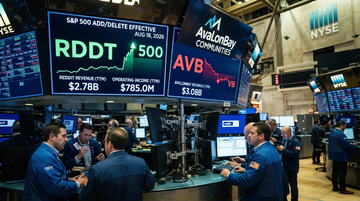
On Aug. 18, 2026, Reddit is scheduled to be added to the S&P 500 and AvalonBay to be deleted, per an S&P Dow Jones Indices change notice published through PR Newswire.
Mechanically, that means S&P 500 index funds and ETFs that benchmark to the S&P 500 have a near-term exposure target change: they increase holdings of Reddit to match index weights (often executed across one or more trading days around the effective date), and reduce holdings of AvalonBay to remove it. The “crowding tax” frame comes from the idea that initial demand can compress spreads and lift prices temporarily, and then later—when trading normalizes—any price move that was mostly flow-driven becomes harder to sustain.
What the index change actually says (the hard part)
Addition to S&P 500
[Reddit](rddt) (Communication Services)
Effective prior to the opening of trading on Tuesday, Aug. 18, 2026 (per S&P Dow Jones Indices via PR Newswire).
Deletion from S&P 500
[AvalonBay](avb) (Financials)
Same effective timing: Aug. 18, 2026 (per S&P Dow Jones Indices via PR Newswire).
Forced flows: how the math typically works
Sizing the passive pressure: the only number that matters is “index dollars that must rotate”
Inclusion doesn’t guarantee a predictable % move, because the buy/sell pressure depends on (1) how many index-tracking vehicles exist and how closely they replicate, (2) whether they trade execution windows or average-price strategies, and (3) how “float” and shares outstanding translate into index shares.
But the direction is mechanically consistent: if the S&P 500 weight of Reddit implied by its index shares is positive and AvalonBay is removed, then, all else equal, passive portfolios must rotate exposure. That’s why index changes can look like an “announcement alpha” even when fundamentals haven’t changed.
The crowding tax: what happens after the forced-buyer window
Why the easy trade (buy the inclusion) can turn into a liquidity tax once front-running fades
The “front-running fades” part is the key. Early in index rumors, traders often position for a momentum effect. Once the event becomes official and passive flows begin, marginal buyers can thin out quickly.
After the effective date, the price is supposed to reflect fundamentals and risk premia—not incremental mechanical demand. If the price reaction was large relative to fundamentals, then later returns can be capped or even reversed when:
- passive sellers on the other side (from the deletion) have already completed their rotation, and
- any remaining incremental demand is no longer “forced,” but voluntary.
For investors, the practical implication is not “avoid index events.” It’s to separate the short-window flow catalyst from the post-window ownership/liquidity reality.
- If the market expects passive buying to lead to sustained re-rating, the post-effective window can disappoint when flows normalize.
- If a stock has less liquidity or more concentrated hands, then mechanical demand can lift prices more than later fundamental updates can justify.
- If the deletion stock is a dividend/defensive REIT profile, forced selling can create a temporary yield/quality dislocation that mean-reverts.
Fundamentals backdrop: why Reddit and AvalonBay react differently
The business profiles are so different that index flows matter—but they can’t explain everything
Reddit and AvalonBay sit in very different fundamental worlds: Reddit is an internet platform with revenue and margin dynamics tied to advertising and engagement, while AvalonBay is a residential REIT whose investor base typically focuses on dividend stability, balance-sheet risk, and rent/occupancy trends.
That matters because index membership changes don’t change the business—so the longer-term question becomes whether the price you pay is consistent with each company’s operating trajectory.
Below are the basic scale and profitability anchors from reported financial statements for context.
Reddit revenue (TTM)
$2.78B
TTM through Jun. 30, 2026; reported in its most recent financial statement set available in this dataset.
Reddit operating income (TTM)
$785.0M
TTM through Jun. 30, 2026; reported in its most recent financial statement set available in this dataset.
AvalonBay revenue (TTM)
$3.08B
TTM through Jun. 30, 2026; reported in its most recent financial statement set available in this dataset.
AvalonBay operating income (TTM)
$876.3M
TTM through Jun. 30, 2026; reported in its most recent financial statement set available in this dataset.
Short-term vs. long-term: what to watch
Expect the first move on Aug. 18, but judge the event by what happens after ownership normalizes
| Time window | What should move first | What would falsify the flow-only thesis |
|---|---|---|
| Announcement → effective date (days) | Liquidity and spread compression in Reddit, and selling pressure in AvalonBay around rotations | Price continues rising after the rotation window without improving fundamentals expectations |
| Effective date → 1–2 weeks | Normalization of order-book imbalance as forced flows complete | Reddit fails to hold gains while buy-side participation falls; AvalonBay mean-reverts upward if selling was purely mechanical |
| 1–3 years | Investors re-price each name based on earnings durability and risk premium | If Reddit operating trajectory (revenue and profitability) doesn’t follow the multiple expansion implied by the index headline, returns may lag |
The most investor-relevant point is timing. Index flows tend to be concentrated around the effective date. The “crowding tax” is what’s left when the market realizes those flows were never a structural change.
For Reddit, a high-sensitivity outcome is whether valuation expands enough to compensate for volatility. For AvalonBay, the key is whether removal reinforces a discount that should revert once the mechanical selling ends.
Supply-chain aware framing (who benefits / who loses when flows rotate)
Index membership doesn’t change product supply chains—but it changes funding access and trading quality
This is where “supply-chain aware” matters in a market-structure event: the upstream/downstream isn’t hardware or inputs—it’s capital supply.
Upstream of the stock price are market-makers, brokers, and execution venues that absorb order flow around the effective date. When passive and front-running traders all execute together, spreads and market impact tend to widen for the deletion and tighten for the addition—until the order imbalance clears.
Downstream are end investors: pension plans, retail brokerage accounts, and quant funds that hold index trackers. If the price move is flow-driven, downstream investors inherit the crowding risk: they buy after the easy part and potentially sell after the price normalization.
Listed-market tickers most plausibly touched by the flow story
- Reddit is added to the S&P 500 effective Aug. 18, 2026, so forced passive buying can support near-term price momentum into and around the effective date.
- With revenue of $2.78B (TTM through Jun. 30, 2026), any sustained move beyond the flow window should track earnings durability rather than index mechanics alone.
- If post-effective follow-through fades while operating metrics don’t re-accelerate, index-crowding dynamics can cap upside in subsequent weeks.
- AvalonBay is deleted from the S&P 500 effective Aug. 18, 2026, so forced selling can push prices down temporarily during the rotation.
- AvalonBay’s TTM operating income of $876.3M (through Jun. 30, 2026) means fundamentals may limit downside if the market was over-discounting the mechanical effect.
- If the deletion discount mean-reverts after passive flows complete, the setup can turn into a value re-rating on a 1–3 year horizon.