%22%2F%3E%0A%20%20%3Ccircle%20cx%3D%22220%22%20cy%3D%22150%22%20r%3D%22180%22%20fill%3D%22%2322d3ee%22%20fill-opacity%3D%220.12%22%2F%3E%0A%20%20%3Ccircle%20cx%3D%221010%22%20cy%3D%22130%22%20r%3D%22220%22%20fill%3D%22%2338bdf8%22%20fill-opacity%3D%220.08%22%2F%3E%0A%20%20%3Ccircle%20cx%3D%22920%22%20cy%3D%22520%22%20r%3D%22170%22%20fill%3D%22%2322d3ee%22%20fill-opacity%3D%220.06%22%2F%3E%0A%20%20%3Cpath%20d%3D%22M140%20430h920%22%20stroke%3D%22url(%23line)%22%20stroke-width%3D%2212%22%20stroke-linecap%3D%22round%22%2F%3E%0A%20%20%3Cpath%20d%3D%22M220%20360c120-150%20260-220%20380-220s260%2070%20380%20220%22%20fill%3D%22none%22%20stroke%3D%22%2367e8f9%22%20stroke-opacity%3D%220.5%22%20stroke-width%3D%2216%22%20stroke-linecap%3D%22round%22%20stroke-linejoin%3D%22round%22%2F%3E%0A%20%20%3Cpath%20d%3D%22M300%20398h600%22%20stroke%3D%22%2394a3b8%22%20stroke-opacity%3D%220.24%22%20stroke-width%3D%228%22%20stroke-linecap%3D%22round%22%2F%3E%0A%20%20%3Ctext%20x%3D%22220%22%20y%3D%22510%22%20fill%3D%22%23e2e8f0%22%20fill-opacity%3D%220.7%22%20font-family%3D%22Arial%2C%20Helvetica%2C%20sans-serif%22%20font-size%3D%2238%22%20letter-spacing%3D%228%22%3EINSIGHTS%3C%2Ftext%3E%0A%3C%2Fsvg%3E)
Copilot consolidation
Microsoft is merging Copilot surfaces—and explicitly retiring specific features with a fixed end date
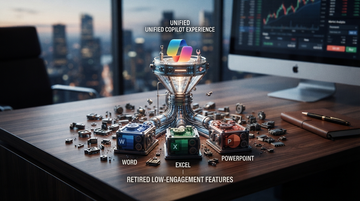
Microsoft is rolling out a unified Copilot experience that combines the previously separate consumer and Microsoft 365 Copilot surfaces, with a scheduled retirement of several consumer Copilot capabilities starting Aug. 18, 2026. In parallel, Microsoft is redesigning Copilot so it behaves less like a standalone prompt box and more like a task-aware entry point across Microsoft 365 apps.
- merges Copilot experiences into one unified entry point starting Aug. 18, 2026 (consumer + Microsoft 365 Copilot consolidation timeline across mobile/web first).
- retires consumer Group Chat after Aug. 18, 2026 (threads/messages/images will not carry forward).
- fully retires consumer Podcasts on Aug. 18, 2026 (creation/access ends; files can be downloaded before retirement).
- ends consumer Deep Research availability after Aug. 18, 2026 (existing content remains accessible, but the feature stops for consumer users).
What actually changed in the user experience
The redesign moves Copilot from scattered touchpoints to a consistent, task-aware workspace across Microsoft 365
Microsoft frames the redesign as moving “from individual features to connected experiences,” placing Copilot above the work so the same assistant can operate with context across the Microsoft 365 app surfaces. The key investor-relevant element is that this is paired with measurable rollout performance claims—Microsoft is implying that the unified, in-flow experience drives higher usage.
Word usage uplift
+27%
Microsoft 365 Copilot redesign rollout claim (reported alongside the app redesign announcement).
Excel usage uplift
+33%
Microsoft 365 Copilot redesign rollout claim (reported alongside the app redesign announcement).
PowerPoint usage uplift
+43%
Microsoft 365 Copilot redesign rollout claim (reported alongside the app redesign announcement).
Outlook usage uplift
+30%
Microsoft 365 Copilot redesign rollout claim (reported alongside the app redesign announcement).
Microsoft also highlights performance improvements for the redesigned Copilot app—claims that align with the idea that conversion depends on latency and responsiveness, not only model capability. If the product is being consolidated to a smaller set of best-performing surfaces, the biggest near-term question becomes whether Microsoft can preserve (or improve) monetization while cutting feature surface area.
Investor read-through
Why this “feature purge” matters: AI monetization is a distribution game, not a model game
AI software features often compete for attention, licensing trust, and repeated usage. Consolidating Copilot into fewer, stronger entry points can lower “prompting friction,” reduce user confusion from multiple Copilot experiences, and concentrate compute spend on the flows that actually get used.
| Stage in the funnel | Before (separate surfaces) | After (unified Copilot) |
|---|---|---|
| Discovery | Multiple Copilot entry points across consumer vs. Microsoft 365 | Consistent entry point across Microsoft 365, designed to sit above the work |
| Activation | Users evaluate features unevenly across surfaces | Unified experience steers users toward a smaller set of high-value workflows |
| Retention | Feature-specific engagement can fragment behavior | Fewer retired/merged experiences reduce fragmentation and support repeat usage |
| Compute efficiency | Lower-engagement features may still run in the background for some cohorts | Retiring low-engagement features can narrow usage to better-performing flows |
Supply-chain map (full stack, not just apps)
The purge ripples upstream (compute/agent tooling) and downstream (enterprise deployment choices)
- Upstream (compute + tooling): retiring consumer features can shift how often certain Copilot workflows run, which indirectly affects inference demand patterns even if Microsoft doesn’t disclose internal throughput changes.
- Midstream (AI app platform): consolidating Copilot surfaces increases pressure on shared components (tools, context, permissioning) to work reliably across more app contexts.
- Downstream (enterprise buyers): unified Copilot changes procurement/rollout narratives; IT teams may standardize fewer configurations, which can speed adoption but also concentrates risk if the unified experience underperforms.
Because Microsoft did not frame this as model retraining, the more direct read-through is product operations: Microsoft is curating which AI capabilities stay “packaged for scale.” That typically rewards companies in the ecosystem that can deliver reliable tool integrations and enterprise-ready workflows, and it can punish features that require heavy setup or that don’t reach repeat behavior.
Where Microsoft’s fundamentals fit (and where they don’t)
Microsoft’s core financial engine supports the pivot—but the pivot still has to win seat-level behavior
Microsoft continues to generate substantial operating cash flow and free cash flow at the company level, giving it flexibility to adjust product packaging without immediate balance-sheet stress. But Copilot economics depend on recurring user behavior—feature removals are a direct lever on which behaviors become monetizable.
FY2026 free cash flow (TTM figure used for valuation context)
$74.1B
FY ending Jun 30, 2026 context; reported figures used to characterize cash generation strength for product investment.
FY2026 operating margin (context)
46.8%
FY ending Jun 30, 2026 context; used to show Microsoft’s profitability headroom.
Five concrete questions investors should track next
What to watch after Aug. 18, 2026: adoption, attachment, and whether retirement reduces confidence
- Does unified Copilot keep the usage uplift Microsoft claims (+27% to +43% across key apps) once Group Chat, Podcasts, and Deep Research (consumer) are gone.
- Does the unified experience translate into higher “in-app” attachment (how often Copilot is invoked per active user) versus feature-specific engagement.
- Can Microsoft reduce cognitive load without reducing perceived value (users may prefer fewer features if the remaining ones are consistently good).
- Does consolidation improve enterprise rollout speed—fewer configurations can reduce IT burden, but unified changes can also create a single point of failure.
- Is retirements’ narrative framed as “better experiences” rather than “we were wrong,” because trust affects paid seat conversion.
Listed companies with the clearest read-through to Copilot consolidation
- Unified Copilot is designed as a single entry point across Microsoft 365, supporting higher recurring usage—management claims +27% to +43% app uplift.
- Retiring consumer features can reduce low-engagement compute and support monetization focus starting Aug. 18, 2026, improving product economics.
- If consolidation succeeds, Microsoft can increase attach rates per seat by concentrating the Copilot layer into fewer, clearer workflows.
- Microsoft’s move to consolidate Copilot surfaces can raise switching costs within productivity, potentially compressing share for assistant features inside office-like workflows.
- Feature retirements can signal “winner-takes-attention” dynamics that favor incumbents with distribution, challenging Alphabet’s ability to match enterprise seat-level adoption.
- Unified AI assistant experiences often trigger enterprise “standardization” cycles; Salesforce is a watch for implementation-based reallocation of AI budgets after Aug. 18, 2026 rollout behavior stabilizes.
- Feature retirement can shift inference demand patterns toward fewer, higher-frequency Copilot workflows rather than total compute reduction (investor impact depends on net usage).
- If Copilot consolidation increases seat-level invocation, NVIDIA can benefit from higher sustained inference demand even if some features are cut.