%22%2F%3E%0A%20%20%3Ccircle%20cx%3D%22220%22%20cy%3D%22150%22%20r%3D%22180%22%20fill%3D%22%2322d3ee%22%20fill-opacity%3D%220.12%22%2F%3E%0A%20%20%3Ccircle%20cx%3D%221010%22%20cy%3D%22130%22%20r%3D%22220%22%20fill%3D%22%2338bdf8%22%20fill-opacity%3D%220.08%22%2F%3E%0A%20%20%3Ccircle%20cx%3D%22920%22%20cy%3D%22520%22%20r%3D%22170%22%20fill%3D%22%2322d3ee%22%20fill-opacity%3D%220.06%22%2F%3E%0A%20%20%3Cpath%20d%3D%22M140%20430h920%22%20stroke%3D%22url(%23line)%22%20stroke-width%3D%2212%22%20stroke-linecap%3D%22round%22%2F%3E%0A%20%20%3Cpath%20d%3D%22M220%20360c120-150%20260-220%20380-220s260%2070%20380%20220%22%20fill%3D%22none%22%20stroke%3D%22%2367e8f9%22%20stroke-opacity%3D%220.5%22%20stroke-width%3D%2216%22%20stroke-linecap%3D%22round%22%20stroke-linejoin%3D%22round%22%2F%3E%0A%20%20%3Cpath%20d%3D%22M300%20398h600%22%20stroke%3D%22%2394a3b8%22%20stroke-opacity%3D%220.24%22%20stroke-width%3D%228%22%20stroke-linecap%3D%22round%22%2F%3E%0A%20%20%3Ctext%20x%3D%22220%22%20y%3D%22510%22%20fill%3D%22%23e2e8f0%22%20fill-opacity%3D%220.7%22%20font-family%3D%22Arial%2C%20Helvetica%2C%20sans-serif%22%20font-size%3D%2238%22%20letter-spacing%3D%228%22%3EINSIGHTS%3C%2Ftext%3E%0A%3C%2Fsvg%3E)
Verified deal terms and what they imply
The “AI-cloud tenant” story is real: a reported $10B, six-year compute contract anchored in Norway
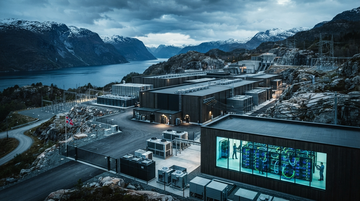
Volta Infra emerged from stealth around a headline that matters for the whole AI infrastructure supply chain: it reportedly secured a $10B six-year compute partnership to provide cloud computing capacity in Europe. The reported buyer is Anthropic, and the capacity delivery is described as coming from a Norway data center operated/developed with Bitdeer Technologies Group. The deal’s scale is big enough that it’s hard to view as “pilot capacity”—it reads like a capacity reservation that is meant to behave like contracted cloud revenue.
What’s explicitly supported vs. not
Deal value / duration
$10B over six years
Supported by Reuters and corroborated by other reporting.
Buyer / AI lab identity
Anthropic (reported; Reuters says it couldn’t independently verify)
Primary reporting indicates the buyer identity is attributed to Bloomberg/other sources.
Where compute is delivered
Norway (Bitdeer data center / capacity described as 133MW)
Supported across reporting.
Chip platform
Nvidia Vera Rubin systems (reported)
Supported by reporting; deal terms beyond chip family are not fully disclosed.
- anchors Volta’s launch around contracted hyperscaler-aligned compute demand, not around generalized “AI cloud” marketing.
- forces a build-out sequencing shift toward power + siting first (133MW Norway described) to make the contract credible.
- concentrates delivery risk into a landlord/operator partnership (Volta ↔ Bitdeer) instead of a hyperscaler’s internal capital plan.
Supply chain mapping
Full supply-chain view: where revenue, risk, and execution actually sit
This isn’t just a new “AI cloud startup.” It’s a re-partitioning of the AI data-center value chain. Volta (tenant layer / orchestration) reportedly sells compute outcomes to an AI lab; Bitdeer reportedly provides (or partners to develop) the physical data-center capacity in Norway; Nvidia is referenced as the accelerator platform behind the compute. The economically important part is that the contract is structured so that compute supply is “rented” from a specialized operator rather than waiting for a hyperscaler to build a new node—or for an AI lab to become its own facilities company.
| Layer | Company | Role in the model | What’s evidenced in reporting |
|---|---|---|---|
| Demand / AI customer | Anthropic | Buys long-duration cloud compute | Reported as the buyer; Reuters notes it couldn’t independently verify the identity. |
| Tenant / compute orchestrator | Volta Infra | Aggregates capacity and delivers a cloud service | Deal announced as Volta’s $10B AI partnership/contract. |
| Capacity operator / landlord | Bitdeer Technologies Group | Develops/operates data-center capacity in Norway | Partnership named; Norway facility described at 133MW. |
| Accelerator platform | NVIDIA | Provides the compute chip family referenced for the deployed systems | Reporting references Nvidia’s Vera Rubin systems. |
Why this deal matters for investors (not just infrastructure people)
The investing thesis: “tenant-first” AI infrastructure tightens the link between contracted demand and scarce power/capex
Most of the market’s AI infrastructure narratives in the last cycle treated demand as a trailing indicator: vendors built capacity first, then hoped utilization would follow. Volta’s reported structure flips that. It points to a model where a specialized tenant/operator combination can monetize demand visibility (an AI lab’s multi-year spend) and translate it into a financed and deliverable data-center program.
- supports a financing narrative where contract duration (six years) makes lenders/investors more comfortable funding capacity—at least in principle.
- increases the probability of early utilization because the contract is demand-specific, not generic “GPU availability.”
- compresses the time-to-revenue for capacity developers relative to greenfield builds without a named customer commitment.
Numbers that can be used on a model
Key deal primitives you can plug into a scenario model
Volta deal value (reported)
$10B
Reuters and other reporting cite a $10B AI cloud/compute partnership.
Agreement duration
6 years
Reported as a six-year period for compute provision.
Norway facility capacity (described)
133MW
Reported as the capacity delivered from the Norway site associated with Bitdeer.
A scenario model should treat the $10B as (a) revenue potential and (b) a capacity utilization anchor. The most decision-relevant number in the public reporting is the reported Norway capacity at 133MW, which lets you sanity-check whether the implied revenue density is plausible relative to typical AI facility economics (though exact pricing per MW is not disclosed).
Short-term vs long-term horizons
What moves first: contract credibility, then deployment cadence
Deal “primitives” that determine how the market will price risk
Illustrative map of what’s known from reporting: contract value, contract duration, and capacity described. (Not a projection.)
Unit: reported magnitude
Reported partnership value ($B)
Compute/cloud contract value cited in reporting.
10
Contract duration (years)
Compute provision duration cited in reporting.
6
Norway capacity described (MW)
Facility capacity described in reporting.
133
In the next few days to quarters, the market will likely focus on “paper-to-power” execution: whether capacity delivery and procurement sequencing starts on time, and whether more details emerge around what exactly is included in the $10B (capacity reservation vs measured compute consumption). Over 1–3 years, the bigger question is whether Volta’s tenant-first model can replicate at scale without becoming dependent on a single customer or a single geography/power pipeline.
- tests whether the contract was capacity-reservation-like (utilization support) or more akin to flexible services (utilization risk).
- measures whether 133MW turns into “usable compute” on schedule, because the first deployment is the proof point.
- reveals whether Nvidia platform procurement bottlenecks get smoothed through partner execution (not disclosed in detail).
Fundamentals for public comps (what we can actually measure)
Why the listed supply-chain comps react differently: capex intensity vs platform pull
Because Volta and Anthropic are not public stand-alone financials, the cleanest way to translate the deal into public-market signals is to look at the listed ecosystem components. NVIDIA is the referenced accelerator platform; Bitdeer Technologies Group is a listed capacity/landlord partner referenced for Norway delivery; Dell Technologies is referenced as part of the broader Nvidia-backed ecosystem in reporting (but the deal’s exact deliverables at Dell are not specified).
Public comps: what the data tools can support today
NVIDIA basic scale (TTM)
Revenue ~$253.5B; Gross margin ~74.1%
From data tools overview.
Bitdeer financial posture (TTM)
Revenue ~$739.1M; Operating margin ~-43.3%
From data tools overview; reflects mining economics volatility.
Dell financial posture (TTM)
Revenue ~$134.0B; Operating margin ~8.9%
From data tools overview.
Synthesis
Bottom line: Volta is trying to turn “independent AI cloud” into a contract-backed landlord model
The investment-relevant meaning of Volta’s launch is that a new independent AI cloud operator is reportedly securing multi-year, contracted compute demand and tying it to deployable data-center capacity in Europe (Norway described at 133MW). If this model scales beyond a single flagship customer/site, it can siphon some incremental AI infrastructure spend away from hyperscaler-only build plans and toward specialized tenant/operator structures. The counterweight is execution risk: without more primary confirmation and more disclosed deployment mechanics, the market should treat the $10B as “credible but not fully adjudicated.”
Listed stocks most plausibly touched by Volta’s reported tenant-first compute model
- Nvidia’s accelerator pull is supported by reporting that the Norway capacity is tied to Vera Rubin systems, making incremental demand for its AI platform more likely through the tenant model.
- In days–quarters, watch for AI data-center systems procurement signals via Nvidia’s reported demand commentary rather than deal headlines.
- In 1–3 years, the tenant-first build approach can increase the number of “qualified” deployment nodes for its hardware footprint if capacity scales.
- Bitdeer is named as the Norway partner; with reported 133MW capacity delivery, it is positioned to earn more infrastructure-related utilization revenue.
- In days–quarters, equity reaction may be tempered because Bitdeer’s TTM operating margin is negative (~-43.3%) in current reported fundamentals.
- In 1–3 years, if compute contracts persist through the cycle, Bitdeer could diversify away from pure mining economics; if not, the hedge is incomplete.
- Reporting associates Volta’s ecosystem with Nvidia/Dell; if systems integration is part of the delivery, Dell’s AI server supply relevance increases even though exact bill-of-materials aren’t disclosed.
- In days–quarters, the market impact is likely limited until procurement specifics emerge (no disclosed Dell contract terms).
- In 1–3 years, if tenant-first clouds expand in Europe, Dell could benefit from higher rack-level deployments if it captures build integration.