%22%2F%3E%0A%20%20%3Ccircle%20cx%3D%22220%22%20cy%3D%22150%22%20r%3D%22180%22%20fill%3D%22%2322d3ee%22%20fill-opacity%3D%220.12%22%2F%3E%0A%20%20%3Ccircle%20cx%3D%221010%22%20cy%3D%22130%22%20r%3D%22220%22%20fill%3D%22%2338bdf8%22%20fill-opacity%3D%220.08%22%2F%3E%0A%20%20%3Ccircle%20cx%3D%22920%22%20cy%3D%22520%22%20r%3D%22170%22%20fill%3D%22%2322d3ee%22%20fill-opacity%3D%220.06%22%2F%3E%0A%20%20%3Cpath%20d%3D%22M140%20430h920%22%20stroke%3D%22url(%23line)%22%20stroke-width%3D%2212%22%20stroke-linecap%3D%22round%22%2F%3E%0A%20%20%3Cpath%20d%3D%22M220%20360c120-150%20260-220%20380-220s260%2070%20380%20220%22%20fill%3D%22none%22%20stroke%3D%22%2367e8f9%22%20stroke-opacity%3D%220.5%22%20stroke-width%3D%2216%22%20stroke-linecap%3D%22round%22%20stroke-linejoin%3D%22round%22%2F%3E%0A%20%20%3Cpath%20d%3D%22M300%20398h600%22%20stroke%3D%22%2394a3b8%22%20stroke-opacity%3D%220.24%22%20stroke-width%3D%228%22%20stroke-linecap%3D%22round%22%2F%3E%0A%20%20%3Ctext%20x%3D%22220%22%20y%3D%22510%22%20fill%3D%22%23e2e8f0%22%20fill-opacity%3D%220.7%22%20font-family%3D%22Arial%2C%20Helvetica%2C%20sans-serif%22%20font-size%3D%2238%22%20letter-spacing%3D%228%22%3EINSIGHTS%3C%2Ftext%3E%0A%3C%2Fsvg%3E)
What changed—and why the signal matters
The “hedge” isn’t new China demand; it’s second-source qualification for supply-chain continuity
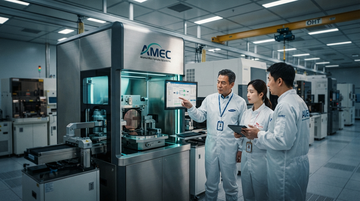
The Reuters EXCLUSIVE on Aug. 5, 2026 is specific: Samsung and SK Hynix are evaluating Chinese equipment—reported as AMEC etching tools—for potential use at their China factories, framed explicitly as a hedge against U.S. export-control risk.
What makes this analytically different from typical localization stories is the mechanism: it’s not “switching production to China.” It’s keeping Chinese tool suppliers in reserve so the fabs can maintain and upgrade existing production if U.S. controls expand to servicing, repair, replacement, or ongoing import permissions for Western tools.
Verified facts from the Reuters report (event base)
Samsung / SK Hynix testing claim
Evaluating [AMEC](688012.ss) etching equipment
Reported by Reuters with “three people familiar with the matter” (sources unnamed).
Stated rationale
Hedge against tighter U.S. export controls
Includes concern about restrictions extending to servicing/repair/replacement of Western tools already installed.
Stage / commitment level
Testing ≠ deployment commitment
Reuters frames it as evaluations; not a decision to deploy at scale.
Supply-chain map (full chain, not just end-demand)
A tool-vendor hedge transmits backwards into etch/clean/deposition suppliers—and forwards into fab uptime
A fab tool qualification decision is “mid-chain” by definition: it happens after wafer-processing recipes are defined, but before volume production depends on tool uptime, yield learning, and maintenance lead times.
So the supply-chain transmission here is two-step: 1) Upstream tool vendors (etch/deposition/cleaning) gain qualification slots and qualification learning cycles that can later convert into installed base and recurring service. 2) Downstream fabs (Samsung and SK Hynix) gain operational continuity if U.S. approvals become less predictable—because the qualification work reduces switching friction later.
This is why the buy-side angle focuses on when demand is pulled forward: qualification testing can start before procurement volume, but it creates a credible pathway to future installs and spare-part demand.
The “competitive substitution” question
If Western tool access tightens, etch is one of the first areas where second-sourcing can scale
Reuters indicates the test is for AMEC etching equipment. In practice, etch is a natural hedge target because:
- Etch tool sets are heavily recipe-dependent but not lithography-dependent (i.e., less tied to the most geopolitically chokepointed categories like EUV).
- Replacement/servicing constraints matter immediately for uptime; a qualified alternative reduces downtime risk.
- Cost and procurement flexibility matter when fabs face approval volatility for Western spares and service.
Reuters also cites cost/competitive positioning reported by TechInsights: Chinese tools can cost 20%–30% less than comparable equipment (as referenced in the report). That matters for the economic hedge: if firms must carry an alternative tool set for continuity, margin impact becomes part of the decision.
Reported pricing gap (tool economics used in the hedging decision)
TechInsights is cited in Reuters: Chinese tools can cost 20%–30% less than comparable equipment.
Unit: percent
Lower end of reported gap
Reuters-reported TechInsights reference
20%
Upper end of reported gap
Reuters-reported TechInsights reference
30%
- Etch tool qualification is easier to hedge operationally than lithography access because continuity can rely on etch/deposition alternatives without requiring an EUV capability shift (category-level inference; exact scope of Reuters hedging is etch equipment).
- Second-sourcing converts from “testing” to “installed-base demand” only after yield/recipe stability is proven, so the first measurable KPI for equipment vendors is qualification pipeline lengthening before revenue replacement shows up (timing inference; stage of Reuters report is testing/evaluation).
- The economics of carrying a hedge set are enhanced by Reuters-cited 20%–30% lower Chinese tool pricing, making reserve capacity less margin-dilutive.
Market sizing hook (why this becomes an investable demand shift)
Reuters’ cited bank math implies meaningful upside for Chinese etch/deposition vendors if “hedge” turns into installs
Reuters also includes Deutsche Bank estimates around 2026 for Chinese tool suppliers. The reporting states that Deutsche Bank estimates Naura Technology, AMEC, Piotech and ACM Research each generate more than $1B revenue in 2026, and that together they could capture 25%–30% of China’s projected $28B wafer fabrication equipment market that year. It further adds that excluding lithography and metrology, Chinese suppliers’ share could approach 40%.
Even though those are not “guarantees,” they frame why this particular hedge matters to investors: it implies the equipment category is already large enough for second-sourcing to translate into multi-billion dollars of incremental addressable revenue—if qualification work converts into scalable installs and service demand.
Reported Chinese WFE market size (China, projected)
$28B
Deutsche Bank estimate cited by Reuters
Cited capture range (2026, combined group)
25%–30%
Deutsche Bank estimate cited by Reuters
Cited ex-lithography/metrology Chinese share ceiling
≈40%
Deutsche Bank estimate cited by Reuters
Fundamentals cross-check: who is paying, who is at risk
For Samsung and SK Hynix, the hedge is capital-protection; for U.S. tool vendors, it’s pricing and share pressure
Even without attributing the Reuters hedging decision to a specific line item, the investor implication is straightforward: when equipment import permissions become less predictable, fabs push to protect throughput.
For leading memory makers, that translates into ongoing capex and service/maintenance spend, with the hedge reducing downside from tool supply uncertainty. For Western tool suppliers, the risk is not an immediate demand collapse—it’s that qualification work creates a credible competing installed base, which can cap share growth or force more competitive pricing in later ordering cycles.
To ground the “who matters” side of the chain, the article links this event to listed company fundamentals below (not as causal proof, but to enable investable framing).
| Company | Latest margin proxy (TTM) | Profitability signal | Why it matters to the hedge thesis |
|---|---|---|---|
| SK Hynix | EBIT margin: 0.768 | Operating intensity + high profitability | High cash generation supports qualification spending without jeopardizing fab continuity. |
| Samsung Electronics | EBIT margin: 0.365 | Healthy operating profitability | Supports second-source qualification as a resilience strategy. |
| ASML | EBIT margin: 0.361 | Lithography-centric exposure | If etch hedging scales while lithography remains constrained, ASML’s upside stays less directly pressured; however policy-driven uncertainty still matters. |
| Applied Materials | EBIT margin: 0.367 | Materials engineering + services | Downstream risk is share/recapture in etch/deposition adjacent categories if qualification converts. |
Horizons: what moves first vs. what changes over 1–3 years
Near-term: qualification headlines; medium-term: spare parts + service; long-term: installed base share
- In the next days–quarters, equipment-vendor expectations should move before revenues do because qualification testing is disclosed (Reuters) while procurement conversion lags testing outcomes.
- Within 1–2 years, service and spare-part demand can reflect the hedge even without full tool swaps if fabs maintain dual sourcing to reduce downtime from servicing approvals.
- Over 1–3 years, installed-base share is the battlefield: once yield/recipe qualification is proven, subsequent process upgrades can prefer the alternative source to manage policy risk.
A critical uncertainty remains: Reuters explicitly reports a testing/evaluation phase and states it is not a commitment to deploy at scale. So the article treats any installed-base conversion beyond “potential” as not disclosed yet.
Actionable synthesis
Thesis: this is the first visible “tool-vendor hedging” step in high-end memory supply chains—so equipment valuation should start pricing multi-source continuity, not just node ramps
The strongest, verifiable takeaway from this session is that Samsung and SK Hynix are evaluating AMEC etching equipment specifically as a hedge against U.S. export-control risk, with Reuters stating they began testing around two years earlier.
If that hedge matures, it changes what investors should watch: not only WFE capex totals, but the qualification calendar and dual-sourcing durability—whether Chinese vendors can keep learning and maintenance support aligned with high-volume memory processing.
In other words, the U.S. semicap “chokehold” narrative now has an early counter: tool-vendor substitution work that aims to protect fab uptime even when approvals for Western tools and their ongoing servicing become less certain.
Listed stocks with the clearest linkage to this hedge signal
- Samsung is moving from single-source to reserve qualification for etch tools in China, so investor focus should shift to operational continuity risk metrics.
- If hedge testing turns into installs, Samsung can reduce downtime risk without fully relying on U.S. approvals (hedge rationale from Reuters).
- In the near term, capex narratives won’t change overnight, but governance disclosures and procurement patterns could.
- SK hynix is evaluating AMEC etch equipment as a continuity hedge, implying that tooling redundancy planning is now part of China operations.
- If qualification succeeds, SK hynix can mitigate export-control servicing shocks, supporting throughput stability.
- Over 1–3 years, SK hynix could lock in dual-source processes that influence equipment ordering mix.
- AMEC is moving from supplier competition to qualification-driven pipeline inclusion with Samsung and SK hynix (Reuters).
- Reuters-cited Deutsche Bank math suggests the Chinese etch/deposition group can reach multi-$B revenue scale in 2026, so qualification conversion can amplify upside.
- Near-term read-through is expectation lift via tool acceptance/testing visibility, while revenue impact requires deployment confirmation.
- Applied Materials faces share and pricing pressure risk if Chinese tool qualification reduces Western tool exclusivity in etch/deposition adjacent processes.
- In days–quarters, market may discount future China capture based on Reuters hedge signal even before demand drops.
- Over 1–3 years, dual-source installs can cap service attach-rate growth if buyers maintain Chinese backup capacity.
- ASML is less directly the etch hedge beneficiary because the Reuters hedge centers on AMEC etching tools rather than lithography access.
- However, if export-control regimes tighten further, cross-policy uncertainty can still influence upgrade timing even for lithography-centric vendors.
- Near-term direction is mixed: etch hedging supports diversification narratives, but policy remains a swing factor for China roadmaps.
- Lam Research is exposed to etch/deposition tooling substitution risk if Chinese qualification expands beyond discrete tools to broader processing stacks.
- Near-term, investors could re-rate competitive moat on China tool resilience (hedge mechanism from Reuters).
- Over 1–3 years, the hedge can shift new orders’ preference toward suppliers that reduce uptime uncertainty.
- ACM Research is in the Reuters-cited Chinese-tool peer set for 2026 revenue estimates (Deutsche Bank referenced in report), so hedge-related demand could indirectly support wet-processing alternatives.
- In near term, the key is whether hedge qualification expands from etch into broader cleaning/processing steps, which Reuters does not yet disclose.
- Over 1–3 years, if qualification includes more wet-clean steps, incremental installed-base demand becomes plausible but remains unconfirmed.