%22%2F%3E%0A%20%20%3Ccircle%20cx%3D%22220%22%20cy%3D%22150%22%20r%3D%22180%22%20fill%3D%22%2322d3ee%22%20fill-opacity%3D%220.12%22%2F%3E%0A%20%20%3Ccircle%20cx%3D%221010%22%20cy%3D%22130%22%20r%3D%22220%22%20fill%3D%22%2338bdf8%22%20fill-opacity%3D%220.08%22%2F%3E%0A%20%20%3Ccircle%20cx%3D%22920%22%20cy%3D%22520%22%20r%3D%22170%22%20fill%3D%22%2322d3ee%22%20fill-opacity%3D%220.06%22%2F%3E%0A%20%20%3Cpath%20d%3D%22M140%20430h920%22%20stroke%3D%22url(%23line)%22%20stroke-width%3D%2212%22%20stroke-linecap%3D%22round%22%2F%3E%0A%20%20%3Cpath%20d%3D%22M220%20360c120-150%20260-220%20380-220s260%2070%20380%20220%22%20fill%3D%22none%22%20stroke%3D%22%2367e8f9%22%20stroke-opacity%3D%220.5%22%20stroke-width%3D%2216%22%20stroke-linecap%3D%22round%22%20stroke-linejoin%3D%22round%22%2F%3E%0A%20%20%3Cpath%20d%3D%22M300%20398h600%22%20stroke%3D%22%2394a3b8%22%20stroke-opacity%3D%220.24%22%20stroke-width%3D%228%22%20stroke-linecap%3D%22round%22%2F%3E%0A%20%20%3Ctext%20x%3D%22220%22%20y%3D%22510%22%20fill%3D%22%23e2e8f0%22%20fill-opacity%3D%220.7%22%20font-family%3D%22Arial%2C%20Helvetica%2C%20sans-serif%22%20font-size%3D%2238%22%20letter-spacing%3D%228%22%3EINSIGHTS%3C%2Ftext%3E%0A%3C%2Fsvg%3E)
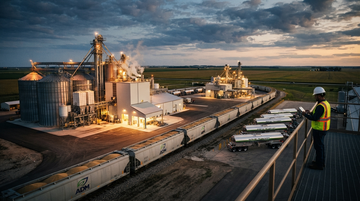
ADM’s latest guidance raise is being sold as “biofuels demand support.” But the more investable read is simpler: ADM is forecasting earnings improvement after U.S. RVO policy clarity, which implies the company is seeing less randomness in renewable-fuels economics than in prior years.
ADM raised 2026 adjusted EPS guidance
$4.15–$4.70
Raised from $3.60–$4.25 (company-reported guidance in Q1 2026 results release). Source: ADM IR press release (2026-05-05).
ADM’s 2025 revenue (FY)
$80.27B
Full-year revenue from income statement data. Source: financials tool.
ADM’s 2025 net income (FY)
$1.08B
Full-year net income from income statement data. Source: financials tool.
ADM’s 2025 free cash flow (FY)
$4.20B
Free cash flow derived in cash flow data. Source: financials tool.
Verified event
ADM raised 2026 adjusted EPS after it judged the biofuels backdrop to be “constructive”
On 2026-05-05, ADM reported Q1 2026 results and raised its full-year 2026 adjusted EPS range to $4.15–$4.70, up from the prior $3.60–$4.25. In its explanation, the company anchored the upgrade on the “sustainment of a constructive environment” after U.S. biofuels policy clarity and linked the improvement primarily to crushing and ethanol earnings.
What ADM said changed (load-bearing facts only)
New 2026 adjusted EPS guidance
$4.15–$4.70
ADM investor release; guidance raised.
Prior 2026 adjusted EPS guidance
$3.60–$4.25
ADM investor release; guidance originally issued earlier in 2026.
Why it raised guidance
Biofuels policy clarity; “constructive” environment
Company-reported; explicitly tied to crushing and ethanol earnings improvement.
Mechanism
Biofuels clarity flows through feedstock demand first, then through crushers and ethanol margins
If biofuels demand is structurally supported (not just spot-driven), the first observable transmission is usually stronger demand signals for corn and oilseed feedstocks feeding renewable fuels. ADM’s own segment narrative and 10-Q language reinforce that the company is modeling improved economics in its crushing/ethanol chain—i.e., feedstock procurement economics and processing spreads move together when RVO/blending economics look steadier.
- ADM’s Q1 2026 release ties the guidance raise to a constructive biofuels environment after U.S. policy clarity, with earnings improvement primarily in crushing and ethanol businesses.
- ADM’s 2026-03-31 Form 10-Q explicitly discusses “positive Renewable Volume Obligations (RVO) clarity” in North America ethanol context.
- ADM warns that renewable-fuel markets remain exposed to regulatory timing/substance and credit/blending-economics volatility—so the upside is contingent, not guaranteed.
Supply-chain mapping
Who captures value across the profit chain: crushers/ethanol processors vs farmers vs downstream fuel blenders
A useful way to separate “commodity-processing strength” from “biofuel demand tailwind” is to map value-capture points. In ADM’s case, the company is both a processor and a participant in renewable-fuels economics, so it can benefit from steadier spreads—but the same policy clarity also increases how much incremental crushing capacity must be supported by upstream acreage.
| Supply-chain node | Economic variable that moves | ADM evidence in this session | Investor implication |
|---|---|---|---|
| Farmers / feedstock acreage | Demand signal and basis (indirectly via volumes/blending economics) | ADM later quantifies feedstock demand uplift tied to additional crush capacity. | If policy clarity persists, acreage incentives can strengthen; weakness can return if RVO/credit economics wobble. |
| Crushers / oilseed processors | Crush margins/spreads and utilization | Guidance raise cites earnings improvement primarily in crushing and ethanol businesses. | Cleaner renewable-fuels economics should lift utilization and tighten margin dispersion—not necessarily just raise average spreads. |
| Ethanol refiners / carbohydrate processors | Ethanol margin support via RVO clarity and blending environment | 10-Q references positive RVO clarity amid tightened ethanol stocks and strong export demand context. | Ethanol economics become a more durable contributor when blending obligations appear more stable. |
| Downstream fuel blenders / refiners | Cost of compliance (feedstock & blend economics) and crack/ethanol demand synchronization | Geared to RVO-driven blending requirements (policy-driven demand). | Blenders/refiners can benefit if compliance costs stabilize; they also face policy/regulatory change risk. |
Proof via capacity
ADM is translating guidance confidence into real crush-capacity investment
Guidance is a forecast; capex is the commitment. On 2026-07-30, ADM announced it would expand North America crush capacity, framing it around strong biofuel demand supported by U.S. biofuels policy.
Incremental annual oilseed crush unlocked
~700k metric tons
Company press release; tied to additional annual crush capacity.
Additional demand for American farmers
>25M bushels
Company press release; explicitly links capacity to upstream feedstock demand.
Target completion window
mid–late 2028 (plus early 2029)
Multiple facilities; company press release includes facility-by-facility expected completions.
Earnings quality lens (listed fundamentals)
ADM’s margins can look “less cyclical” when cash flow and operating profit hold through the policy window
To avoid overfitting the guidance raise, compare it to the company’s recent fundamentals. Financials data shows ADM generated $80.27B of revenue in FY 2025 and $1.08B net income, with $4.20B free cash flow—i.e., the company has capacity to fund both shareholder returns and capex cycles when processing conditions are supportive.
| Fiscal year | Revenue | Net income | Free cash flow |
|---|---|---|---|
| 2025 | $80.27B | $1.08B | $4.20B |
| 2024 | $85.53B | $1.78B | $1.23B |
| 2023 | $93.94B | $3.48B | $2.97B |
- Revenue and net income have varied across 2023–2025, consistent with commodity-processing cycle effects.
- Despite that volatility, ADM’s 2025 free cash flow remains strong enough to support expansion plans without assuming instant margin maxima.
- This matters because the guidance raise is a forecast of higher 2026 earnings; the market will want to know whether the company can monetize that forecast into cash—recent cash generation suggests it can.
Research angles answered
Five investable angles this event clarifies (and two it can’t)
- Separates forecast-driven biofuel demand support from generic grain-trading noise by tying the raise directly to U.S. biofuels policy clarity and to crushing/ethanol earnings.
- Identifies the most direct value-capture links: RVO/blending economics → feedstock demand → crusher utilization and ethanol margins.
- Connects “forecast confidence” to “capacity commitment” via ~700,000 metric tons of incremental crush capacity and >25M bushels of additional demand for U.S. farmers.
- Highlights that ADM’s upside is conditional: its own filings emphasize policy/regulatory and credit/timing volatility as a key risk.
- Offers a practical “watch list” framework: if RVO/credit economics remain constructive, the chain can stay tight; if not, the cycle reasserts itself.
Two questions remain not disclosed in the sources opened here: (1) the exact forecasted crush margin or ethanol margin spread change implied by the guidance raise, because ADM’s press release provides directional rationale rather than a quantified crush/ethanol spread table; (2) the specific share of guidance uplift attributable to each feedstock (corn vs soymeal/oil) because the materials provided here don’t break out that mix quantitatively.
Horizons
Short-term vs long-term: what moves first after a guidance raise tied to RVO clarity
In the short term (days to quarters), markets typically reprices on: (a) updated EPS/earnings expectations and (b) near-term utilization/margin confidence in crushers and ethanol. In the long term (1–3 years), the question becomes whether incremental capacity and policy-backed blending obligations sustainably support utilization and spreads without renewed regulatory disruption.
- Short term: traders focus on whether constructive policy clarity sustains crushing/ethanol economics and whether guidance implies incremental stability vs prior volatility.
- Short term: investors should watch for competitor read-throughs (e.g., peers raising outlook on similar oilseed/crush/biofuels strength), which would validate the “structural-ish” margin-cycle claim.
- Long term: capex execution and ramp timing will matter as much as policy—capacity that comes online into a weaker RVO/blending environment can disappoint.
Related listed stocks (evidence-backed linkages)
- ADM raised 2026 adjusted EPS guidance to $4.15–$4.70, citing a constructive post-policy biofuels environment.
- ADM plans to unlock ~700,000 metric tons of extra North America crush capacity, implying stronger utilization if RVO economics hold.
- ADM guidance remains exposed to RVO/Section 45Z timing and credit-blending volatility, which can reverse the margin-cycle compression.
- If RVO clarity tightens ethanol/crush spreads broadly, Bunge is likely to see utilization and crush-margin confidence improve alongside ADM (watch peer-quarter disclosures).
- If regulatory volatility returns, both companies’ oilseed-crush economics can deviate rapidly from guidance expectations—so peer revisions will be the signal.
- ADM’s crush expansion references a Green Bison joint venture operational optimization at Spiritwood that sits within the Marathon Petroleum ecosystem, so policy-backed renewables could support downstream renewable fuel blending economics (indirect linkage).
- However, Marathon Petroleum’s downstream margins can still move with crude/refining spreads even if biofuel policy stays constructive.
- If renewable-fuels policy clarity supports incremental crush demand and acreage, CF could benefit indirectly from higher fertilizer demand intensity (watch farm economics and utilization).
- But if blending economics deteriorate, acreage incentives can fade quickly, making this a watch rather than a conviction trade.