%22%2F%3E%0A%20%20%3Ccircle%20cx%3D%22220%22%20cy%3D%22150%22%20r%3D%22180%22%20fill%3D%22%2322d3ee%22%20fill-opacity%3D%220.12%22%2F%3E%0A%20%20%3Ccircle%20cx%3D%221010%22%20cy%3D%22130%22%20r%3D%22220%22%20fill%3D%22%2338bdf8%22%20fill-opacity%3D%220.08%22%2F%3E%0A%20%20%3Ccircle%20cx%3D%22920%22%20cy%3D%22520%22%20r%3D%22170%22%20fill%3D%22%2322d3ee%22%20fill-opacity%3D%220.06%22%2F%3E%0A%20%20%3Cpath%20d%3D%22M140%20430h920%22%20stroke%3D%22url(%23line)%22%20stroke-width%3D%2212%22%20stroke-linecap%3D%22round%22%2F%3E%0A%20%20%3Cpath%20d%3D%22M220%20360c120-150%20260-220%20380-220s260%2070%20380%20220%22%20fill%3D%22none%22%20stroke%3D%22%2367e8f9%22%20stroke-opacity%3D%220.5%22%20stroke-width%3D%2216%22%20stroke-linecap%3D%22round%22%20stroke-linejoin%3D%22round%22%2F%3E%0A%20%20%3Cpath%20d%3D%22M300%20398h600%22%20stroke%3D%22%2394a3b8%22%20stroke-opacity%3D%220.24%22%20stroke-width%3D%228%22%20stroke-linecap%3D%22round%22%2F%3E%0A%20%20%3Ctext%20x%3D%22220%22%20y%3D%22510%22%20fill%3D%22%23e2e8f0%22%20fill-opacity%3D%220.7%22%20font-family%3D%22Arial%2C%20Helvetica%2C%20sans-serif%22%20font-size%3D%2238%22%20letter-spacing%3D%228%22%3EINSIGHTS%3C%2Ftext%3E%0A%3C%2Fsvg%3E)
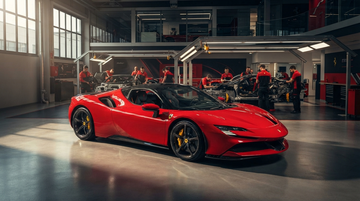
Ferrari lifted 2026 guidance on July 30 after a Q2 beat that arrived while the rest of luxury is still digesting the Strait of Hormuz shock. Net revenues of €1,938M were up 8% reported and 11% at constant currency, EBITDA reached €755M at a 39.0% margin (+7% reported, +12% cc), and adjusted EPS of €2.62 cleared the €2.50 consensus. The raise takes full-year revenue to ~€7.60B (from ~€7.50B), adjusted EBITDA to ≥€2.97B (from ≥€2.93B), and adjusted EPS to ≥€9.68 (from ≥€9.45) — a mid-single-digit upgrade across the P&L that management attributes to richer personalization mix and lower FX headwinds.
Q2 2026 net revenues
€1,938M
+8% reported, +11% cc; vs €1,880M consensus
Q2 2026 EBITDA
€755M
39.0% margin, +7% reported / +12% cc
Q2 2026 adj. EPS
€2.62
vs €2.50 consensus; +5% beat
FY26 revenue guide (new)
~€7.60B
raised from ~€7.50B
FY26 adj. EPS guide (new)
≥€9.68
raised from ≥€9.45 (+2.4%)
Order book coverage
Full 2027
F80 sold out; Luce EV ~500-unit 2026 allocation sold in 2 months
The Q2 mix did the heavy lifting — Americas unit volume actually fell
The cleanest read of the quarter is what was missing, not what was added. Ferrari shipped 3,366 cars in Q2, and management told analysts the Americas was down on the quarter because of model changeovers. That makes the +11% constant-currency revenue growth a pure ASP/mix story: personalizations accounted for roughly 20% of cars-and-spare-parts revenue, the F80 supercar (€3.6M list) is shipping into the order book, and the new Luce EV allocation is sold through 2026 before a single customer car has been delivered. In other words, Ferrari printed revenue growth in a quarter where its biggest region by historical volume went backwards — exactly the print investors needed to see.
- Q2 2026 shipments 3,366 units; Americas share of 1H 2026 shipments was 27% (vs 30% in Q1), with the Q2 step-down explicitly attributed to model changeovers.
- Personalizations drove ~20% of cars-and-spare-parts revenue; mix enrichment plus lower FX headwinds are the two items management cited for the guidance upgrade.
- Industrial free cash flow of €276M in Q2 was up 39% YoY, and Q2 EBIT margin of 31.2% (+10% YoY) is the operating proof point.
- Luce EV: ~500-unit 2026 allocation filled within two months of launch, with China-led demand pushing incremental orders into 2027; customer deliveries start October.
This is the cleanest luxury margin in Q2 2026 — by a wide gap
- Ferrari Q2 EBITDA margin: 39.0% — and that's before the F80 cost amortization runs off and Luce deliveries start in 4Q.
- Mass-luxury fashion prints this quarter are decelerating: LVMH Fashion & Leather Goods +1% organic (first positive quarter in seven), with the Americas the only growth region (+6% reported) but at low single-digits at group level.
- Hermès Q2 sales +6.7% at constant currency (€4.1B), Americas double-digit; Kering/Gucci +2% on the quarter, sending the stock up ~14% in a day on the US read-through.
- Bottom-quintile Tapestry is showing the opposite signal: revenue running ~$7.85B TTM with margins compressed under SG&A pressure, illustrating why ultra-luxury is the cleanest slice of the sector right now.
| Company | Q2 2026 rev growth | EBITDA / op. margin | FY26 read |
|---|---|---|---|
| Ferrari | +11% cc (€1,938M) | 39.0% EBITDA / 31.2% EBIT | Guidance raised; FY26 rev ~€7.60B |
| LVMH fashion & leather goods | +1% organic | Op. margin 22.5% group H1 | First positive org. growth in 7 qtrs |
| Hermès | +6.7% cc (€4.1B) | Group H1 op. margin maintained | Americas double-digit growth |
| Kering / Gucci | +2% (Kering comp.) | Trading update; margin recovery | +14% one-day stock move on US beat |
| Brunello Cucinelli H1 2026 | +9.5% reported / ~+13% cc | Americas +20.6% cc (€278.7M) | FY26 guidance raised again |
| Tapestry TTM | Flat-to-down SG&A pressure | Margin compressed under Coach capex | Capri deal legacy dragging multiples |
The print matters not because Ferrari beat by a few percent — they usually do — but because it did so while its biggest region went backwards on volume. That is the signature of demand-side pricing power rather than restock dynamics: when a company can lose unit share in its largest market and still print +11% cc revenue growth at a 39% EBITDA margin, it is selling scarcity, not cars.
Why US ultra-luxury is decoupling from the global luxury slowdown
The Iran war and the closure of the Strait of Hormuz (March 4, 2026) pushed Brent above $120 and lifted war-risk insurance across the Gulf. That shock has been net-negative for European luxury demand: LVMH flagged a hit to its overall business and Hermès cited margin pressure from energy-cost pass-through. Against that, US Q2 prints from LVMH (+6% reported), Hermès (double-digit Americas), and Kering/Gucci show the offset. Ferrari is the cleanest, highest-margin manifestation of that same offset — and crucially, it's a US super-rich buyer (per management commentary on personalization mix) doing the lifting, not a tourist flow. The Luce EV sell-out before deliveries begin in October is the second datapoint in two weeks that the high-end US buyer has detached from macro.
- Hormuz closure on 4 March 2026 pushed Brent past $120; the oil shock has flowed through European luxury cost lines but not into top-of-pyramid US demand.
- LVMH Q2 US +6% reported (vs -3% in Q1, -11% China in Q1) — the inflection is the US, not Europe or China.
- Pre-sold order book (full 2027 coverage) insulates FY26 revenue from any near-term demand wobble in any single region, including Americas.
- Ferrari's US clientele skews toward personalization-driven buyers (€100K+ on top of list) — this cohort's wealth has been insulated by the equity rally, while European luxury's middle-tier tourist buyer is exposed to energy costs and FX.
Upstream: the components flywheel still feeds the machine
If Ferrari revenue is up 11% cc and the F80 is sold out, the suppliers of high-performance braking, tires, and suspension ride the same wave. Brembo renewed its full braking-system partnership with Ferrari for F1 and Hypercars in February 2026 and completed its $405M acquisition of Öhlins Racing (a Ferrari suspension supplier), expanding its content per vehicle. Tires go through Pirelli's Prestige Selection program, which is structured around homologated fitments per model — so each new F80, 12Cilindri, and Luce delivery pulls Pirelli revenue with it. The asymmetry is that Brembo and Pirelli capture content at every car delivered, including changeover-down quarters like Q2 Americas, because Ferrari ships against its order book, not against current-quarter demand.
- Brembo renewed full braking-system deal with Ferrari in Feb 2026 (F1 + Hypercars); Öhlins acquisition expands content per vehicle.
- Pirelli Prestige Selection is model-homologated — each F80, 12Cilindri, Luce delivery pulls tire revenue regardless of region.
- Q2 industrial FCF of €276M (+39% YoY) at Ferrari means supplier payment cycles remain healthy — the components flow isn't a receivables risk.
- Even when Americas unit volume falls on changeovers, supplier revenue holds because the build schedule against the order book is fixed.
Competitive read: ultra-luxury is bifurcating inside the sector
Q2 2026 is the quarter where ultra-luxury and mass-luxury visibly diverged. At the top, Ferrari printed +11% cc revenue and a 39.0% EBITDA margin. Brunello Cucinelli raised its full-year guidance again, with Americas H1 2026 revenue up 20.6% at constant currency. Hermès hit +6.7% cc. At the bottom, Tapestry is still absorbing Capri deal overhead and trading at ~30x trailing EBITDA, while Kering's broader portfolio (ex-Gucci) remains in negative comps. The spread between Ferrari's Q2 EBITDA margin (39%) and Tapestry's TTM EBITDA margin (~14%) is the cleanest evidence of where pricing power is concentrated.
- Ferrari (Ferrari N.V., NYSE:RACE): FY26 revenue raised to ~€7.60B; pre-sold through 2027; F80 + Luce sold out.
- Brunello Cucinelli: H1 2026 Americas revenue +20.6% cc; FY26 guidance raised; 10% growth target held into 2027.
- Hermès (RMS.PA): Q2 sales +6.7% cc; Americas double-digit; H1 operating margin maintained.
- Kering (KER.PA) / Gucci: Q2 +2% on US beat; stock +14% in a day; broader portfolio still in negative comps.
- Aston Martin H1 2026: revenue +38% to £629M on Valhalla ramp; gross margin to 34% (from 28%); still loss-making, kept guidance.
Horizons: what moves first, what compounds for three years
Short-term (days–quarters). Three near-term catalysts drive the next leg. First, Luce EV deliveries start in October 2026 — every unit is at ~€550K+ list with personalization on top, and the 2026 allocation is already sold, so the launch quarter is a pure margin/risk event rather than a demand event. Second, the Q3 print (early November) will tell us whether the Q2 Americas softness was a model-changeover artifact (one quarter) or something stickier; management has framed it as the former. Third, peer prints in the same window — particularly Brunello Cucinelli and Hermès — will validate or break the US-decoupling thesis; the 4Q festive-quarter data will be the cleanest read.
- Oct 2026: Luce EV deliveries begin — sold-out allocation means launch-quarter risk is margin/cost, not demand.
- Early Nov 2026: Q3 print — key read on whether Americas softness was a one-quarter changeover or a real demand wobble.
- 1H 2027: order book rolls into delivery slots; F80 and 12Cilindri Manuale both fully sold — visibility into FY27 revenue is already de-risked.
- Risk: any further Iran/oil shock that hits equity wealth — Ferrari's US buyer cohort is more exposed to Nasdaq drawdown than to consumer-credit stress.
Long-term (1–3 years). Three structural forces compound. The 2026 business plan called for ≥€2.22B adjusted operating profit and ~30% adj. EBIT margin by 2026; the Q2 print puts FY26 tracking ahead of that, one full year early. Personalization, which is now ~20% of cars-and-spare-parts revenue, is structurally higher-margin than base ASP — every quarter it grows, group EBIT margin compounds. And the Luce EV, despite the design controversy, sold its first-year allocation in two months, which means Ferrari's electrification optionality is real even if the design debate is unresolved. The bear case requires either a Nasdaq drawdown that hits the personalization cohort or a recession that closes the order book; the bull case is that Ferrari ends FY26 ahead of its 2026 plan, holds the 39% EBITDA margin, and starts FY27 with another sold-out year. The Q2 print makes the bull case the base case.
The valuation re-underwriting
At the new €9.68 adj. EPS, Ferrari trades at ~35x forward earnings on consensus prior to the upgrade — not cheap, but the print just lifted the numerator by ~2.4%. More importantly, the multiple should now be anchored to the F80/Luce contribution cycle and the >20% personalization mix, both of which support the 39% EBITDA margin holding through 2027. The structural read is that this is a scarcity-asset compounder priced like a luxury peer — but Q2 just demonstrated it behaves like one only on the demand side, not on the margin side.
Q2 2026 EBITDA margin: Ferrari vs luxury peer set
EBITDA margin (or operating margin where EBITDA not disclosed)
Unit: %
Ferrari Q2 EBITDA
Up 12% cc; raised guidance
39%
LVMH group H1 op. margin
Fashion +1% organic first in 7 qtrs
22.5%
Hermès H1 op. margin
Approx; +6.7% cc Q2
31%
Tapestry TTM EBITDA
Margin compressed post-Capri
14.2%
Aston Martin H1 GP margin
Loss-making; Valhalla ramp
34%
Investable read-throughs from Ferrari's Q2 print
- FY26 revenue raised to ~€7.60B (+1.3%) and adj. EPS to ≥€9.68 (+2.4%); Q2 EBITDA margin held at 39% even as Americas units fell — proves scarcity-pricing carries the P&L through changeover quarters.
- Order book fully covers 2027 and F80/Luce allocations are sold out — removes the FY27 top-line risk for the next 12 months, making the 35x forward multiple an asset, not a liability.
- Luce EV deliveries start October 2026 against a sold-out ~500-unit allocation — this is the single biggest 2H 2026 catalyst, and personalization mix (≈20% of cars revenue) compounds margins as Luce ASPs ramp.
- H1 2026 Americas revenue +20.6% cc (€278.7M); FY26 guidance raised; management reaffirmed 10% growth target into 2027 — the cleanest open-market confirmation of the ultra-luxury US decoupling thesis.
- Q1 2026 Americas revenue +20.3% cc with retail +20.1% — double-digit growth in the region where LVMH/Hermès see 'high single-digit' to 'double-digit' growth, validating the top-of-pyramid US bid.
- Full braking-system renewal with Ferrari in Feb 2026 plus $405M Öhlins acquisition — content per Ferrari vehicle structurally rises as F80 (track-spec braking) and Luce (EV regen + friction) deliver through 2027.
- Q2 Ferrari industrial FCF +39% YoY means supplier payment cycles stay healthy through the changeover-air pocket that hit Q2 Americas unit volumes — credit risk on the components book is low.
- H1 2026 revenue +38% to £629M on Valhalla ramp, gross margin to 34% from 28% — shows the ultra-luxury demand backdrop is real, but kept guidance despite a wider-than-expected Q2 loss.
- Mercedes-Benz technology alliance + Valhalla deliveries pull Aston into the same scarcity-pricing story as Ferrari, but net debt/EBITDA of ~109x and negative FCF keep the equity story levered to execution, not just demand.
- TTM EBITDA margin ~14% versus Ferrari's 39% — the gap is widening inside the same sector as ultra-luxury demand decouples upward and mass-luxury SG&A stays heavy.
- Capri deal legacy continues to compress margins; ~30x trailing EBITDA offers no margin-of-safety against a Q3 print where mass-luxury demand softens while ultra-luxury peers print double-digit growth.