%22%2F%3E%0A%20%20%3Ccircle%20cx%3D%22220%22%20cy%3D%22150%22%20r%3D%22180%22%20fill%3D%22%2322d3ee%22%20fill-opacity%3D%220.12%22%2F%3E%0A%20%20%3Ccircle%20cx%3D%221010%22%20cy%3D%22130%22%20r%3D%22220%22%20fill%3D%22%2338bdf8%22%20fill-opacity%3D%220.08%22%2F%3E%0A%20%20%3Ccircle%20cx%3D%22920%22%20cy%3D%22520%22%20r%3D%22170%22%20fill%3D%22%2322d3ee%22%20fill-opacity%3D%220.06%22%2F%3E%0A%20%20%3Cpath%20d%3D%22M140%20430h920%22%20stroke%3D%22url(%23line)%22%20stroke-width%3D%2212%22%20stroke-linecap%3D%22round%22%2F%3E%0A%20%20%3Cpath%20d%3D%22M220%20360c120-150%20260-220%20380-220s260%2070%20380%20220%22%20fill%3D%22none%22%20stroke%3D%22%2367e8f9%22%20stroke-opacity%3D%220.5%22%20stroke-width%3D%2216%22%20stroke-linecap%3D%22round%22%20stroke-linejoin%3D%22round%22%2F%3E%0A%20%20%3Cpath%20d%3D%22M300%20398h600%22%20stroke%3D%22%2394a3b8%22%20stroke-opacity%3D%220.24%22%20stroke-width%3D%228%22%20stroke-linecap%3D%22round%22%2F%3E%0A%20%20%3Ctext%20x%3D%22220%22%20y%3D%22510%22%20fill%3D%22%23e2e8f0%22%20fill-opacity%3D%220.7%22%20font-family%3D%22Arial%2C%20Helvetica%2C%20sans-serif%22%20font-size%3D%2238%22%20letter-spacing%3D%228%22%3EINSIGHTS%3C%2Ftext%3E%0A%3C%2Fsvg%3E)
Earnings / Data centers / Cloud interconnection
The guide is “soft” on totals, but it’s also soft on the interconnection attribution investors want
Equinix issued its updated outlook with a clear top-line framework for Q3 2026, but it did not provide a Q3-specific interconnection revenue range alongside total company guidance. In practice, that means investors get a read on platform momentum, yet they don’t get a hard confirmation that the incremental AI buildout is flowing to interconnection at the same rate (or with the same pricing power) as the overall ecosystem.
Equinix Q3 2026 revenue guide (total company)
$2.525B–$2.575B
Company guidance; implies +9% to +11% YoY at midpoint on an as-reported basis
Equinix Q3 2026 Adjusted EBITDA guide (total company)
$1.275B–$1.315B
Margin guided at ~51% (company guidance)
What’s verified vs. what’s not disclosed
Verified: Q3 2026 total revenue range
Yes
Stated directly in Equinix’s Q2 2026 results release as the Q3 2026 outlook range
Verified: interconnection revenue range for Q3 2026
No
The release provided overall Q3 revenue / EBITDA ranges; interconnection was not given as a separate Q3 range in the opened primary excerpt
Analyst takeaway
Attribution risk
Lack of interconnection-specific underwriting can be consistent with steady platform demand—but it doesn’t prove incremental AI value is flowing to interconnection at the margin investors model
Mechanism
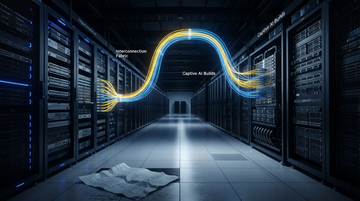
Interconnection can grow while pricing power fades if hyperscalers pull “fabric + networking” into captive demand
Equinix’s model depends on third parties needing low-latency connectivity across clouds, SaaS, and enterprise systems. But AI buildouts don’t only raise compute demand—they also increase the share of infrastructure spend that can be optimized internally by hyperscalers (especially when they expand their own GPU and AI-ready campus footprints and then connect workloads with private networking). The investment-relevant question is not whether interconnection demand exists—it’s whether the marginal AI dollar is “routed through” the interconnection REIT or is absorbed upstream by captive builds.
- Equinix’s disclosure supports that its interconnection engine is still scaling, but the Q3 guide itself doesn’t isolate interconnection upside separately (so investors must infer the AI-routing outcome from proxies).
- When hyperscalers internalize networking + integration spend, interconnection volume may still rise while incremental monetization per unit can soften (less outsourcing of network path design and fewer third-party “aggregation” services).
- This is why a “soft guide” can function as a warning: it can be consistent with growth, yet inconsistent with the high-conviction narrative that all AI value accrues to the interconnection layer.
Data anchors from recent interconnection performance
Interconnection momentum remains real—but it’s not the same thing as AI-captive leakage being absent
In the most recent quarter disclosures we opened, Equinix highlighted record interconnection net additions and provided interconnection revenue levels. Those facts matter for the baseline thesis (platform demand is intact). However, they do not answer the counterfactual investors care about: whether incremental AI-driven connectivity spend is increasingly being satisfied through hyperscaler-owned or hyperscaler-directed paths that reduce third-party interconnection revenue per incremental AI capacity.
| Metric | Latest quarter value | What it signals |
|---|---|---|
| Interconnection net adds | 9,700 net interconnections (Q2 2026) | Continued expansion of the platform’s connectivity footprint |
| Interconnection revenue | $453M (Q2 2026 services basis) | Interconnection is still a large, recurring revenue line |
| Interconnection revenue YoY (as stated in excerpt framing) | Up vs. $407M in Q2 2025 | Supports resilience through AI buildout cycles |
Full supply-chain view
How value might shift across the stack: from interconnection to hyperscaler-owned delivery and back again
A practical supply-chain chain looks like this: (1) AI GPU and accelerator capacity is built in data centers, (2) the workloads need private, predictable connectivity to clouds, data stores, and enterprise applications, and (3) operators monetize either through wholesale network services (interconnection ecosystems) or through integrated captive networking within hyperscaler campuses and partner programs.
If hyperscalers increase captive networking share, interconnection operators can still benefit from the existence of more AI-ready capacity they colocate on—but they may capture less of the incremental networking “integration” layer per added AI workload.
- Upstream (infrastructure): demand for interconnection grows with more deployed capacity, but the type of connectivity buyer shifts when hyperscalers favor private paths.
- Midstream (interconnection monetization): the interconnection REIT monetizes cross-cloud / cross-ecosystem routing, yet captive programs can reduce the number of third-party routing decisions exposed to the platform.
- Downstream (customer experience): enterprises still need predictable AI workload connectivity; when hyperscalers internalize routing, customers can still be served—just via different bill-of-materials and contract structures.
What investors should watch next
Near-term: demand doesn’t break, but attribution will—watch interconnection guidance granularity and booking mix
- In the next earnings release, look for whether Equinix provides a Q3/Q4 interconnection-specific guidance proxy (range, growth rate, or explicit interconnection revenue drivers).
- Watch for whether management repeats “AI factory / AI-ready architecture” language while interconnection attribution metrics lag total guidance—if that happens, the market may re-rate the incremental AI value flow.
- Track the gap between total company growth and interconnection-specific monetization signals (e.g., how interconnection revenue changes relative to total revenues over consecutive quarters).
This isn’t a claim that Equinix is losing interconnection demand. It’s a narrower claim: the market may be paying for an AI buildout “tax” that interconnection REITs might not fully collect if hyperscalers keep integrating more of the fabric and orchestration inside their own spend.
Fundamentals cross-check
Equinix’s financial base supports the platform story—so the debate is about incremental mix, not survival
Equinix quarterly revenue trend (recent quarters from data tools)
Used to contextualize whether the company’s total growth momentum is consistent with an “interconnection value leak” argument.
Unit: USD
Q1 2025
2,225,000,000
Q2 2025
2,256,000,000
Q3 2025
2,316,000,000
Q4 2025
2,442,000,000
Total revenue (Q4 2025)
$2.442B
Quarterly revenue from income statement data tool
Total revenue (Q3 2025)
$2.316B
Quarterly revenue from income statement data tool
Listed supply-chain links the market typically pairs with interconnection REITs
- Equinix guides $2.525B–$2.575B revenue in Q3 2026, so the platform holds up near-term even if interconnection attribution is unclear.
- A future quarter-by-quarter separation between total revenue and interconnection-specific drivers would confirm or refute AI value leakage into captive hyperscaler spend.