%22%2F%3E%0A%20%20%3Ccircle%20cx%3D%22220%22%20cy%3D%22150%22%20r%3D%22180%22%20fill%3D%22%2322d3ee%22%20fill-opacity%3D%220.12%22%2F%3E%0A%20%20%3Ccircle%20cx%3D%221010%22%20cy%3D%22130%22%20r%3D%22220%22%20fill%3D%22%2338bdf8%22%20fill-opacity%3D%220.08%22%2F%3E%0A%20%20%3Ccircle%20cx%3D%22920%22%20cy%3D%22520%22%20r%3D%22170%22%20fill%3D%22%2322d3ee%22%20fill-opacity%3D%220.06%22%2F%3E%0A%20%20%3Cpath%20d%3D%22M140%20430h920%22%20stroke%3D%22url(%23line)%22%20stroke-width%3D%2212%22%20stroke-linecap%3D%22round%22%2F%3E%0A%20%20%3Cpath%20d%3D%22M220%20360c120-150%20260-220%20380-220s260%2070%20380%20220%22%20fill%3D%22none%22%20stroke%3D%22%2367e8f9%22%20stroke-opacity%3D%220.5%22%20stroke-width%3D%2216%22%20stroke-linecap%3D%22round%22%20stroke-linejoin%3D%22round%22%2F%3E%0A%20%20%3Cpath%20d%3D%22M300%20398h600%22%20stroke%3D%22%2394a3b8%22%20stroke-opacity%3D%220.24%22%20stroke-width%3D%228%22%20stroke-linecap%3D%22round%22%2F%3E%0A%20%20%3Ctext%20x%3D%22220%22%20y%3D%22510%22%20fill%3D%22%23e2e8f0%22%20fill-opacity%3D%220.7%22%20font-family%3D%22Arial%2C%20Helvetica%2C%20sans-serif%22%20font-size%3D%2238%22%20letter-spacing%3D%228%22%3EINSIGHTS%3C%2Ftext%3E%0A%3C%2Fsvg%3E)
This article focuses on one question: when a frontier AI lab signs up for next-gen compute before its model or product is ready, what does that do to the supply chain—and to how investors should value the compute platform provider?
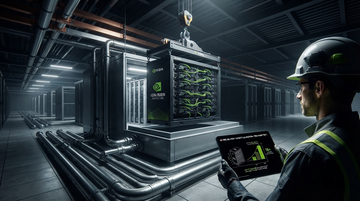
Nvidia and Ilya Sutskever’s Safe Superintelligence (SSI) announced a long-term strategic partnership centered on access to the next-generation Nvidia Vera Rubin platform, with SSI stating the partnership should increase its compute by about an order of magnitude. That single sentence is the whole mechanism: it converts an otherwise speculative “frontier training demand will exist” narrative into a (nominally) contracted, dated capacity commitment—even though the model isn’t shipping yet.
1) Verified event + what’s actually promised
SSI’s announcement is a compute-access commitment, not a research caption
Nvidia and SSI announced a long-term strategic partnership under which Nvidia will invest in SSI and provide SSI access to Nvidia’s next-generation Vera Rubin compute platform. SSI stated this access should allow it to increase its compute by about an order of magnitude.
Compute scaling SSI expects
~10×
SSI said the Vera Rubin access should increase its compute by about an order of magnitude
Partnership structure
Long-term
Nvidia described it as a long-term strategic partnership; access is tied to next-generation Vera Rubin systems
2) Platform timing and why it matters
Rubin-based products aren’t shipping in 2025—so this is a forward lock-in
Nvidia previously positioned the Vera Rubin platform as entering partner availability in the second half of 2026. That means SSI’s commitment is a pre-model, forward-looking allocation rather than a “current training pipeline upgrade.” In practice, that turns the partnership into an early demand datapoint for liquid-cooled rack-scale capacity, interconnect, power, and datacenter build-out required to actually run frontier training workloads.
What the supply chain must already have ready (to make SSI’s promise real)
Compute hardware
Rubin system availability in 2H 2026
Partner availability window is tied to Rubin platform rollout
Data-center build-out
Rack-scale, liquid-cooled deployment readiness
Rubin is positioned as a rack-scale platform; real capacity needs facility readiness
Interconnect + networking
NVLink-class scaling
Rubin platform is built around high-bandwidth interconnect scaling
Power + cooling + operations
AI factory-level utility capacity
Frontier compute scaling implies material increases in power and thermal management
3) The “order book” analogy for a private frontier lab
This is the AI-lab version of a contracted order book—capex comes first
Public-market investors often try to infer whether AI demand is real from earnings guidance and capex commentary. But this partnership creates a different kind of evidence: a private frontier lab publicly stating it will scale compute by ~10× using a specific next-gen platform.
Why that’s different from a typical “we’re excited to partner” statement: the lab’s internal scaling plan is a hard dependency. If compute access increases materially, you have to assume either (1) the lab is effectively buying/allocating compute capacity in a way that can be serviced by Rubin deployments, or (2) Nvidia is underwriting capacity delivery via investment and access commitments.
Either way, it strengthens the causal chain between (a) platform rollout and (b) downstream capital spending that data centers and component suppliers must make to support training-class workloads.
- Converts frontier demand from forecast to a dated capacity dependency because the compute increase is tied to a named next-gen platform.
- Pulls forward supply-chain readiness into 2H 2026 since the lab’s scaling goal needs Rubin deployments to be available for utilization.
- Raises the probability that “AI factory” capex is not just retail/consumer inference because frontier labs train at very different utilization patterns than typical deployed inference fleets.
4) Full supply-chain view: upstream vs downstream transmission
The partnership tightens multiple bottlenecks at once: GPUs, liquid cooling, power, and memory
To translate SSI’s “~10× compute” into real-world effects, you have to think in layers.
Upstream, Nvidia’s platform rollout implies demand for the underlying compute stack. Downstream, SSI’s frontier training workload implies higher utilization of AI-factory infrastructure: liquid cooling, power delivery, rack-scale integration, and fast networking to move data and synchronize training.
Finally, training-class scaling usually runs into memory/bandwidth pressure. Even without specific bill-of-materials published in the partnership announcement, the implication is structural: next-gen training capacity requires the entire system to scale, not just the GPU.
| Layer | What must happen | Why the SSI commitment increases confidence | What to watch next |
|---|---|---|---|
| GPU/platform supply | Rubin systems must be available for partner deployment | SSI is targeting ~10× compute increase tied to Rubin access | Partner availability timing and utilization announcements |
| Datacenter infrastructure | AI-factory power + liquid cooling readiness | Training-class scaling requires facility-level capacity, not just chips | Rack-scale deployment capacity expansion |
| Interconnect + networking | High-bandwidth fabrics to scale training | Rubin platform is positioned as a unified system | Reports of datacenter network provisioning for Rubin-era training |
| Memory and bandwidth | System-level bandwidth must keep pace with training | Frontier training at ~10× compute scaling amplifies memory pressure | Memory vendor guidance on AI-factory training demand |
5) What investors should infer about Nvidia’s forward demand
Treat this as “capacity pull” before “product pull”—it changes the shape of demand
The most actionable inference is not qualitative excitement. It’s that Nvidia’s customer pipeline is becoming more observable in a training-relevant way.
If you’re valuing Nvidia with a model that treats demand as arriving only when product revenue is visible, you underweight how fast contracted capacity can form before commercialization. The SSI partnership is consistent with a strategy where Nvidia invests alongside major frontier labs and uses Rubin access as the delivery mechanism.
Quantitatively, the partnership doesn’t yet give a dollar value for SSI’s contracted hours, and the open NVIDIA announcement copy could not be fully retrieved in this session due to access restrictions. So the “investor math” here stays at mechanism-level unless and until the exact investment amount and compute-hours schedule are disclosed in accessible primary text.
NVIDIA's capex intensity is already structurally high—Rubin-era demand must keep showing up
Capex as a fraction of operating cash flow (recent annual datapoints from data tools). This matters because contracted training demand will eventually show in supply chain investment intensity, not just product shipments.
Unit: ratio (capex / operating cash flow)
FY2024 capex / operating cash flow
0
FY2025 capex / operating cash flow
0.1
- Implied demand visibility arrives through partnerships, not just earnings guidance, because the lab commits to a named next-gen platform and a quantified compute scaling goal (~10×).
- Investment intensity matters because it determines how fast Rubin capacity can be delivered—and Nvidia’s recent cash-flow metrics show capex is a recurring driver.
6) Horizons and what would falsify the thesis
Short-term: signals in partnerships; Long-term: proof in utilization and system-level constraints
- Short-term (days–quarters): watch for follow-on announcements from additional frontier labs and datacenter partners confirming Rubin availability timelines; lack of follow-through weakens the “capacity pull” read.
- Short-term: watch Nvidia’s commentary for any hint that contracted frontier demand is accelerating system shipment plans rather than just strategic “access.”
- Long-term (1–3 years): the thesis strengthens if utilization and deployments ramp with measurable training-class capacity; it weakens if the industry focus shifts back toward inference-only deployments.
- Long-term: the thesis is also falsified if power/cooling or memory bottlenecks prevent training-class scaling even when compute access is contracted.
7) Actionable conclusion (the thesis in one chain)
SSI’s Rubin access turns Nvidia’s frontier platform into a contracted capacity story
Here is the causal chain investors should carry forward.
1) The partnership states SSI gets access to Nvidia’s next-gen Vera Rubin platform and expects ~10× compute scaling. 2) Because Rubin partner availability is positioned for 2H 2026, this is pre-model, forward capacity lock-in—not just near-term infrastructure spending. 3) That makes demand more “order book-like” at the training-capacity layer, tightening the timeline between platform rollout and AI-factory capex/utilization. 4) Therefore, valuation should increasingly weight early capacity commitments (contracted access and investment) rather than only inference product revenue schedules.
What’s uncertain: the open primary announcement text (including exact investment amount and any compute-hours schedule) could not be fully retrieved in this session due to access restrictions, so the analysis stays at mechanism-level and avoids turning the partnership into unsupported dollar figures.
Listed names most likely to be pulled by Rubin-era contracted frontier demand
- benefits when contracted frontier demand tightens the Rubin capacity timeline because access commitments should translate into earlier system utilization once 2H 2026 availability arrives
- supports valuation when capex intensity stays consistent with platform ramp, with capex/operating-cash-flow rising from 0.038 in FY2024 to 0.050 in FY2025