%22%2F%3E%0A%20%20%3Ccircle%20cx%3D%22220%22%20cy%3D%22150%22%20r%3D%22180%22%20fill%3D%22%2322d3ee%22%20fill-opacity%3D%220.12%22%2F%3E%0A%20%20%3Ccircle%20cx%3D%221010%22%20cy%3D%22130%22%20r%3D%22220%22%20fill%3D%22%2338bdf8%22%20fill-opacity%3D%220.08%22%2F%3E%0A%20%20%3Ccircle%20cx%3D%22920%22%20cy%3D%22520%22%20r%3D%22170%22%20fill%3D%22%2322d3ee%22%20fill-opacity%3D%220.06%22%2F%3E%0A%20%20%3Cpath%20d%3D%22M140%20430h920%22%20stroke%3D%22url(%23line)%22%20stroke-width%3D%2212%22%20stroke-linecap%3D%22round%22%2F%3E%0A%20%20%3Cpath%20d%3D%22M220%20360c120-150%20260-220%20380-220s260%2070%20380%20220%22%20fill%3D%22none%22%20stroke%3D%22%2367e8f9%22%20stroke-opacity%3D%220.5%22%20stroke-width%3D%2216%22%20stroke-linecap%3D%22round%22%20stroke-linejoin%3D%22round%22%2F%3E%0A%20%20%3Cpath%20d%3D%22M300%20398h600%22%20stroke%3D%22%2394a3b8%22%20stroke-opacity%3D%220.24%22%20stroke-width%3D%228%22%20stroke-linecap%3D%22round%22%2F%3E%0A%20%20%3Ctext%20x%3D%22220%22%20y%3D%22510%22%20fill%3D%22%23e2e8f0%22%20fill-opacity%3D%220.7%22%20font-family%3D%22Arial%2C%20Helvetica%2C%20sans-serif%22%20font-size%3D%2238%22%20letter-spacing%3D%228%22%3EINSIGHTS%3C%2Ftext%3E%0A%3C%2Fsvg%3E)
What changed
The regulator is not just cooling speculation. It is admitting the AI chip trade had become structurally levered.
The crackdown matters because the product structure was amplifying the same chip names that powered the AI rally. SK Hynix and Samsung Electronics were not only operating businesses; they had become the underlying collateral for a retail leverage machine.
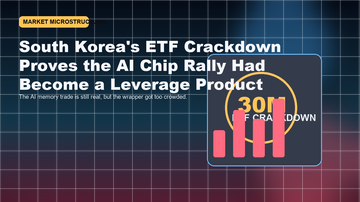
Once the market fell far enough to force a sidecar halt, the regulator's next move was predictable: suspend new single-stock leveraged ETF listings and triple the deposit floor to 30 million won. That is not an earnings tweak. That is a market microstructure intervention.
The deeper read is that the AI memory boom is still real, but the equity wrapper was getting ahead of the business cycle. When flows become the marginal buyer, the tape can detach from fundamentals even when the fundamental story is intact.
Why it matters
A leverage unwind in Seoul should be treated as a warning signal for every AI beta basket, not as a purely local event.
The Korean ETF crackdown matters to U.S. investors because it exposes the hidden second derivative inside the semiconductor trade. A memory cycle driven by HBM demand can still correct hard if retail leverage, options, and ETF rebalancing become the dominant marginal flow.
That is why the deposit floor matters. Raising the required cash buffer changes who can participate and how aggressively they can participate. It also slows the reflexive loop where a rising chip stock begets more leveraged ETF demand, which begets more buying, which begets more leverage.
The policy response also tells us something about valuation. If a market needs leverage to sustain the rally, the rally is already living on borrowed time, regardless of how strong the underlying AI capex story may look on slide decks.
South Korea AI trade stress stack
Key market-structure metrics behind the July 16 volatility spike.
Unit: percent / USD billions / won
KOSPI 1-day drop (%)
Risk reset
6.4
Deposit floor (M won)
New retail hurdle
30
Leveraged ETF AUM ($B)
Crowding proxy
12
Daily volume share (%)
Crowding proxy
35
Annualized volatility (%)
Positioning stress
80
SK Hynix move (%)
Most direct beta
-12
Read-through
The market is repricing the way AI exposure is delivered, not just the earnings line underneath it.
That is why this isn't just a Korea story. The same investor base that was piling into AI chips through leverage is also active in U.S. semis, memory ETFs, and data-center suppliers. The trade can de-rate even while the capex thesis survives.
The best way to frame this is simple: the operating businesses may still be in an AI supercycle, but the public-market expression of that supercycle just got less speculative and more expensive to carry.
| Move | Immediate effect | Second-order effect |
|---|---|---|
| Suspend new single-stock leveraged ETF listings | Slower retail speculation | Lower reflexive buying |
| Raise minimum deposit to 30M won | Higher cash hurdle | Less leverage per investor |
| Sidecar halt after 6.4% KOSPI drop | Temporary circuit-breaker | Signals crowding stress |
| Focus on SK Hynix and Samsung Electronics | Concentrated chip beta | AI trade becomes one crowded basket |