%22%2F%3E%0A%20%20%3Ccircle%20cx%3D%22220%22%20cy%3D%22150%22%20r%3D%22180%22%20fill%3D%22%2322d3ee%22%20fill-opacity%3D%220.12%22%2F%3E%0A%20%20%3Ccircle%20cx%3D%221010%22%20cy%3D%22130%22%20r%3D%22220%22%20fill%3D%22%2338bdf8%22%20fill-opacity%3D%220.08%22%2F%3E%0A%20%20%3Ccircle%20cx%3D%22920%22%20cy%3D%22520%22%20r%3D%22170%22%20fill%3D%22%2322d3ee%22%20fill-opacity%3D%220.06%22%2F%3E%0A%20%20%3Cpath%20d%3D%22M140%20430h920%22%20stroke%3D%22url(%23line)%22%20stroke-width%3D%2212%22%20stroke-linecap%3D%22round%22%2F%3E%0A%20%20%3Cpath%20d%3D%22M220%20360c120-150%20260-220%20380-220s260%2070%20380%20220%22%20fill%3D%22none%22%20stroke%3D%22%2367e8f9%22%20stroke-opacity%3D%220.5%22%20stroke-width%3D%2216%22%20stroke-linecap%3D%22round%22%20stroke-linejoin%3D%22round%22%2F%3E%0A%20%20%3Cpath%20d%3D%22M300%20398h600%22%20stroke%3D%22%2394a3b8%22%20stroke-opacity%3D%220.24%22%20stroke-width%3D%228%22%20stroke-linecap%3D%22round%22%2F%3E%0A%20%20%3Ctext%20x%3D%22220%22%20y%3D%22510%22%20fill%3D%22%23e2e8f0%22%20fill-opacity%3D%220.7%22%20font-family%3D%22Arial%2C%20Helvetica%2C%20sans-serif%22%20font-size%3D%2238%22%20letter-spacing%3D%228%22%3EINSIGHTS%3C%2Ftext%3E%0A%3C%2Fsvg%3E)
Bottom line
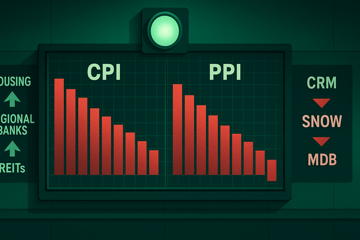
June 2026's -0.4% CPI and -0.3% PPI in the same week are the first real disinflation trade of the cycle - and the rate-sensitive rotation has a green light.
The BLS June 2026 CPI fell 0.4% MoM - the biggest monthly drop since April 2020 - bringing YoY inflation to 3.5%, per CNBC's Jeff Cox reporting on July 15, 2026. Core CPI slipped to 2.6% YoY after prices were unchanged for the month. The same day, the BLS reported the June PPI fell 0.3% MoM - vs the consensus of unchanged - with goods prices posting a 1.4% monthly decline (the biggest since July 2022) driven by a 12% gasoline drop. Core PPI rose just 0.2%, less than the 0.3% consensus, and core less trade services was up 0.1%. The May PPI reading was revised sharply lower, from an initially reported +1.1% to +0.6% - a meaningful data revision.
The reason the timing matters more than a normal inflation print is that both CPI and PPI printed declines in the same week, with the gasoline-led goods component doing most of the work. The disinflation regime is now visible across both the consumer-side and the producer-side gauges. The Fed's preferred inflation measure - the personal consumption expenditures price index - is due later this month. For May, the PCE index indicated headline inflation of 4.1% YoY and core of 3.4% - both likely to come down following this week's CPI/PPI releases. The market has already started to price the disinflation: stocks were higher Wednesday morning, with traders scaling back expectations for interest rate hikes, with September now a 50-50 bet according to the CME Group's FedWatch gauge.
For the rate-sensitive sectors (JPMorgan, Bank of America, Wells Fargo, D.R. Horton, Lennar, PulteGroup, Realty Income, Simon Property Group, IWM) and the AI-application cohort (Salesforce, Snowflake, MongoDB, Datadog), the read-through is direct. The rate-sensitive cohort has the green light; the AI-application cohort has to clear a Fed pivot on top of the post-IBM enterprise-AI multiple reset. The cleanest expression is to be long the rate-sensitive rotation and short the high-multiple AI-application cohort that was the trade when the Fed was tightening.
The trade that broke
The 'Fed is tightening' trade is being split into 'Fed is on hold' and 'rate-sensitive rotation is back' - and the AI-application cohort is being repriced into the new regime.
For most of 2024 and the first half of 2025, the playbook for the rate-sensitive cohort was that the Fed was tightening, the curve was flat or inverted, and the rate-sensitive sectors were range-bound. The trade was to be neutral on rate-sensitive and overweight the AI capex cohort (Nvidia, Microsoft, Alphabet, Amazon, Meta, Broadcom) on the assumption that AI capex was the structural growth story and the rate cycle was the secondary constraint. The June 2026 CPI and PPI prints break that framework: the Fed is on hold, the curve is steepening, and the rate-sensitive rotation has the green light.
The first piece of the new framing is 'Fed is on hold.' The June CPI -0.4% MoM and the June PPI -0.3% MoM are the cleanest single signal that the disinflation regime is intact. Core CPI at 2.6% YoY is meaningfully above the Fed's 2% target, but the trajectory is now decisively down. The May PPI revision from +1.1% to +0.6% is a clean signal that the producer-side inflation pressure is also fading. The September FOMC is now a 50-50 bet on a hike, vs a near-certain hike priced before the prints. The Fed is on hold, and the rate-sensitive rotation has the green light.
The second piece is 'AI-application cohort is being repriced into the new regime.' The AI-application cohort - Salesforce, Snowflake, MongoDB, Datadog, CrowdStrike, ServiceNow - has to clear a Fed pivot on top of the post-IBM enterprise-AI multiple reset. The post-IBM 25% crash on July 14 and the post-Oracle 63% drawdown from the 52-week high have already started the multiple-compression process. A Fed pivot compresses the multiple further by adding a discount-rate headwind to the cohort. The cleanest expression of the disinflation trade is long rate-sensitive cyclicals, short high-multiple AI-application names.
| Name | Ticker | Disinflation read-through |
|---|---|---|
| JPMorgan | JPM | Direct: rate-sensitive bank; steeper curve, NIM expansion |
| Bank of America | BAC | Direct: rate-sensitive bank; same dynamic |
| Wells Fargo | WFC | Direct: rate-sensitive bank; asset-cap conversation is the next watch |
| D.R. Horton | DHI | Direct: housing; lower mortgage rates support affordability |
| Lennar | LEN | Direct: housing; same dynamic |
| Realty Income | O | Direct: REIT; lower discount rate supports cap-rate compression |
| Russell 2000 | IWM | Direct: small caps; floating-rate debt benefits from cuts |
| Salesforce | CRM | Negative: AI-application; multiple compression + Fed pivot |
| Snowflake | SNOW | Negative: AI-application; same dynamic |
| MongoDB | MDB | Negative: AI-application; same dynamic |
| Datadog | DDOG | Negative: AI-application; same dynamic |
What the numbers say
CPI -0.4% and PPI -0.3% in the same week, plus a gasoline-led goods drop, is the cleanest disinflation signal of 2026 - and the Fed has to engage.
The June 2026 inflation prints are the cleanest disinflation signal of 2026. CPI fell 0.4% MoM - the biggest monthly drop since April 2020 - bringing YoY inflation to 3.5%. Core CPI was unchanged for the month, with the YoY rate slipping to 2.6%. PPI fell 0.3% MoM - vs the consensus of unchanged - with goods prices posting a 1.4% monthly decline, the biggest since July 2022. Gasoline tumbled 12%, accounting for about two-thirds of the monthly PPI decrease. Services prices rose 0.2%, boosted by a 0.4% increase in trade services. The May PPI reading was revised sharply lower, from an initially reported +1.1% to +0.6% - a meaningful data revision that smooths the producer-side trajectory.
The Fed's preferred inflation measure - the personal consumption expenditures price index - is due later this month from the Commerce Department. For May, the PCE index indicated headline inflation of 4.1% YoY and core of 3.4% - both likely to come down following this week's CPI/PPI releases. The market has already started to price the disinflation: stocks were higher Wednesday morning, with traders scaling back expectations for interest rate hikes, with September now a 50-50 bet according to the CME Group's FedWatch gauge of futures pricing.
Fed Chairman Kevin Warsh on Tuesday told House lawmakers that the June decline in prices did not represent a 'mission accomplished' moment for inflation, but the data is doing the work for the disinflation regime. The combination of -0.4% CPI, -0.3% PPI, the gasoline-led goods drop, the services-side sticky component, and the May revision is the cleanest single signal that the inflation regime is now decisively down. The Fed has to engage: the September FOMC will be the binding test. A clean Warsh win on the AI-inflation debate clears the way for a hold. A Cook win forces a hike. The PCE print later this month is the variable.
June 2026: the first real disinflation trade of the cycle
Reference points from CNBC reporting on the July 15, 2026 CPI/PPI releases and the FedWatch gauge. The chart documents the inflation surprise, the Fed-cut pricing, and the rate-sensitive rotation.
Unit: USD / percent
June CPI MoM (%)
Biggest drop since April 2020
-0.4
June PPI MoM (%)
Consensus was unchanged; biggest goods drop since July 2022
-0.3
Core CPI YoY (%)
Cooled from prior; still above 2% target
2.6
Core PPI MoM (%)
Below 0.3% consensus; core less trade services +0.1%
0.2
PPI goods MoM (%)
Biggest drop since July 2022; gasoline -12%
-1.4
May PPI revision (MoM %)
Revised down from initial +1.1%; smooths the trajectory
0.6
September hike probability (%)
CME FedWatch; collapsed from near-certain hike to 50-50
50
Why it matters
The disinflation regime is now the base case - and the rate-sensitive rotation is the cleanest expression of the post-IBM, post-Oracle equity tape.
The macro question underneath the June CPI/PPI prints is whether the disinflation regime is durable. The post-Powell Fed spent two years trying to bring inflation down from 9% to 2%, with mixed results. The June 2026 prints are the first clean signal that the disinflation regime is intact: -0.4% CPI, -0.3% PPI, gasoline-led goods drop, services-side sticky component, May revision. The Fed has to engage. The rate-sensitive rotation has the green light. The cleanest expression of the post-IBM, post-Oracle equity tape is to be long the rate-sensitive cohort and short the high-multiple AI-application cohort that was the trade when the Fed was tightening.
For the rate-sensitive cohort (JPMorgan, Bank of America, Wells Fargo, D.R. Horton, Lennar, PulteGroup, Realty Income, Simon Property Group, IWM), the disinflation regime is a clean re-rating catalyst. A steeper curve supports bank NIM expansion; lower mortgage rates support housing affordability and order growth; a lower discount rate supports REIT cap-rate compression; floating-rate debt sensitivity benefits small caps. The rate-sensitive rotation has multiple legs and is the cleanest single expression of the disinflation trade.
For the AI-application cohort (Salesforce, Snowflake, MongoDB, Datadog, CrowdStrike), the disinflation regime is a multiple-compression catalyst. The post-IBM 25% crash and the post-Oracle 63% drawdown from the 52-week high have already started the multiple-compression process. A Fed pivot adds a discount-rate headwind on top of the enterprise-AI multiple reset. The cleanest expression of the disinflation trade is long rate-sensitive cyclicals, short high-multiple AI-application names. The next binding data point is the PCE print later this month, which will confirm or refute the disinflation trajectory.
- June CPI -0.4% MoM (biggest drop since April 2020) and PPI -0.3% MoM (consensus unchanged) are the cleanest disinflation signal of 2026.
- Core CPI slipped to 2.6% YoY; core PPI rose just 0.2% MoM; goods PPI fell 1.4% (biggest since July 2022) on -12% gasoline.
- May PPI was revised down from +1.1% to +0.6% - a meaningful data revision that smooths the producer-side trajectory.
- September rate-hike probability collapsed from near-certain to 50-50 on the CME FedWatch gauge after the prints.
- Cleanest expression: long rate-sensitive (JPM, BAC, WFC, DHI, LEN, O, SPG, IWM); short AI-application (CRM, SNOW, MDB, DDOG, CRWD).
What to watch
Watch the PCE print, the September FOMC, the rate-sensitive rotation, and the AI-application cohort's next earnings cycle.
The first tell is the late-July PCE print. The Fed's preferred inflation gauge is due later this month, and both headline and core are likely to come down following this week's CPI/PPI releases. A clean PCE print confirms the disinflation regime and locks in a Fed hold. A hot PCE print - especially on services or supercore - reopens the inflation debate and pushes the rate-sensitive rotation back into neutral.
The second tell is the September FOMC. Watch the dot plot, the statement language on 'data dependent,' and the press conference tone. A clean hold with dovish guidance is the path for the rate-sensitive rotation to extend through year-end. A hike with hawkish guidance caps the rotation. A cut with dovish guidance is the bullish surprise that the bond market is starting to price.
The third tell is the rate-sensitive rotation itself. JPMorgan, Bank of America, Wells Fargo, D.R. Horton, Lennar, Realty Income, Simon Property Group, IWM all need to lead on the upside for the rotation to confirm. The fourth tell is the AI-application cohort's next earnings cycle. Salesforce, Snowflake, MongoDB, Datadog, CrowdStrike all print within the next 30 days. A clean quarter with revenue acceleration is a multiple-stabilization event. A weak quarter is a multiple-compression event.