%22%2F%3E%0A%20%20%3Ccircle%20cx%3D%22220%22%20cy%3D%22150%22%20r%3D%22180%22%20fill%3D%22%2322d3ee%22%20fill-opacity%3D%220.12%22%2F%3E%0A%20%20%3Ccircle%20cx%3D%221010%22%20cy%3D%22130%22%20r%3D%22220%22%20fill%3D%22%2338bdf8%22%20fill-opacity%3D%220.08%22%2F%3E%0A%20%20%3Ccircle%20cx%3D%22920%22%20cy%3D%22520%22%20r%3D%22170%22%20fill%3D%22%2322d3ee%22%20fill-opacity%3D%220.06%22%2F%3E%0A%20%20%3Cpath%20d%3D%22M140%20430h920%22%20stroke%3D%22url(%23line)%22%20stroke-width%3D%2212%22%20stroke-linecap%3D%22round%22%2F%3E%0A%20%20%3Cpath%20d%3D%22M220%20360c120-150%20260-220%20380-220s260%2070%20380%20220%22%20fill%3D%22none%22%20stroke%3D%22%2367e8f9%22%20stroke-opacity%3D%220.5%22%20stroke-width%3D%2216%22%20stroke-linecap%3D%22round%22%20stroke-linejoin%3D%22round%22%2F%3E%0A%20%20%3Cpath%20d%3D%22M300%20398h600%22%20stroke%3D%22%2394a3b8%22%20stroke-opacity%3D%220.24%22%20stroke-width%3D%228%22%20stroke-linecap%3D%22round%22%2F%3E%0A%20%20%3Ctext%20x%3D%22220%22%20y%3D%22510%22%20fill%3D%22%23e2e8f0%22%20fill-opacity%3D%220.7%22%20font-family%3D%22Arial%2C%20Helvetica%2C%20sans-serif%22%20font-size%3D%2238%22%20letter-spacing%3D%228%22%3EINSIGHTS%3C%2Ftext%3E%0A%3C%2Fsvg%3E)
The event
The UK government did not merely save a factory. It asserted that virgin steel is a strategic asset worth owning when the market fails.
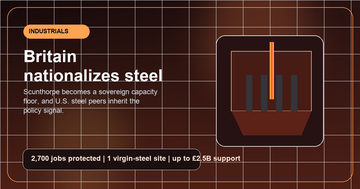
The official UK statement on July 16, 2026 said the government had concluded it was in the public interest to take ownership of British Steel. The stated reason was straightforward: preserve steel production, protect thousands of jobs, safeguard supply chains, and keep material available for infrastructure and national-security needs. That is not the language of a normal cyclical bailout. It is the language of strategic industrial policy.
This matters because Scunthorpe is not just another plant on a spreadsheet. It is the last remaining primary steelmaking site in the UK, and the government is effectively signaling that it is willing to own and stabilize the asset rather than let the supply chain disappear. Once a state does that, the valuation math for adjacent assets changes because the policy floor becomes visible.
Why it matters
When a government backstops capacity, the market stops asking only about EBITDA and starts asking about sovereignty.
That is why the read-through reaches the U.S. steel names. Nucor, Steel Dynamics, and Cleveland-Cliffs do not own Scunthorpe, but they do operate in a world where policy can preserve supply, encourage domestic capacity, and make local production politically valuable. The more governments act like strategic owners, the more domestic low-cost capacity matters relative to imported metal.
The second-order effect is on capital allocation. If a country is willing to own a loss-making or margin-compressed asset to preserve industrial sovereignty, then the return profile of steel stops looking like a pure commodity spread and starts looking like a protected strategic utility with cyclical upside. That does not make the business easy. It does make the downside more socially expensive.
For U.S. Steel and other domestic producers, the broader lesson is that policy can change the effective supply curve. For mills with efficient operations and access to scrap, the signal is constructive because governments are telling the market that capacity is worth preserving, even if it takes public money to do it.
Evidence table
The nationalization is best understood as a policy stack: jobs, capacity, infrastructure, and decarbonization.
The table below strips away the politics and shows the industrial logic. The UK did not nationalize British Steel because of sentiment. It did it because the plant sits at the intersection of jobs, domestic supply, and strategic resilience.
| Policy object | Evidence | Why it matters | Read-through |
|---|---|---|---|
| Jobs | 2,700 direct jobs | Local political and labor impact is immediate. | Government support is more likely when employment is concentrated. |
| Primary capacity | 1 virgin-steel site | Losing it would remove primary production from the UK. | Primary capacity becomes a strategic premium. |
| Support package | Up to £2.5B | Modernization and decarbonization require capital. | Asset value includes policy capital, not just operating cash flow. |
| Security | Defense and infrastructure supply | Domestic steel is tied to public procurement. | Strategic sectors favor local supply. |
British Steel became a strategic asset, not just a distressed asset
Key policy and industrial markers from the nationalization decision.
Unit: Jobs / count / GBP millions / years
Jobs protected
Local employment
2,700
Blast furnaces
Physical capacity
2
Support package
GBP millions
2,500
Years of history
Industrial legacy
130
Read-through
The market implication is a higher floor for domestic industrial capacity and a higher premium for efficient operators with policy leverage.
The obvious beneficiaries are the companies that can serve domestic infrastructure demand without relying on a fragile imported-capacity story. That is favorable for Nucor and Steel Dynamics, because both names are already associated with efficient U.S. operations, domestic scrap access, and a cleaner policy relationship than the old blast-furnace model.
The more subtle point is that the nationalization normalizes intervention. Once governments show they are willing to own strategic steel, investors must allow for more state involvement in energy-intensive industries, especially where grid reliability, defense supply, and industrial jobs overlap.
What to watch
The follow-up questions are compensation, modernization spending, and whether this becomes a template for other strategic assets.
Watch the compensation process for Jingye, the new board's turnaround plan, and the eventual capex path toward a lower-carbon steel process. If the UK uses this asset to prove that strategic steel can be kept alive and upgraded, then the decision will be remembered as a policy template rather than a one-off rescue.