%22%2F%3E%0A%20%20%3Ccircle%20cx%3D%22220%22%20cy%3D%22150%22%20r%3D%22180%22%20fill%3D%22%2322d3ee%22%20fill-opacity%3D%220.12%22%2F%3E%0A%20%20%3Ccircle%20cx%3D%221010%22%20cy%3D%22130%22%20r%3D%22220%22%20fill%3D%22%2338bdf8%22%20fill-opacity%3D%220.08%22%2F%3E%0A%20%20%3Ccircle%20cx%3D%22920%22%20cy%3D%22520%22%20r%3D%22170%22%20fill%3D%22%2322d3ee%22%20fill-opacity%3D%220.06%22%2F%3E%0A%20%20%3Cpath%20d%3D%22M140%20430h920%22%20stroke%3D%22url(%23line)%22%20stroke-width%3D%2212%22%20stroke-linecap%3D%22round%22%2F%3E%0A%20%20%3Cpath%20d%3D%22M220%20360c120-150%20260-220%20380-220s260%2070%20380%20220%22%20fill%3D%22none%22%20stroke%3D%22%2367e8f9%22%20stroke-opacity%3D%220.5%22%20stroke-width%3D%2216%22%20stroke-linecap%3D%22round%22%20stroke-linejoin%3D%22round%22%2F%3E%0A%20%20%3Cpath%20d%3D%22M300%20398h600%22%20stroke%3D%22%2394a3b8%22%20stroke-opacity%3D%220.24%22%20stroke-width%3D%228%22%20stroke-linecap%3D%22round%22%2F%3E%0A%20%20%3Ctext%20x%3D%22220%22%20y%3D%22510%22%20fill%3D%22%23e2e8f0%22%20fill-opacity%3D%220.7%22%20font-family%3D%22Arial%2C%20Helvetica%2C%20sans-serif%22%20font-size%3D%2238%22%20letter-spacing%3D%228%22%3EINSIGHTS%3C%2Ftext%3E%0A%3C%2Fsvg%3E)
Bottom line
AI is starting to show up where investors usually want it last: in prices, utilities, and the Fed's reaction function.
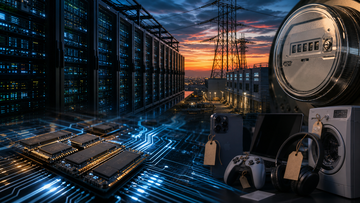
The market likes the AI story when it is framed as capex, software leverage, and long-duration productivity. That framing is still valid, but it is no longer complete. The same buildout is now moving through the economy as a cost shock: memory chips are tighter, electricity demand is rising, and consumer electronics makers are passing through more of the bill.
That matters because the first phase of a capex boom is usually easy to celebrate and hard to model. The second phase is where investors find out whether the upside is real enough to justify the higher input costs. For Apple, Microsoft, Alphabet, Amazon, and Meta, the question is not whether AI creates value. It is whether the value arrives before the margin hit becomes visible.
What changed
The capex wave is already leaking into consumer hardware and power costs.
AP reported that four large tech companies are expected to invest about $720 billion in AI data centers this year. That scale is large enough to distort supply chains all by itself. It pushes demand into semiconductors, memory, servers, cooling systems, and power infrastructure faster than many suppliers can add capacity.
The price signal is already visible. AP cited JPMorgan estimates that some memory chips could rise as much as 400% between 2024 and the end of this year. Apple has raised prices on laptops and iPads, while Microsoft, Sony, Dell, and HP have also been forced to adjust pricing in response to component inflation.
| Channel | Evidence | Market consequence |
|---|---|---|
| Data-center capex | About $720B expected this year | Pulls capital and materials into a narrow set of AI-heavy suppliers |
| Memory and semis | JPMorgan sees some memory chips up as much as 400% | Raises input costs for PCs, servers, consoles, and phones |
| Consumer hardware | Apple lifted laptop and iPad prices by roughly 15% to 25% | Moves inflation from the enterprise stack into the consumer basket |
| Electricity | Data centers are absorbing a larger share of new electrical capacity | Utilities and grid vendors gain, but power prices can rise |
Why it matters
The inflation read-through is bigger than one product cycle because it changes the Fed's tolerance for temporary shocks.
The FT's reporting on Christopher Waller's warning is important because it shows the Fed is not dismissing the AI impulse as background noise. If core inflation stays too hot, the central bank does not have to wait for a clean labor-market breakdown to tighten again. It can react to the persistence of price pressure itself.
That makes the AI trade more complicated. High-growth names still benefit from stronger demand, but duration-sensitive stocks now have to absorb a higher-rate narrative at the same time. Nvidia, Broadcom, Dell, HP, and utility names tied to data-center load growth can all gain from the buildout. The risk is that the market keeps paying for the growth while underestimating the inflation side effect.
- If price pressure stays narrow, the Fed can look through it.
- If the shock keeps spreading across chips, electronics, and electricity, it stops looking temporary.
- That would keep long-duration equity multiples more fragile than the tape suggests.
What to watch
The next tells are not just earnings. They are memory pricing, power bills, and whether the Fed starts talking about AI demand as an inflation source.
Watch for whether June and July inflation prints show continued pressure in electronics and electricity. Also watch whether Apple and other hardware vendors keep talking about pricing discipline instead of just product mix. If the AI buildout keeps pushing costs up while wage growth cools, the market may have to reconcile a very awkward combination: higher inflation with only moderate demand growth elsewhere.
That is the core thesis. AI is not only a productivity story; it is also a supply-allocation story. Whoever controls the scarce inputs - chips, power, and capital - gets paid first.
AI inflation transmission ladder
Qualitative pressure scores based on the reported market evidence. This is an inference, not an official macro series.
Unit: relative pressure
Data-center capex
Largest immediate pull on supply chains
10
Memory chips
Highest visible component inflation
9
Consumer electronics
Price pass-through is already visible
8
Electricity
Power demand starts to move utilities
7
Core inflation
Broader pass-through is still emerging
5