%22%2F%3E%0A%20%20%3Ccircle%20cx%3D%22220%22%20cy%3D%22150%22%20r%3D%22180%22%20fill%3D%22%2322d3ee%22%20fill-opacity%3D%220.12%22%2F%3E%0A%20%20%3Ccircle%20cx%3D%221010%22%20cy%3D%22130%22%20r%3D%22220%22%20fill%3D%22%2338bdf8%22%20fill-opacity%3D%220.08%22%2F%3E%0A%20%20%3Ccircle%20cx%3D%22920%22%20cy%3D%22520%22%20r%3D%22170%22%20fill%3D%22%2322d3ee%22%20fill-opacity%3D%220.06%22%2F%3E%0A%20%20%3Cpath%20d%3D%22M140%20430h920%22%20stroke%3D%22url(%23line)%22%20stroke-width%3D%2212%22%20stroke-linecap%3D%22round%22%2F%3E%0A%20%20%3Cpath%20d%3D%22M220%20360c120-150%20260-220%20380-220s260%2070%20380%20220%22%20fill%3D%22none%22%20stroke%3D%22%2367e8f9%22%20stroke-opacity%3D%220.5%22%20stroke-width%3D%2216%22%20stroke-linecap%3D%22round%22%20stroke-linejoin%3D%22round%22%2F%3E%0A%20%20%3Cpath%20d%3D%22M300%20398h600%22%20stroke%3D%22%2394a3b8%22%20stroke-opacity%3D%220.24%22%20stroke-width%3D%228%22%20stroke-linecap%3D%22round%22%2F%3E%0A%20%20%3Ctext%20x%3D%22220%22%20y%3D%22510%22%20fill%3D%22%23e2e8f0%22%20fill-opacity%3D%220.7%22%20font-family%3D%22Arial%2C%20Helvetica%2C%20sans-serif%22%20font-size%3D%2238%22%20letter-spacing%3D%228%22%3EINSIGHTS%3C%2Ftext%3E%0A%3C%2Fsvg%3E)
Bottom line
The market is still underpricing the volatility that sits inside Hormuz.
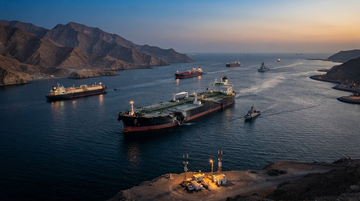
A tanker strike in the Strait of Hormuz is not just another Middle East headline. It is a reminder that a narrow lane carrying roughly one-fifth of the world's oil and a meaningful share of global LNG can still turn a geopolitical flashpoint into a pricing event.
The mistake is to treat the story as a binary question about closure. The bigger equity and macro question is how much every incident raises freight, war-risk insurance, LNG, and the inflation path, even if traffic keeps moving.
What happened
A fresh projectile strike showed the corridor is still fragile.
Reuters posted that a ship was struck in Hormuz as Iran and the U.S. traded attacks in the worst escalation since the peace deal. A UKMTO-linked report said the tanker was hit by an unidentified projectile. That matters because even a single incident can force the market to reprice route risk, not just barrel availability.
The signal is not that the strait is instantly closed. The signal is that the corridor can still be disrupted without a formal shutdown, which is exactly how a risk premium sneaks into oil, shipping, and inflation expectations.
Flow versus buffer
These bars compare the size of the chokepoint with the limited capacity to work around it. EIA and IEA use different estimates for bypass capacity, but both point in the same direction.
Unit: million b/d
Hormuz flow
2024 average oil throughput
20
IEA alt. route
Midpoint of 3.5-5.5 mb/d range
4.5
EIA bypass
Saudi and UAE bypass capacity
2.6
U.S. exposure
Persian Gulf imports via Hormuz
0.5
Why it matters
Hormuz is still the cleanest example of a global bottleneck with weak substitutes.
The EIA says the strait carried about 20 million barrels per day in 2024, equivalent to about 20% of global petroleum liquids consumption, and more than one-quarter of global seaborne oil trade. It also says the United States imported about 0.5 million barrels per day of crude and condensate from Persian Gulf countries through Hormuz.
The IEA says nearly 20 million barrels per day of oil was exported through the strait in 2025 and that most exports go to Asia. That is the real point: the demand shock does not land evenly. It lands first on Asia's import bill, then on freight and insurance, and only later on U.S. gas prices and CPI.
| Exposure | Reading | Interpretation |
|---|---|---|
| Global petroleum liquids | 20 million b/d | About 20% of global consumption passed through Hormuz in 2024. |
| Global seaborne oil trade | >25% | The strait is not just regional; it is a price-setting global chokepoint. |
| LNG trade | ~20% | Qatar's LNG exports give the strait a second gas-price transmission channel. |
| U.S. crude imports | 0.5 million b/d | Only about 7% of U.S. crude imports, but enough to matter for gasoline and jet fuel. |
Upstream / downstream
The market impact is asymmetric, and the winners are not the same as in a normal oil rally.
Upstream producers can benefit if the risk premium holds because realized prices and cash flow rise first. But the bigger immediate winners are often not the producers; they are the groups that can monetize volatility through freight, insurance, or alternative routing.
Downstream, airlines, logistics names, and Asia-heavy importers feel the first inflation hit. Refiners are mixed because crude input costs rise while product cracks can also widen. That means investors should not confuse 'higher oil' with a uniform trade.
| Sector | Likely effect | How it shows up |
|---|---|---|
| Oil producers | Higher realized prices | If the risk premium sticks, upstream cash flow improves first. |
| Tankers / insurance | War-risk premiums rise | Freight and insurance get repriced before physical shortages do. |
| Airlines / transport | Fuel cost pressure | Jet fuel and logistics costs react faster than headline oil demand. |
| Refiners | Mixed | Crude input cost rises, but crack spreads can help if products tighten too. |
| Asian importers | Most exposed | China, India, Japan, and Korea feel the largest second-order inflation shock. |
My conclusion
This is a volatility story, not just a commodity story.
If the corridor stays open, spot oil may not explode. But the cost of keeping the corridor open just went up again, and that cost shows up in insurance, shipping, LNG hedging, and eventual fuel inflation. That is enough to change portfolio math even without a formal supply cut.
The market should therefore treat Hormuz as a standing option on global inflation. The option is cheap until it is not, and this week proved it can reprice in a single session.