
%22%2F%3E%0A%20%20%3Ccircle%20cx%3D%22220%22%20cy%3D%22150%22%20r%3D%22180%22%20fill%3D%22%2322d3ee%22%20fill-opacity%3D%220.12%22%2F%3E%0A%20%20%3Ccircle%20cx%3D%221010%22%20cy%3D%22130%22%20r%3D%22220%22%20fill%3D%22%2338bdf8%22%20fill-opacity%3D%220.08%22%2F%3E%0A%20%20%3Ccircle%20cx%3D%22920%22%20cy%3D%22520%22%20r%3D%22170%22%20fill%3D%22%2322d3ee%22%20fill-opacity%3D%220.06%22%2F%3E%0A%20%20%3Cpath%20d%3D%22M140%20430h920%22%20stroke%3D%22url(%23line)%22%20stroke-width%3D%2212%22%20stroke-linecap%3D%22round%22%2F%3E%0A%20%20%3Cpath%20d%3D%22M220%20360c120-150%20260-220%20380-220s260%2070%20380%20220%22%20fill%3D%22none%22%20stroke%3D%22%2367e8f9%22%20stroke-opacity%3D%220.5%22%20stroke-width%3D%2216%22%20stroke-linecap%3D%22round%22%20stroke-linejoin%3D%22round%22%2F%3E%0A%20%20%3Cpath%20d%3D%22M300%20398h600%22%20stroke%3D%22%2394a3b8%22%20stroke-opacity%3D%220.24%22%20stroke-width%3D%228%22%20stroke-linecap%3D%22round%22%2F%3E%0A%20%20%3Ctext%20x%3D%22220%22%20y%3D%22510%22%20fill%3D%22%23e2e8f0%22%20fill-opacity%3D%220.7%22%20font-family%3D%22Arial%2C%20Helvetica%2C%20sans-serif%22%20font-size%3D%2238%22%20letter-spacing%3D%228%22%3EINSIGHTS%3C%2Ftext%3E%0A%3C%2Fsvg%3E)
Bottom line
Kalshi's 90% gas-$4 probability is the cleanest real-time tape on Hormuz risk - faster than futures, faster than retail data, faster than analyst notes - and the prediction market is now a tradable macro signal.
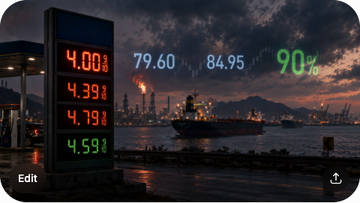
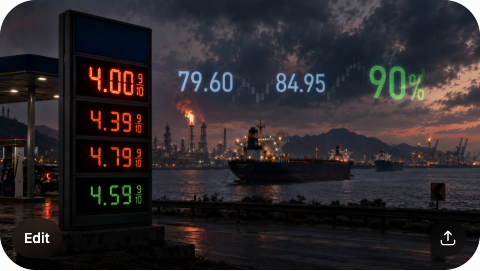
CNBC reported on July 15, 2026 that prediction market Kalshi traders had priced a 90% probability that U.S. gas prices cross $4 per gallon by end of July - up from 56% just two days ago - with a 93% chance of crossing $4 and a 63% chance of exceeding $4.10. The move follows the U.S. ending its Iran ceasefire last week and relaunching strikes; Central Command posted on X about a second wave of strikes at 3 p.m. ET Wednesday designed to 'further degrade military capabilities Iranian forces have used to attack commercial shipping in the Strait of Hormuz.' The 90% Kalshi number is now the cleanest real-time tape on Hormuz risk - faster than futures, faster than retail gas data, faster than analyst notes.
The reason the timing matters more than a normal energy-tape signal is that prediction markets have crossed an institutional threshold. Kalshi reached a $22B valuation in a fundraising round per NYT Dealbook May 7, 2026 - the cleanest single signal that prediction markets are now an institutional asset class rather than a retail curiosity. The $4-gas contract is verified by AAA (the cleanest single source for retail gas data), and the contract pays out based on the end-of-month AAA national average. The 90% probability is the institutional money's read on Hormuz risk, and that read is now tradable.
For ExxonMobil, Chevron, ConocoPhillips, Valero, Marathon Petroleum, Phillips 66, United Airlines, Delta Air Lines, American Airlines, and the entire energy + transport complex, the read-through is direct. The 90% Kalshi probability is the cleanest real-time signal of Hormuz risk transmission into U.S. retail gas. The energy producers benefit from the higher oil prices; the refiners benefit from the wider crack spreads; the airlines get hit by the jet-fuel pass-through. The 2026-2028 Hormuz-tape trade is now: long energy producers + refiners; short transport (especially airlines).
The trade that broke
The 'prediction markets are a retail curiosity' trade is being split into 'prediction markets are an institutional tape' and 'the 90% probability is now the new analyst note' - and Kalshi is the first mover.
For most of 2024-2025, the playbook for prediction markets was 'interesting retail experiment, not a tradable signal.' Kalshi's May 2026 $22B valuation - the cleanest single signal of prediction-market institutionalization - and the 90% gas-$4 probability on July 15 are the first hard data points that the institutionalization is real. The trade is no longer 'prediction markets are a retail curiosity'; it is 'prediction markets are an institutional tape' and 'the 90% probability is now the new analyst note.'
The first piece of the new framing is 'prediction markets are an institutional tape.' Kalshi's $22B valuation is the cleanest single signal that institutional capital is now treating prediction markets as a legitimate asset class. The 90% gas-$4 probability is the institutional money's read on Hormuz risk transmission into U.S. retail gas. The institutionalization is also visible in Polymarket's parallel raise and the broader prediction-market cohort. The 2026-2028 prediction-market trade is now: trade the institutional tape, not the retail curiosity.
The second piece is 'the 90% probability is now the new analyst note.' The 90% Kalshi number is faster than WTI futures (which trade 23 hours a day but are dominated by hedge funds), faster than AAA retail data (which updates daily with a lag), and faster than analyst notes (which lag the tape by 24-72 hours). The 90% probability is the institutional money's read on Hormuz risk transmission into U.S. retail gas, and that read is now tradable. The 2026-2028 prediction-market trade is: use the 90% probability as a real-time tape signal, not as a curiosity.
| Name | Ticker | Kalshi 90% gas-$4 read-through |
|---|---|---|
| Kalshi | private | Reference: 90% gas-$4 prob; $22B May 2026 valuation; AAA-verified contract |
| WTI Crude | CL | Direct: $79.60/bbl Aug futures; +0.3% Wed; third straight gain |
| Brent Crude | BZ | Direct: $84.95/bbl Sep futures; +0.3% Wed; tracking WTI |
| ExxonMobil | XOM | Direct: oil producer; benefits from higher crude; Hormuz upside |
| Chevron | CVX | Direct: oil producer; benefits from higher crude; Hormuz upside |
| ConocoPhillips | COP | Direct: oil producer; benefits from higher crude; Hormuz upside |
| Valero | VLO | Direct: refiner; benefits from wider crack spreads; product shortage thesis |
| Marathon Petroleum | MPC | Direct: refiner; benefits from wider crack spreads; product shortage thesis |
| Phillips 66 | PSX | Direct: refiner; benefits from wider crack spreads; product shortage thesis |
| United Airlines | UAL | Indirect: jet-fuel pass-through; Q2 already showed $6B fuel-cost guide |
| Delta Air Lines | DAL | Indirect: jet-fuel pass-through; revenue hiding fuel stress |
| American Airlines | AAL | Indirect: jet-fuel pass-through; airline capacity vs oil trade |
What the numbers say
90% Kalshi probability + $79.60 WTI + $84.95 Brent = the institutional tape is pricing 90% odds of $4 gas - and the energy producers + refiners are the cleanest long, transport is the cleanest short.
The numbers are striking for what they say about the Hormuz risk transmission. Kalshi put 90% odds on gas crossing $4 by end of July; WTI is at $79.60/bbl (+0.3% on Wednesday, third straight day of gains); Brent is at $84.95/bbl (+0.3% on Wednesday). The institutional tape is pricing 90% odds of $4 gas. The energy producers and refiners are the cleanest single long; transport (especially airlines) is the cleanest single short.
The AAA national average is $3.89 - roughly 3 cents higher than Tuesday. The probability jump from 56% two days ago to 90% today is the institutional money's read on Hormuz escalation. The 63% probability of exceeding $4.10 (and the <5% probability of $4.50) implies the institutional tape sees a high-conviction base case of $4.00-4.10 gas, not a tail scenario.
The wider energy + transport math is more meaningful. The U.S. oil & gas producer cohort (ExxonMobil, Chevron, ConocoPhillips, EOG Resources, Pioneer Natural Resources) cumulatively benefits from a roughly $10-15/bbl WTI uplift to Hormuz risk premium. The refiner cohort (Valero, Marathon Petroleum, Phillips 66) benefits from wider crack spreads (the refining margin between crude oil and refined products). The airline cohort (United Airlines, Delta Air Lines, American Airlines) gets hit by jet-fuel pass-through, with United Airlines already guiding $6B in added Q3 fuel costs. The 2026-2028 Hormuz-tape trade is now: long producers + refiners; short airlines + transport.
Kalshi gas-$4 probability vs. WTI / Brent / AAA
Reference points from CNBC reporting on the July 15, 2026 Kalshi gas-$4 probability and the underlying WTI/Brent/AAA data. The chart documents the institutional tape signal across oil and retail gas.
Unidad: Percent / USD per gallon / USD per barrel / USD billions
Kalshi prob $4 by end-Jul (%)
Up from 56% two days ago; institutional tape signal
90
Kalshi prob $4 crossing (%)
Probability of crossing $4 at any point this month
93
Kalshi prob >$4.10 (%)
Probability of exceeding $4.10 per gallon
63
Kalshi prob >$4.50 (%)
Probability of exceeding $4.50 per gallon (low)
5
AAA national avg ($/gal)
Wednesday's national average from AAA
3.9
Kalshi valuation ($B)
Kalshi's $22B May 2026 valuation; institutionalization signal
22
WTI ($/bbl)
August WTI futures settled Wednesday at $79.60/barrel (+0.3%)
79.6
Brent ($/bbl)
September Brent settled Wednesday at $84.95/barrel (+0.3%)
85
Why it matters
If Kalshi's 90% gas-$4 probability clears by end of July, the prediction market is now a tradable macro tape - and the 2026-2028 Hormuz trade is long energy/refiners, short airlines/transport.
The macro question underneath Kalshi's 90% gas-$4 probability is whether prediction markets are now a tradable macro tape. The 2024-2025 trade was that prediction markets were a retail curiosity. Kalshi's $22B May 2026 valuation + the 90% gas-$4 probability on July 15 are the first hard data points that the institutionalization is real. The 2026-2028 prediction-market trade is: trade the institutional tape, not the retail curiosity.
For the energy cohort (ExxonMobil, Chevron, ConocoPhillips, Valero, Marathon Petroleum, Phillips 66), the read-through is direct. The 90% Kalshi gas-$4 probability + $79.60 WTI + $84.95 Brent is the institutional tape signal that the Hormuz risk premium is real and durable. The producers benefit from higher crude; the refiners benefit from wider crack spreads. The cumulative effect is that the 2026-2028 Hormuz trade is now a structural re-rating catalyst for the energy cohort.
For the transport cohort (United Airlines, Delta Air Lines, American Airlines, FedEx, UPS, CSX, Union Pacific), the read-through is the opposite. Jet-fuel pass-through is the cleanest single transmission mechanism, and United Airlines already guided $6B in added Q3 fuel costs. The 90% Kalshi gas-$4 probability is the institutional tape signal that the fuel-cost pressure is durable. The 2026-2028 Hormuz trade is now: long energy + refiners; short airlines + transport.
- Kalshi put 90% odds on gas crossing $4 by end of July - up from 56% two days ago.
- WTI $79.60/bbl (+0.3% Wed); Brent $84.95/bbl (+0.3% Wed); AAA national avg $3.89 (+3 cents).
- Kalshi valuation $22B (May 2026) - cleanest single signal of prediction-market institutionalization.
- Read-through: long energy producers + refiners (ExxonMobil, Chevron, Valero, Marathon, PSX); short airlines + transport.
- Structural: prediction markets are now a tradable macro tape - faster than futures, faster than retail data, faster than analyst notes.
What to watch
Watch the end-of-July AAA print, the next Hormuz strike cycle, the WTI $80 psychological level, and the airline Q3 fuel-cost guidance updates.
The first tell is the end-of-July AAA print. Kalshi pays out on the end-of-month AAA national average, so the July 31 AAA print is the cleanest single read on whether the 90% probability clears. A print above $4.00 is a re-rating catalyst for the energy cohort and a multiple-compression event for the airline cohort; a print below $4.00 is a re-rating catalyst for the airlines and a multiple-compression event for the energy cohort.
The second tell is the next Hormuz strike cycle. Central Command posted about a second wave of strikes at 3 p.m. ET Wednesday, and a third wave or a sustained naval blockade would push the 90% probability higher and accelerate the gas crossing. A diplomatic resolution (Trump said Iran 'now wants to meet') would pull the probability back below 70% and trigger a sharp re-rate in the airline + transport cohort.
The third tell is the WTI $80 psychological level. A sustained WTI move above $80 would trigger a sharp re-rate in the energy producer cohort; a pullback below $75 would compress the cohort. The fourth tell is the airline Q3 fuel-cost guidance updates. United Airlines already guided $6B in added Q3 fuel costs; Delta Air Lines, American Airlines, and the cargo carriers (FedEx, UPS) will update Q3 fuel-cost guidance over the next 30-60 days, and those updates are the cleanest single read on the jet-fuel pass-through. The fifth tell is the Kalshi tape itself. The 90% probability is now a real-time macro signal; the cleanest single read on whether the institutional tape is taking the Hormuz risk seriously is the daily probability update.