시게이트와 웨스턴 디지털 주가가 하락 중: 알아야 할 사항
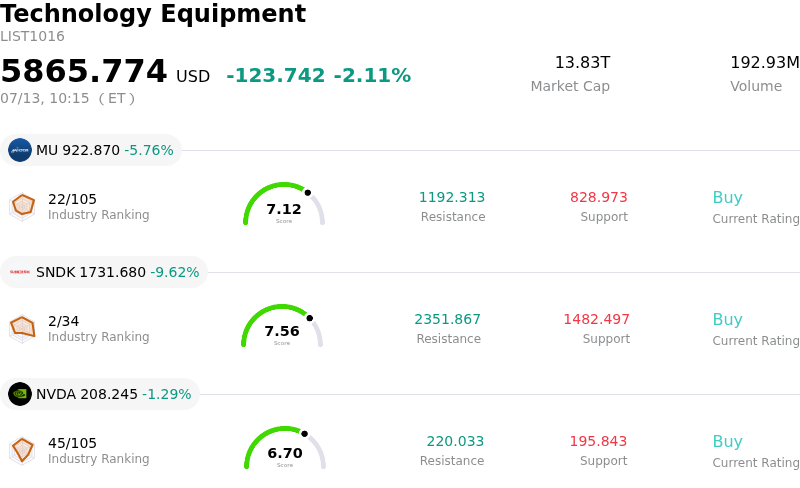
시게이트(NASDAQ:STX)와 웨스턴 디지털(NASDAQ:WDC) 주가는 투자자들이 반도체 업종의 강한 랠리 이후 차익실현에 나서면서 오후 거래에서 하락했다. 이번 매도세는 한국의 한 증권사가 SK하이닉스의 Q2 실적 전망을 고정가격 HBM 계약에 대한 의존을 이유로 낮춘 데다, 재점화된 중동 긴장도 유가를 끌어올리면서 안전자산 선호를 촉진해 시장의 방어적 포지셔닝에 영향을 줬다.


Micron Technology, Inc.는 고급 반도체 메모리 및 스토리지 솔루션의 개발, 제조, 판매를 전문으로 하는 글로벌 리더입니다. 회사의 사업 운영은 Compute and Networking, ...
시게이트(NASDAQ:STX)와 웨스턴 디지털(NASDAQ:WDC) 주가는 투자자들이 반도체 업종의 강한 랠리 이후 차익실현에 나서면서 오후 거래에서 하락했다. 이번 매도세는 한국의 한 증권사가 SK하이닉스의 Q2 실적 전망을 고정가격 HBM 계약에 대한 의존을 이유로 낮춘 데다, 재점화된 중동 긴장도 유가를 끌어올리면서 안전자산 선호를 촉진해 시장의 방어적 포지셔닝에 영향을 줬다.
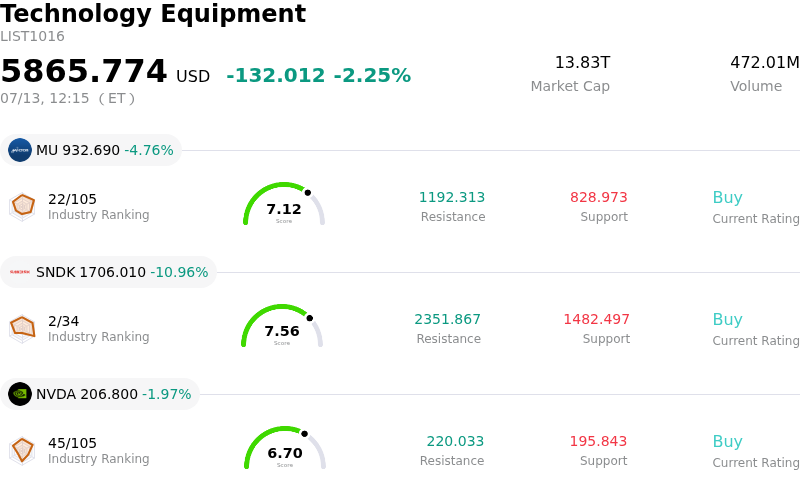
웨스턴 디지털(WDC) 주가가 낸드 플래시 가격에 대한 우려, 엔터프라이즈 수요 냉각, 사업부 분리 지연 가능성으로 인해 6.02% 하락했다. 더 넓은 기술 섹터 역시 거시경제 요인과 신중한 업계 가이던스의 영향으로 압박을 받고 있다. 기술적 지표는 중립~매도 조건을 시사하며, 회사는 복잡한 구조적 분리, AI에 의한 하이퍼스케일 예산의 잠식, 낸드 가격의 취약성, 지정학적 공급망 취약성 같은 리스크에 직면해 있다.

시게이트 테크놀로지스 홀딩스 PLC(STX) 주가는 7월 13일 클라우드 서비스 제공업체의 자본지출(CapEx) 사이클에 대한 우려와 데이터 저장 부문에서의 재고 누적 가능성으로 5.23% 하락했다. 분석가들은 수요가 정체되고 AI 통합이 느려지고 있다고 지적하며 전망치를 하향 조정했다. 회사는 또한 하이퍼스케일 CapEx 전용 가능성, HAMR 기술 실행 지연 가능성, 경쟁 심화에 따른 가격 압박 리스크도 안고 있다.

짐 크레이머는 엔비디아의 고유(자체) 특성을 강조하며, 흔히 같이 비교되는 것과 달리 이를 상품형 칩 제조업체들과 대비시켰다. 그는 엔비디아(NVDA)가 고객 규모나 고객과의 비교 대상 문제와는 무관하게, 데이터센터의 핵심에 놓여 있고 그에 필적할 수 없는 제품을 갖추고 있다고 주장했다. 크레이머는 상품형 칩 회사들이 때때로 엔비디아보다 더 높은 PER(주가수익비율)을 보유하는 경우가 있다며, 그것이 엔비디아의 독특한 시장 포지션에 대한 모욕이라고까지 말했다.
램리서치(Lam Research, LRCX) 주가는 반도체 장비 부문에 영향을 미친 거시경제 및 업종 특유의 어려움으로 인해 7월 13일 5.28% 하락했습니다. 하락의 주요 요인으로는 수출 규제와 관련된 지정학적 위험의 증대, 메모리 시장 사이클의 잠재적 둔화, 고성장 기술 자산에서의 더 넓은 섹터 로테이션 등이 있습니다. 또한 회사의 밸류에이션은 애널리스트들의 실적 전망 하향 조정과 운영 비용 증가의 영향을 받고 있습니다.


시게이트(NASDAQ:STX)와 웨스턴 디지털(NASDAQ:WDC) 주가는 투자자들이 반도체 업종의 강한 랠리 이후 차익실현에 나서면서 오후 거래에서 하락했다. 이번 매도세는 한국의 한 증권사가 SK하이닉스의 Q2 실적 전망을 고정가격 HBM 계약에 대한 의존을 이유로 낮춘 데다, 재점화된 중동 긴장도 유가를 끌어올리면서 안전자산 선호를 촉진해 시장의 방어적 포지셔닝에 영향을 줬다.
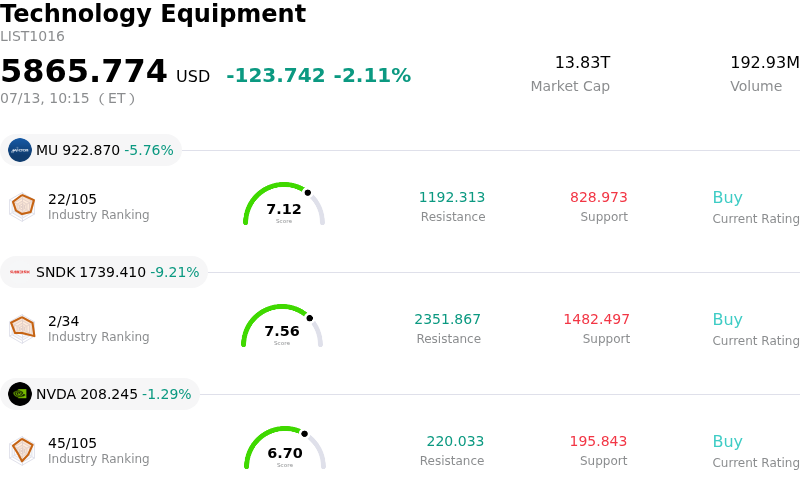
웨스턴 디지털(WDC) 주가가 낸드 플래시 가격에 대한 우려, 엔터프라이즈 수요 냉각, 사업부 분리 지연 가능성으로 인해 6.02% 하락했다. 더 넓은 기술 섹터 역시 거시경제 요인과 신중한 업계 가이던스의 영향으로 압박을 받고 있다. 기술적 지표는 중립~매도 조건을 시사하며, 회사는 복잡한 구조적 분리, AI에 의한 하이퍼스케일 예산의 잠식, 낸드 가격의 취약성, 지정학적 공급망 취약성 같은 리스크에 직면해 있다.

시게이트 테크놀로지스 홀딩스 PLC(STX) 주가는 7월 13일 클라우드 서비스 제공업체의 자본지출(CapEx) 사이클에 대한 우려와 데이터 저장 부문에서의 재고 누적 가능성으로 5.23% 하락했다. 분석가들은 수요가 정체되고 AI 통합이 느려지고 있다고 지적하며 전망치를 하향 조정했다. 회사는 또한 하이퍼스케일 CapEx 전용 가능성, HAMR 기술 실행 지연 가능성, 경쟁 심화에 따른 가격 압박 리스크도 안고 있다.
짐 크레이머는 엔비디아의 고유(자체) 특성을 강조하며, 흔히 같이 비교되는 것과 달리 이를 상품형 칩 제조업체들과 대비시켰다. 그는 엔비디아(NVDA)가 고객 규모나 고객과의 비교 대상 문제와는 무관하게, 데이터센터의 핵심에 놓여 있고 그에 필적할 수 없는 제품을 갖추고 있다고 주장했다. 크레이머는 상품형 칩 회사들이 때때로 엔비디아보다 더 높은 PER(주가수익비율)을 보유하는 경우가 있다며, 그것이 엔비디아의 독특한 시장 포지션에 대한 모욕이라고까지 말했다.

램리서치(Lam Research, LRCX) 주가는 반도체 장비 부문에 영향을 미친 거시경제 및 업종 특유의 어려움으로 인해 7월 13일 5.28% 하락했습니다. 하락의 주요 요인으로는 수출 규제와 관련된 지정학적 위험의 증대, 메모리 시장 사이클의 잠재적 둔화, 고성장 기술 자산에서의 더 넓은 섹터 로테이션 등이 있습니다. 또한 회사의 밸류에이션은 애널리스트들의 실적 전망 하향 조정과 운영 비용 증가의 영향을 받고 있습니다.

어드밴스드 마이크로 디바이시스(Advanced Micro Devices, AMD) 주가는 7월 13일 4.27% 하락했으며, 반도체 전반의 섹터 변동성, 거시경제 우려, AI 관련 자본지출(CAPEX) 둔화에 대한 불안이 영향을 미쳤습니다. 다만 애널리스트들은 평균 목표주가 510.16달러와 함께 '매수(Buy)' 등급을 유지하고 있습니다. 이 기사는 기술적 지표, 언론 보도, 그리고 마진 압박 및 지정학적 수출 취약성과 같은 회사별 리스크를 다룹니다.
어플라이드 머티어리얼즈(Applied Materials, AMAT) 주가는 7월 13일 4.31% 하락했는데, 이는 주요 파운드리에서의 장비 주문 감소, 무역 및 수출 규정에 영향을 미치는 지정학적 위험, 그리고 금리 상승을 포함한 보다 전반적인 거시경제 경계감 때문입니다. 회사는 업종 대비 부진했으며, 애널리스트의 심리와 기술적 지표 역시 하락 압력에 기여했습니다. 주요 리스크로는 수출 통제 준수, 법적 조사, 경기순응적 수요 둔화, 그리고 마진 압박이 포함됩니다.

디렉시온 데일리 MSCI 한국 불 3X 레버리지 상장지수펀드( Direxion Daily MSCI South Korea Bull 3X Shares ETF, KORU )는 소매 투자자들이 "저가 매수(buy the dip)"라는 낙관적 정서를 보였음에도 불구하고 큰 폭의 하락을 겪으며, 이달 들어 최악의 날을 기록했습니다. 이러한 조정은 한국의 KOSPI 지수가 6월 고점 대비 25% 하락한 이후 나타났으며, 이는 주로 삼성과 SK하이닉스에 대한 높은 쏠림, 시장 밸류에이션, 글로벌 AI 무역에 영향을 미치는 거시경제 위험에 대한 우려 때문입니다. 변동성에도 불구하고 개인 트레이더들은 고대역폭 메모리(HBM) 수요가 여전히 강하다고 보고 있으며, KORU ETF는 연초 이후 누적 기준으로도 126% 증가를 이어오고 있습니다.

Micron Technology Inc. (MU) experienced a significant stock price rally in the first half of 2026, driven by high demand for memory chips due to AI advancements. Despite a recent 22% decline from its peak, the company presents a strong investment opportunity, supported by substantial expected revenue and earnings growth, impressive gross margins, and strategic investments in AI-driven memory solutions. Analysts project significant upside potential, and the stock is considered undervalued compared to industry averages, making it a "Strong Buy" according to Zacks Rank.

Memory and storage stocks, including Micron, SanDisk, and Western Digital, dropped by 6% on Monday. This decline was triggered by a weak second-quarter profit estimate for South Korea’s SK Hynix, which cited slower-than-expected HBM4 shipments. Despite historic year-to-date gains exceeding 200% for some of these companies, the report has raised concerns about pricing power and the cooling momentum of the memory "super-cycle," leading to broader sell-offs in the sector.
This article highlights four tech stocks — SanDisk Corporation (SNDK), Micron Technology, Inc. (MU), Digital Turbine, Inc. (APPS), and Hewlett Packard Enterprise Company (HPE) — that have seen significant year-to-date rallies but are still considered cheap based on their forward 12-month P/E multiples relative to the sector average. These companies are benefiting from strong industry tailwinds such as AI infrastructure, memory demand recovery, digital advertising growth, and enterprise modernization, leading to accelerating earnings and attractive valuations. The article suggests these stocks could continue their upward momentum due to robust growth drivers and favorable analyst ratings.

RBC Capital has reduced its price target for CoStar Group (NASDAQ:CSGP) to $34 from $39, maintaining a Sector Perform rating, due to tougher year-over-year comparisons expected for Q2 2026 net new bookings. Despite this, revenue, EBITDA, and EPS are projected to be in line or higher than guidance, and the company is expected to reiterate its full-year guidance. The stock is currently trading near its 52-week low, having declined significantly over the past year, though InvestingPro analysis suggests it may be undervalued.

Western Digital (WDC) shares dropped 5.4% in premarket trading due to a global chip selloff, particularly affecting memory and storage stocks. The decline was triggered by significant losses in Asian semiconductor stocks, especially SK Hynix, and an analyst forecast for SK Hynix that was below market expectations, leading to a reassessment of the memory supercycle's momentum. Despite analyst optimism for WDC, market sentiment drove sector-wide selling.

This article details how major tech companies like Apple, Micron, Microsoft, Meta, and Alibaba are capturing retail trader attention due to significant operational and legal developments. Apple is suing OpenAI over alleged trade secret theft, Micron is making substantial investments in U.S. chip manufacturing, and Microsoft is undergoing significant job cuts amidst AI-driven restructuring. Meta pulled an AI image-generation feature due to user concerns, while Alibaba is boosting its AI capabilities with access to Nvidia H200 chips.

Zacks highlights several stocks that have outperformed the market, demonstrating the success of its various investment strategies. These include Silicon Motion Technology and Valmont Industries from the Zacks Rank system, Micron Technology and Advanced Micro Devices from the Focus List, UnitedHealth Group and Monster Beverage from the ECAP, and J. M. Smucker and Automatic Data Processing from the ECDP. The article underscores how Zacks' analytical tools and portfolios have consistently guided investors to strong returns across different market conditions.
Zacks Investment Research highlights several outperforming stocks, including Micron Technology (MU), UnitedHealth Group (UNH), and J.M. Smucker (SJM), showcasing the effectiveness of its various stock-picking methodologies like the Zacks Rank, Focus List, and specialized portfolios. The article details the significant returns these stocks have generated and attributes the market's mixed performance to tech and AI-related shares leading growth while the Dow experienced weakness due to rotation towards high-growth sectors. It emphasizes Zacks' unbiased guidance and time-tested methodologies in helping investors navigate market uncertainties.

SK Hynix shares tumbled after their Nasdaq debut and Seoul-listed shares posted their worst day amid broader pressure on memory and chip stocks, impacting companies like Sandisk, Western Digital, Micron, Intel, and AMD. Conversely, CCC Intelligent Solutions rose after Elliott Investment Management reportedly built a large stake, MGM Resorts gained on news of private talks with Barry Diller, and energy stocks were up due to rising oil prices. Fastenal, Shopify, and Deckers Outdoor Group also saw gains following favorable analyst coverage and upgrades.
The article discusses the performance of several technology stocks, including Intel, AMD, and SanDisk, in the current market. It notes that artificial intelligence stocks were experiencing a downturn as investors questioned the sustainability of aggressive spending by Big Tech companies.

Hon Hai Precision Industry Co Ltd's subsidiary, HCM International Company, is divesting its entire 1.11% stake in Galaxy Digital Inc., amounting to 4,337,080 common shares with a cumulative value of over $17.2 million. The disposal is for investment realization, and Hon Hai stated there is no relationship with Galaxy Digital and the counterparty is not a related party. The move represents 0.03% of Hon Hai’s total assets.

U.S. stock futures presented a mixed picture, influenced by a selloff in the global memory-chip sector and positive developments in biotechnology. Agenus surged premarket after announcing an $85 million private placement, while Micron Technology and Western Digital experienced declines due to a broader selloff triggered by South Korean memory-chip makers. This divergence highlights varied investor sentiment across different sectors.

BofA Securities has increased its price target for Amgen Inc. (NASDAQ:AMGN) to $312 from $307, while maintaining a Neutral rating, citing strong execution in its growth franchises. Despite the biotech giant trading above this target at $363.39, an InvestingPro tip suggests it appears undervalued given its low P/E ratio relative to near-term earnings growth. The firm’s revenue and EPS projections for Q2 are slightly below consensus, with a significant focus on pipeline readouts anticipated in 2027.

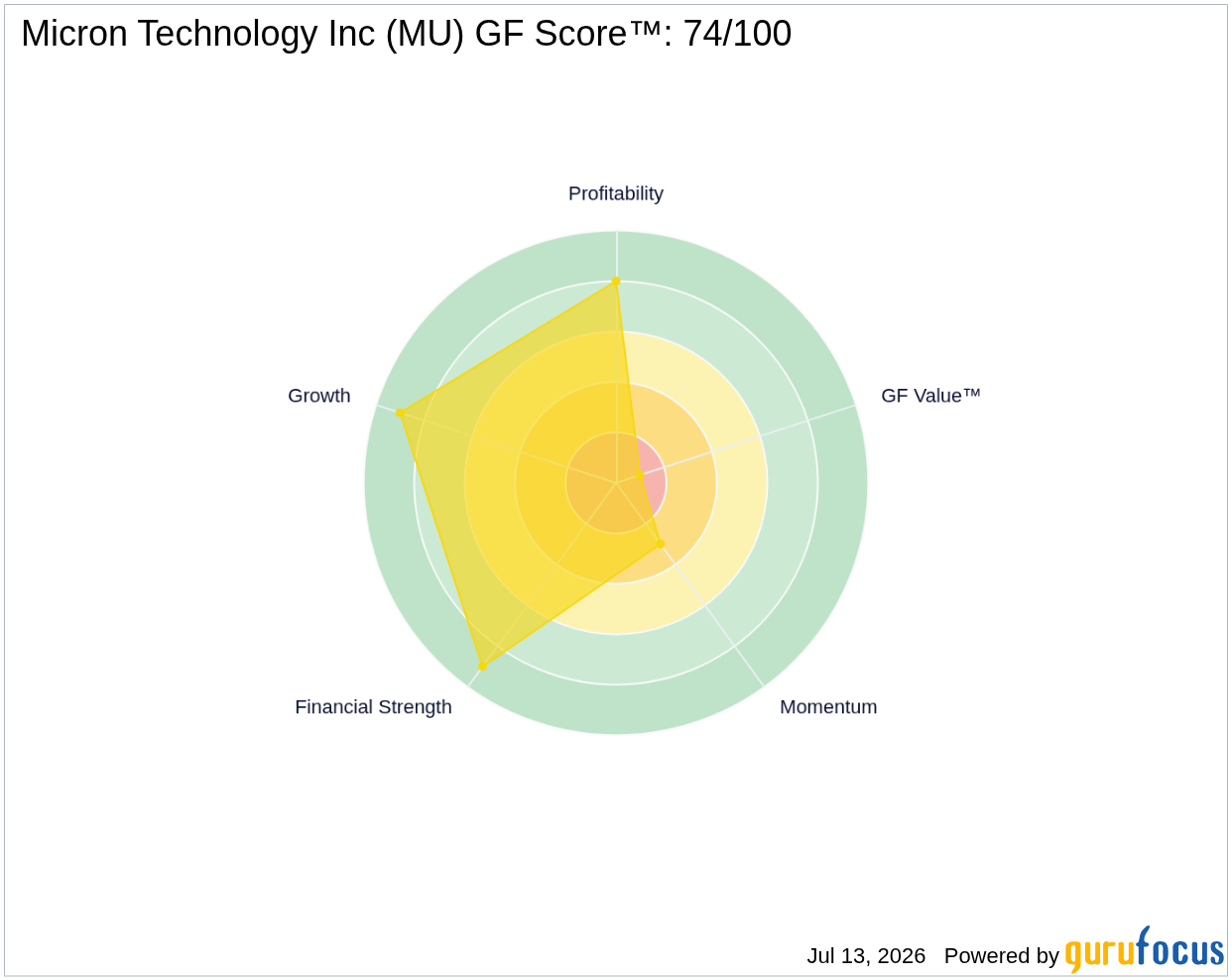
TD Cowen has reaffirmed a "Buy" rating for Micron Technology (MU) with a $1600 target price, citing an anticipated structural shortage of high-bandwidth memory due to AI-driven infrastructure development. Despite this optimistic outlook, GuruFocus indicates that Micron is significantly overvalued at its current trading price of $979.30 compared to its GF Value™ of $512.62, and recent insider selling raises potential concerns for investors. The company's GF Score™ of 74/100 highlights strong financial strength, profitability, and growth, though valuation and momentum are lower.

Rothschild Redburn initiated coverage on Fastenal Co. (NASDAQ:FAST) with a buy rating and a price target of $55.00, citing the company's service-intensive model and advanced shift towards serving large customers. Fastenal's decade of market share gains has been driven by its transition to onsite locations and vending machines, maintaining a 45% gross profit margin. Despite appearing overvalued by InvestingPro data, four analysts have revised earnings upwards, indicating a bullish outlook.

The Global X AI Semiconductor & Quantum ETF (CHPX) has received a 'Buy' rating due to its significant holdings in leading AI semiconductor companies like Micron, TSM, and Nvidia, which demonstrate strong cost efficiency, profitability, and innovation. Despite a high expense ratio and low yield, the ETF's impressive 82% year-to-date return and positive AI-driven growth prospects justify its valuation, though investors should be prepared for volatility in the semiconductor sector.

Semiconductor companies such as Nvidia, Micron, Broadcom, and Applied Materials are projected to collectively generate $430 billion in free cash flow over the next year, tripling their total from two years ago. This surge is attributed to the AI boom, benefiting companies supplying AI infrastructure. Conversely, major tech giants like Amazon, Alphabet, Meta Platforms, Microsoft, and Oracle are expected to see their combined free cash flow turn negative for the first time as they heavily invest in AI infrastructure.
Last week, retail traders were keenly focused on several tech stocks due to significant company developments. Apple is suing OpenAI for trade secret theft related to AI hardware, while Micron expanded its U.S. chip manufacturing investment to $250 billion. Microsoft announced 4,800 job cuts, and Meta Platforms pulled an AI image tool from Instagram due to privacy concerns, yet saw its stock gain significantly. Additionally, Alibaba Cloud received a boost as China allowed access to Nvidia AI chips.

Rambus has launched a new DDR5 9600 Server RDIMM chipset, featuring its sixth-generation Registering Clock Driver (RCD06), to meet the escalating memory demands of AI, HPC, and data center applications. This chipset enables RDIMMs to operate at speeds up to 9,600 MT/s, providing higher bandwidth and capacity crucial for large language model inference and other data-intensive workloads. The solution integrates the RCD06, PMIC5030 power management IC, and an SPD Hub with a temperature sensor, aiming to enhance signal and power integrity while simplifying design for memory module manufacturers.

Candriam S.C.A. increased its stake in Intel Corporation to $16.04 million in the first quarter, now holding 363,368 shares. Despite this increased institutional interest and recent analyst upgrades, Intel currently holds a consensus "Hold" rating with an average target price of $97.88. The company reported strong Q1 earnings, beating expectations with EPS of $0.29 and revenue of $13.58 billion, and has seen improving operating margins.

American Trust increased its stake in Bank of America Corporation (NYSE:BAC) by 105.6% during the first quarter, acquiring an additional 22,849 shares and bringing its total holdings to 44,489 shares valued at $2.169 million. Other institutional investors like Handelsbanken Fonder AB, Legal & General Group Plc, and Nisa Investment Advisors LLC also significantly modified their holdings in BAC. Analysts maintain a "Moderate Buy" rating for Bank of America, with an average price target of $62.19, amid positive sentiment regarding consumer spending, financial inflows, and anticipated strong Q2 earnings.

Western Digital (WDC) is currently trading below a key resistance level, facing technical pressure despite optimistic analyst forecasts driven by long-term AI-driven demand for high-capacity HDDs. The company is set to report Q4 FY2026 earnings on July 29th, with expectations of significant EPS and revenue growth. While some analysts have high price targets, the stock faces a short setup if it breaks below short-term support, and investors are closely watching management guidance regarding hyperscaler demand.
Micron Technology has secured $22 billion in customer commitments through 16 strategic agreements for memory-chip supply, a move strengthening its position in the AI market. These multi-year arrangements include take-or-pay clauses and pricing floors, shifting some capacity and pricing risk to customers. Despite potential future market fluctuations, these agreements signal robust demand for high-bandwidth memory crucial for AI deployments.
Morgan Stanley warns of "chipflation," a phenomenon where memory chip prices rise due to persistent demand outstripping supply from hyperscaler investments in compute capacity. Despite initial hardware deployment, the focus is shifting to utilization and returns on investment, making now a prime time to invest in companies with durable competitive advantages. The article recommends Micron Technology and Broadcom as two AI chip stocks poised to benefit from this environment due to their critical roles in memory and networking infrastructure, respectively.

This article summarizes key Apple-related news from the past week, including Apple's lawsuit against OpenAI for alleged trade secret misuse and the potential for Macs to be Apple's primary AI platform. It also highlights the growing reliance of tech giants like Nvidia and Apple on TSMC for chip manufacturing and how rising prices and profits in the tech sector are driven by increasing demand for AI.
Micron Technology Inc. (MU) is positioned as a leading AI stock within D. E. Shaw's portfolio, with its shares significantly appreciating over the last year. The company is a crucial American manufacturer of high-end memory chips, essential for the AI industry, and recently announced a $3 billion investment in U.S. chip manufacturing facilities. ClearBridge Large Cap Growth Strategy also highlighted Micron's potential due to growing AI infrastructure investment, seeing it as a key way to diversify semiconductor holdings.
Sandisk (SNDK) and Kioxia Corporation have commenced production of their 10th generation 3D flash memory, leading to significant short-term stock price movements. Despite recent AI storage wins and product news, a popular narrative suggests Sandisk's stock might be 8.1% overvalued at $1,915.92 compared to a fair value of $1,772.91, primarily due to optimistic assumptions about AI and memory supply. Investors are advised to examine the underlying assumptions and potential risks, such as a swing from tight NAND supply to oversupply.

The VanEck Semiconductor ETF (SMH) has significantly outperformed Nvidia stock over the past year, returning 113.17% compared to Nvidia's 28.72%. This strong performance is attributed to the widespread AI infrastructure buildout benefiting the entire chip sector, not just individual companies. SMH's diversified holdings across the semiconductor value chain offer a more robust way for investors to capitalize on the AI theme with less single-stock risk.
Morgan Stanley warns that the current stock market rally, largely driven by AI spending, faces significant risks despite aggressive growth forecasts. The bank projects AI investment to reach $1.2 trillion by 2027, but cautions that any hesitation in Q2 earnings from major AI spenders could impact the market. Additionally, potential headwinds include rising oil prices and a more hawkish Federal Reserve stance, which could challenge the current optimistic outlook.

KLCM Advisors Inc. significantly reduced its stake in General Motors (NYSE:GM) by 96.7% in the first quarter, selling 163,868 shares, though other institutional investors have shown mixed activity. Despite some insider selling and a softer U.S. sales outlook, analysts maintain a "Moderate Buy" consensus with an average price target of $97.32, supported by strong quarterly earnings that beat estimates and strategic shifts into energy and advanced battery production. The company also announced a quarterly dividend of $0.18 per share.
The VanEck Semiconductor ETF (SMH) saw a significant 82.1% surge in the first half of 2026, outperforming Nvidia despite Nvidia's major market cap. This strong performance is attributed to the ETF's diversified, capped approach to semiconductor stocks, particularly benefiting from the outperformance of semiconductor equipment manufacturers. The article suggests that increased AI spending and a shift in demand towards CPUs for inference (used more for inference) over GPUs (used for building models) contributed to the success, highlighting the benefits of sector-wide diversification in investing.

ACR Alpine Capital Research LLC reduced its stake in General Motors (NYSE:GM) by 14.1% during the first quarter, selling over 659,000 shares. Despite this, General Motors remains a significant holding for ACR Alpine Capital Research, constituting 4.5% of their portfolio. Other institutional investors like Tsfg LLC and Sumitomo Life Insurance Co. increased their holdings, and analysts have issued new price targets, with a consensus "Moderate Buy" rating.

Morgan Stanley analyst Joseph Moore has reiterated a buy rating for Nvidia (NVDA) stock, setting a price target of $288. This suggests a potential 43% return from its current price of $202, as the analyst remains bullish on the AI sector and semiconductor manufacturers. Moore's previous predictions, including for Micron stock, have proven accurate, indicating his confidence in NVDA's future performance.
The AI trade has experienced high volatility recently, with sharp swings in technology stocks due to reassessments of elevated valuations and macroeconomic concerns. Despite this, investor confidence in AI's long-term growth remains. The article suggests that equal-weight ETFs can help investors balance their AI exposure, reducing concentration risk while still benefiting from the sector's growth potential.

TD Cowen has reiterated a Buy rating and a $1,600 price target for Micron Technology stock, citing persistent supply constraints and strong demand expected to continue beyond 2027. The company hosted meetings with Micron's leadership, who confirmed that physical constraints are limiting supply while customer demand remains robust, with nearly 50% of total revenues projected to be covered by long-term supply and capacity agreements. Analyst Krish Sankar also noted that recent field work suggests DDR average selling prices will see significant growth, leading to potential upside for the Street’s earnings per share estimates for calendar year 2027.

Former President Donald Trump celebrated Micron Technology's expanded commitment to invest $250 billion in U.S. semiconductor manufacturing, up from a previous $200 billion. He hailed this as "The Trump Effect," emphasizing that the investment will create thousands of jobs, particularly in New York where the company is building what is expected to be the largest chip manufacturing site in American history, while also boosting economic and national security. Micron CEO Sanjay Mehrotra also attributed the increased investment and accelerated schedule to Trump's leadership and policies.
Tower Semiconductor (TSEM) recently announced a significant milestone, shipping over five million coherent photonic integrated circuits for Marvell Technology customers, driven by increasing AI computing demand. Despite recent share price fluctuations, the company has shown strong longer-term momentum. Analysts suggest TSEM may be undervalued with a fair value of $313.83, though its high P/E ratio signals a potentially rich entry point.

Venu Holding Corp CEO Jay W. Roth recently purchased 7,850 shares of the company's common stock for $19,910, at a price of $2.5364 per share. This purchase occurs while the stock is trading near its 52-week low, and InvestingPro suggests it is undervalued with potential for upside. Roth's direct and indirect holdings in the company are now substantial, and Venu Holding Corp has also recently engaged in significant sale-leaseback transactions and been added to the Russell 2000 and 3000 indexes.

This article compares SanDisk (SNDK) and Micron Technology (MU), two memory stocks heavily influenced by AI demand, identifying Micron as the safer investment. Micron benefits from owned U.S. fabrication plants, broad product offerings including HBM4, and locked-in contracts, contrasting sharply with SanDisk's dependence on the Kioxia JV for manufacturing and its higher valuation. While both companies have seen significant growth, SanDisk's recent consumer segment slip and manufacturing dependency make it a riskier choice.

Ambarella's VP of Business Development and Marketing, Chen Yun-Lung, sold 5,958 ordinary shares of the company's stock for $468,656 on July 9, 2026. This transaction leaves him with 60,557 shares. The sale occurs as Ambarella's stock shows strong momentum but is considered slightly overvalued, despite analysts projecting profitability and significant growth in its AI and automotive segments.

Tracy G. Smith, EVP and CFO of Optical Cable Corp (NASDAQ:OCC), sold $284,189 worth of company stock across two transactions on June 30 and July 9, 2026. Following these sales, Ms. Smith still holds 329,826 shares. The transactions occurred while OCC's stock is trading at $15.81, significantly above its 52-week low but considered overvalued by InvestingPro.

SanDisk Corporation's stock (SNDK) rose by 3.00% on July 10, primarily due to increased demand for semiconductor and data storage components, particularly high-performance memory and NAND flash. This surge is also influenced by the expansion of AI infrastructure and speculation about a significant supply agreement with a major hyperscale cloud provider. Despite neutral technical indicators, the company's strong annual revenue of $7.36 billion positions it favorably in the Technology Equipment sector, though extreme valuation and sector cyclicality pose risks.