
%22%2F%3E%0A%20%20%3Ccircle%20cx%3D%22220%22%20cy%3D%22150%22%20r%3D%22180%22%20fill%3D%22%2322d3ee%22%20fill-opacity%3D%220.12%22%2F%3E%0A%20%20%3Ccircle%20cx%3D%221010%22%20cy%3D%22130%22%20r%3D%22220%22%20fill%3D%22%2338bdf8%22%20fill-opacity%3D%220.08%22%2F%3E%0A%20%20%3Ccircle%20cx%3D%22920%22%20cy%3D%22520%22%20r%3D%22170%22%20fill%3D%22%2322d3ee%22%20fill-opacity%3D%220.06%22%2F%3E%0A%20%20%3Cpath%20d%3D%22M140%20430h920%22%20stroke%3D%22url(%23line)%22%20stroke-width%3D%2212%22%20stroke-linecap%3D%22round%22%2F%3E%0A%20%20%3Cpath%20d%3D%22M220%20360c120-150%20260-220%20380-220s260%2070%20380%20220%22%20fill%3D%22none%22%20stroke%3D%22%2367e8f9%22%20stroke-opacity%3D%220.5%22%20stroke-width%3D%2216%22%20stroke-linecap%3D%22round%22%20stroke-linejoin%3D%22round%22%2F%3E%0A%20%20%3Cpath%20d%3D%22M300%20398h600%22%20stroke%3D%22%2394a3b8%22%20stroke-opacity%3D%220.24%22%20stroke-width%3D%228%22%20stroke-linecap%3D%22round%22%2F%3E%0A%20%20%3Ctext%20x%3D%22220%22%20y%3D%22510%22%20fill%3D%22%23e2e8f0%22%20fill-opacity%3D%220.7%22%20font-family%3D%22Arial%2C%20Helvetica%2C%20sans-serif%22%20font-size%3D%2238%22%20letter-spacing%3D%228%22%3EINSIGHTS%3C%2Ftext%3E%0A%3C%2Fsvg%3E)
Bottom line
Warsh just turned the Fed from a single-mandate inflation fighter into a multi-task force monetary experiment - and the AI capex question is the wedge that will define his chair.
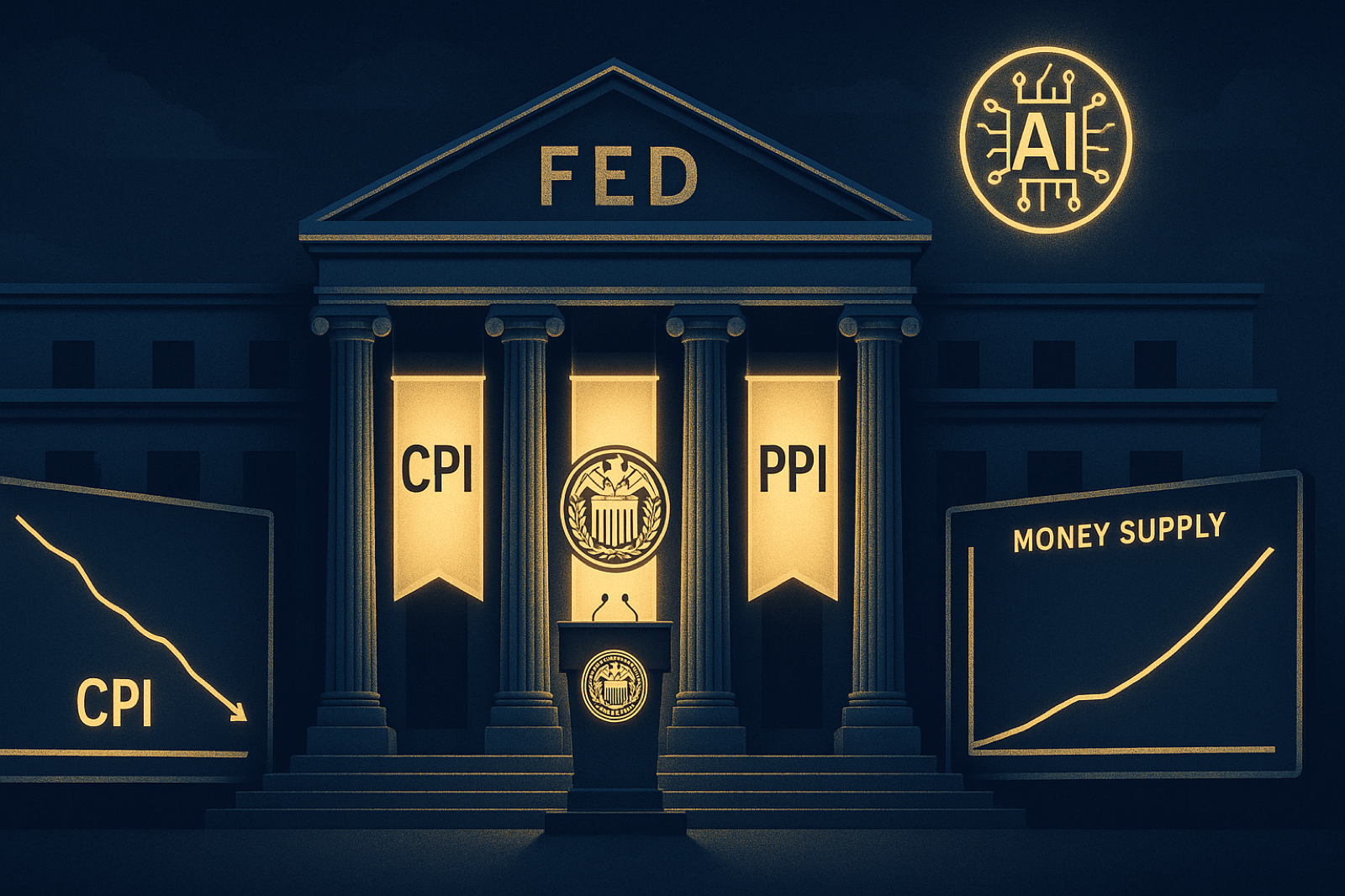
CNBC's Matt Peterson reported on July 15, 2026 that Fed Chair Kevin Warsh used two days of congressional testimony to launch a multi-pronged review of how the Fed measures inflation, restore money-supply reporting to Congress, and convene an all-bullish AI task force - all while CPI and PPI both printed unexpected declines. CPI fell 0.4% MoM in June, the biggest monthly drop since April 2020, bringing YoY inflation down to 3.5%. PPI fell 0.3% MoM, with goods prices posting a 1.4% monthly decline - the biggest drop since July 2022 - driven by a 12% gasoline drop. Core PPI rose just 0.2% and core less trade services was up 0.1%. The May reading was revised sharply lower, from an initially reported +1.1% to +0.6%.
The reason the test matters more than a normal Fed-meeting cycle is that Warsh used the moment to make three structural changes at once. He launched a task force to review how the Fed measures inflation itself, including a separate task force on AI's impact on prices. He revived the practice of reporting the size of the money supply to Congress - a practice the Powell Fed had considered 'essentially irrelevant.' And he positioned himself as the arbiter of the AI-inflation debate inside the FOMC, with the task force's composition - 'all hugely bullish on AI' per CNBC's reporting - signaling that the Fed's institutional view will lean pro-AI-capex.
For every rate-sensitive sector, every AI capex issuer, and the bond market that has been repricing the Fed governance premium for two years, the read-through is direct. The Fed meets in two weeks. Markets are split on whether rates rise, hold, or fall. A clean Warsh win on the AI-inflation debate - and a soft PCE print later this month - clears the way for a hold. A Cook win on the AI-inflation debate - and a re-acceleration in core PCE - forces a hike. The June CPI/PPI prints are the cleanest single signal that the disinflation regime is intact, and the next two weeks will tell whether Warsh's task-force architecture is the new monetary regime or a one-chair experiment.
The trade that broke
The 'Fed is a single-mandate inflation fighter' trade is being split into 'Fed is a multi-task-force governance experiment' and 'AI capex is the new monetary wedge' - and both sides are repricing.
For most of the post-Powell era, the playbook for Fed policy was that the FOMC was a single-mandate inflation fighter. The target was 2% inflation, the policy tool was the federal funds rate, and the policy debate was framed as 'how fast to cut' or 'how long to hold.' The trade worked because the policy framework was simple and the data was the binding constraint. The Warsh era breaks that framework: the Fed is now a three-task-force governance experiment, with the AI capex question as the new monetary wedge.
The first piece of the new framing is 'Fed is a multi-task-force governance experiment.' Warsh has appointed at least three task forces - one on AI's impact on prices, one on how the Fed measures inflation, and one on the monetary aggregates revival. Each task force is a structural change to the way the Fed makes policy. The AI task force will determine whether AI capex is inflationary or productivity-boosting. The inflation-measurement task force will determine whether the Fed's 2% target is even the right target. The monetary-aggregates task force will determine whether money supply returns as a policy input. None of these will deliver answers for months, but the institutional architecture is being set now.
The second piece is 'AI capex is the new monetary wedge.' Fed Governor Lisa Cook pointed to AI spending as a potential inflation driver in a speech the same day, warning of 'significant price increases for chips, other high-tech equipment, software, and utilities' and saying 'inflation risks now outweighing employment risks.' That is a direct contradiction of Warsh's view that supply will catch up with demand. The two camps inside the FOMC are now publicly disagreeing on whether AI capex is inflationary - and that disagreement is the new monetary wedge. A Cook win forces a hike. A Warsh win holds rates. The next two weeks' data will tell which way the FOMC breaks.
| Name | Ticker | Warsh task force read-through |
|---|---|---|
| Warsh (Chair) | private | Reference: three task forces, supply-catches-demand view, money-supply revival |
| Cook (Governor) | private | Counter: AI capex as inflation driver, 'inflation risks outweighing employment' |
| JPMorgan | JPM | Direct: rate-sensitive bank; net interest margin and credit cycle exposure |
| Bank of America | BAC | Direct: rate-sensitive bank; same dynamic as JPM |
| Wells Fargo | WFC | Direct: rate-sensitive bank; asset-cap conversation is the next watch |
| Microsoft | MSFT | Indirect: AI capex issuer; supply-vs-demand debate directly affects capex framing |
| Nvidia | NVDA | Indirect: AI capex proxy; demand-side pricing pressure if Cook is right |
| Constellation Energy | CEG | Indirect: utility; power demand for AI data centers is the supply-side question |
| 10-Year Treasury | TLT | Direct: bond market repricing the Fed governance premium; Warsh regime uncertainty |
What the numbers say
CPI -0.4% and PPI -0.3% in the same week is the cleanest signal that the disinflation regime is intact - and the bond market is already pricing it.
The June CPI and PPI prints are the cleanest single signal that the disinflation regime is intact. CPI fell 0.4% MoM - the biggest monthly drop since April 2020 - bringing YoY inflation to 3.5%. Core CPI slipped to 2.6% YoY after prices were unchanged for the month. PPI fell 0.3% MoM vs the consensus of unchanged, with goods prices posting a 1.4% monthly decline - the biggest drop since July 2022 - driven by a 12% gasoline drop. Core PPI rose 0.2%, less than the 0.3% consensus, and core less trade services was up just 0.1%. The May PPI reading was revised sharply lower, from an initially reported +1.1% to +0.6%, which is a meaningful data revision.
The Fed's preferred inflation gauge - the personal consumption expenditures price index - is due later this month. For May, the PCE index indicated headline inflation of 4.1% YoY and core of 3.4%. Both are likely to come down following this week's CPI/PPI releases. The market has already started to price the disinflation: stocks were higher Wednesday morning, with traders scaling back expectations for interest rate hikes. September is now a 50-50 bet, according to the CME Group's FedWatch gauge of futures pricing. The bond market is repricing the Fed governance premium, with the 10-year Treasury yield dropping on the news.
The other cleanest single signal is the BoK's first rate hike in three years. The Bank of Korea raised 25bp to 2.75% on July 16, against June CPI at a three-year high of 3.2% and a won that had touched a 17-year low. The BoK hike is the first Asian central bank to tighten in this cycle, and it is the cleanest single read on the divergence between the Fed's disinflation regime and the regional inflation regime. The Fed can hold; the BoK cannot. The Kospi's 6.78% decline on the hike day is the cleanest single read on the regional market's repricing of the AI-memory trade - and the read-through is direct for the U.S. semis tape that the Korea tape follows.
Warsh's Fed: the June inflation print and the multi-task-force framework
Reference points from CNBC reporting on the July 15, 2026 Warsh testimony and the June CPI/PPI releases. The chart documents the inflation surprise, the Fed task force architecture, and the rate-cut pricing.
단위: USD / percent
June CPI MoM (%)
Biggest monthly drop since April 2020; YoY now 3.5%
-0.4
June PPI MoM (%)
Consensus was unchanged; biggest goods drop since July 2022
-0.3
Core CPI YoY (%)
Cooled from prior; still above 2% Fed target
2.6
BoK rate post-hike (%)
First Asian central bank to hike in this cycle
2.8
PPI goods MoM change (%)
Biggest drop since July 2022; gasoline -12%
-1.4
September rate hike probability (%)
CME FedWatch; 50-50 bet after the June prints
50
Why it matters
The Warsh framework is the first structural change to Fed governance since Volcker - and the AI capex question is the wedge that will define his chair.
The macro question underneath the Warsh testimony is whether the Fed is entering a structural regime change. The post-Powell era was a single-mandate inflation-fighting framework with the 2% target as the binding constraint. Warsh's three-task-force architecture is a multi-mandate governance experiment: inflation measurement, AI capex impact, and money-supply revival are all being reviewed simultaneously. None of these will deliver answers for months, but the institutional architecture is being set now - and the read-through is direct for every Fed-sensitive trade.
For rate-sensitive sectors (JPMorgan, Bank of America, Wells Fargo, U.S. Bancorp, Truist Financial, Regions Financial), the framework change is a multiple-expansion catalyst. A clean Warsh win on the AI-inflation debate clears the way for a hold and a continued steepening curve, which is the cleanest setup for the bank cohort. A Cook win forces a hike, which compresses the curve and pressures the bank's net interest margin. The next two weeks' data will tell which way the FOMC breaks.
For AI capex issuers (Microsoft, Alphabet, Amazon, Meta, Nvidia, Broadcom), the framework change is a multiple-compression catalyst if Cook wins and a re-rating catalyst if Warsh wins. Cook's view that AI capex is inflationary means the FOMC will slow the capex stack; Warsh's view that supply will catch up with demand means the capex stack continues unimpeded. The next two weeks' data will tell which view the FOMC adopts. For the bond market, the Warsh regime is the cleanest single read on the Fed governance premium - and the 10-year Treasury yield is already pricing the disinflation regime. The next two weeks' PCE print is the binding test.
- Warsh launched three task forces at once: AI spending impact, inflation measurement, and monetary aggregates revival.
- June CPI -0.4% MoM (biggest drop since April 2020) and PPI -0.3% MoM are the cleanest disinflation signal of 2026.
- Cook's speech on AI capex as an inflation driver is the public disagreement that will define the next FOMC meeting.
- BoK's first hike in three years (to 2.75%) is the cleanest signal that the regional inflation regime is diverging from the Fed.
- The September FOMC is the binding test: clean Warsh win = hold; Cook win = hike; PCE print later this month is the variable.
What to watch
Watch the PCE print, the September FOMC, the AI task force composition, and the bond market's repricing of the Fed governance premium.
The first tell is the late-July PCE print. The Fed's preferred inflation gauge is due later this month, and both headline and core are likely to come down following this week's CPI/PPI releases. A clean PCE print confirms the disinflation regime and locks in a Warsh-friendly hold. A hot PCE print - especially on services or supercore - reopens the Cook-vs-Warsh debate and pushes the September FOMC to a closer call.
The second tell is the September FOMC. Watch the dot plot, the statement language on 'data dependent,' and the press conference tone. A clean hold with dovish guidance is the path for the rate-sensitive rotation to extend through year-end. A hike with hawkish guidance (data-dependent, waiting on more prints) caps the rotation. A cut with dovish guidance is the bullish surprise that the bond market is starting to price.
The third tell is the AI task force composition. The task force members are 'all hugely bullish on AI' per CNBC, which means the institutional view will lean pro-AI-capex. A task force that adds labor or anti-monopoly voices is a re-rating catalyst for the inflation-side of the debate. A task force that remains all-bullish is a re-rating catalyst for the AI capex cohort. The fourth tell is the bond market. The 10-year Treasury yield has been dropping on the disinflation news; a continued drop is a clean signal that the market is pricing the Warsh regime as disinflationary. A reversal is a clean signal that the market is pricing the Cook regime as inflationary.