
%22%2F%3E%0A%20%20%3Ccircle%20cx%3D%22220%22%20cy%3D%22150%22%20r%3D%22180%22%20fill%3D%22%2322d3ee%22%20fill-opacity%3D%220.12%22%2F%3E%0A%20%20%3Ccircle%20cx%3D%221010%22%20cy%3D%22130%22%20r%3D%22220%22%20fill%3D%22%2338bdf8%22%20fill-opacity%3D%220.08%22%2F%3E%0A%20%20%3Ccircle%20cx%3D%22920%22%20cy%3D%22520%22%20r%3D%22170%22%20fill%3D%22%2322d3ee%22%20fill-opacity%3D%220.06%22%2F%3E%0A%20%20%3Cpath%20d%3D%22M140%20430h920%22%20stroke%3D%22url(%23line)%22%20stroke-width%3D%2212%22%20stroke-linecap%3D%22round%22%2F%3E%0A%20%20%3Cpath%20d%3D%22M220%20360c120-150%20260-220%20380-220s260%2070%20380%20220%22%20fill%3D%22none%22%20stroke%3D%22%2367e8f9%22%20stroke-opacity%3D%220.5%22%20stroke-width%3D%2216%22%20stroke-linecap%3D%22round%22%20stroke-linejoin%3D%22round%22%2F%3E%0A%20%20%3Cpath%20d%3D%22M300%20398h600%22%20stroke%3D%22%2394a3b8%22%20stroke-opacity%3D%220.24%22%20stroke-width%3D%228%22%20stroke-linecap%3D%22round%22%2F%3E%0A%20%20%3Ctext%20x%3D%22220%22%20y%3D%22510%22%20fill%3D%22%23e2e8f0%22%20fill-opacity%3D%220.7%22%20font-family%3D%22Arial%2C%20Helvetica%2C%20sans-serif%22%20font-size%3D%2238%22%20letter-spacing%3D%228%22%3EINSIGHTS%3C%2Ftext%3E%0A%3C%2Fsvg%3E)
Bottom line
The BoK's first hike since January 2023 is the first Asian central-bank admission that the regional currency-defense regime is ending - and the won at 1,485 is still 5% weaker than cycle support.
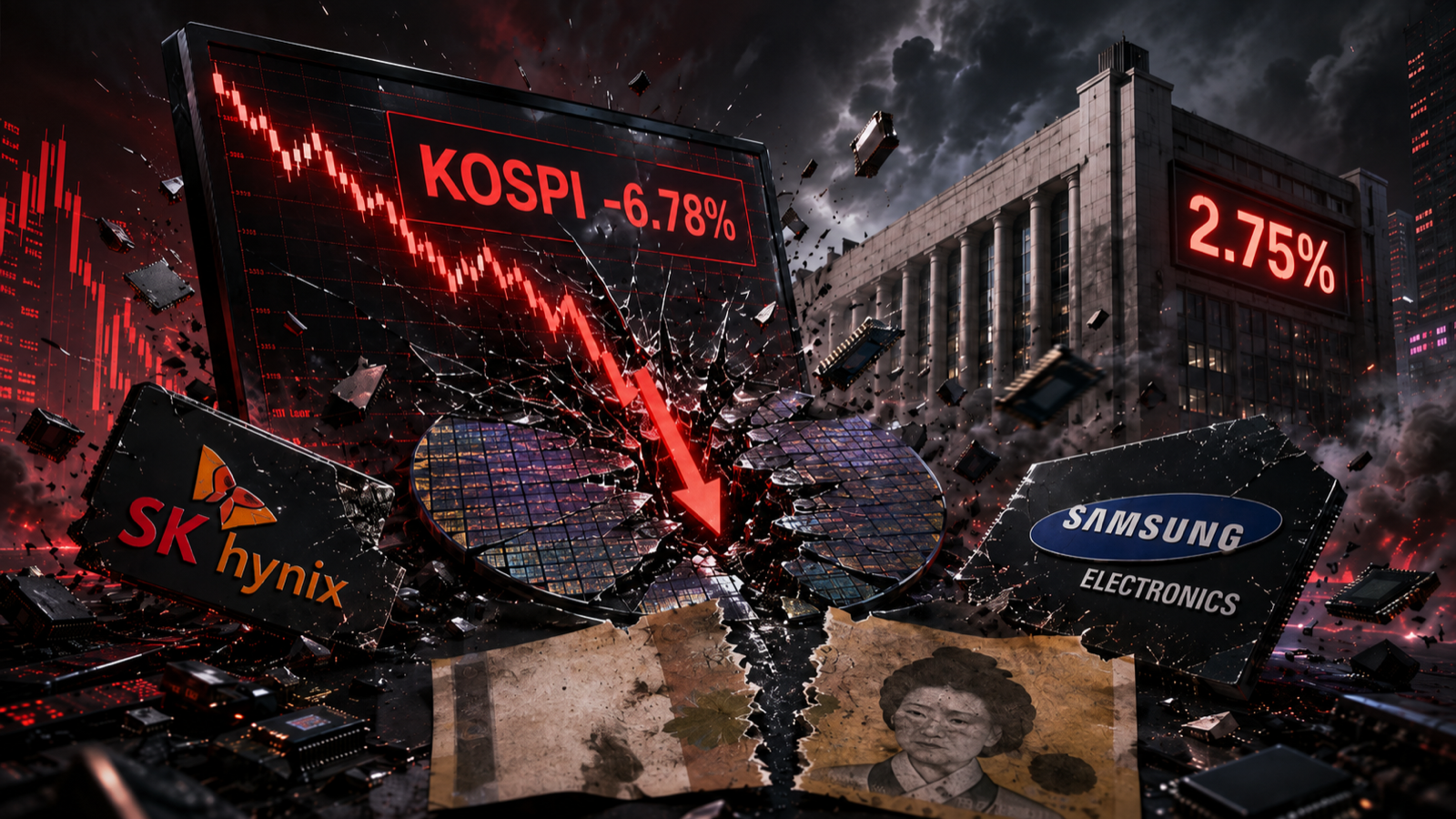
The Bank of Korea hiked its benchmark policy rate by 25 basis points to 2.75% on July 16, 2026, the first hike since January 2023, according to CNBC's Lim Hui Jie reporting. The move came against a backdrop of June headline CPI at a three-year high of 3.2% and a won that had touched a 17-year low of 1,561.5 against the dollar on June 5, 2026. The hike was in line with median estimates from economists polled by Reuters, but the timing matters: it lands in the same session as a -6.78% Kospi close at 6,790.23 and a 10% intraday drop in SK Hynix, making the BoK the first Asian central bank to hike into a falling equity tape this cycle.
BOK Governor Shin Hyun Song reportedly told Seoul's parliament last week that there was 'ample room for the won to strengthen going forward,' adding 'we are currently accumulating a very large current account surplus.' The current account surplus is real - Korea has been running surpluses for most of 2024-2026 - but the equity tape is not buying the strengthening thesis yet. The won at 1,484.86 is still roughly 5% weaker than the 1,400 level that historically supports Korean exporter earnings, and roughly 8% weaker than the 1,375 level that the BOK's own stress-test framework uses as a baseline.
For Samsung Electronics, SK Hynix, Hyundai Motor, Kia, POSCO, KB Financial, Shinhan Financial, and NAVER, the read-through is direct. Higher Korean rates raise the cost of capital at exactly the moment the equity tape is rolling over. The trade used to be 'Korea benefits from a weak won and AI demand'; it is now 'Korea has a central bank that has just hiked for the first time in three years, against sticky inflation, a weak currency, and a falling chip tape.' The funding-cycle ceiling has just been raised.
The trade that broke
The 'weak won is a tailwind for Korean exporters' trade is being split into 'weak won is now a policy problem' and 'strong won would hurt exporters' - both sides of the trade are repricing.
For most of 2024 and 2025, the playbook for Korean equities was that a weak won was a tailwind for the export-heavy Kospi cohort. Samsung Electronics, SK Hynix, Hyundai Motor, Kia, and POSCO all benefit from a weak won because their export revenue is denominated in dollars while their cost base is in won. The trade worked as long as the won weakness was managed by the BoK's verbal interventions and the threat of rate hikes, without the BoK having to actually hike. That trade broke on July 16 when the BoK actually hiked - for the first time in over three years - and the equity tape still fell 6.78%.
The first piece of the new framing is 'weak won is now a policy problem.' The BoK's hike is a direct response to the won's weakness: a stronger won would help on the import side (lower oil, lower commodity costs) and on the inflation side (lower pass-through into domestic prices). The hike makes holding won more attractive, which should support the currency over time. The problem is that the equity tape does not believe the BoK's tightening will be sufficient - the won at 1,484.86 is still well below the 1,400 cycle-supportive level, and the BoK's own commentary suggests it is buying time, not declaring victory.
The second piece is 'strong won would hurt exporters.' A move toward 1,400 - the level that historically supports Korean exporter earnings - would mean a roughly 6% won appreciation from current levels. For Samsung Electronics and SK Hynix, every 1% won appreciation is roughly a 0.7% headwind to operating profit on the export side. For Hyundai Motor and Kia, the elasticity is similar but with a U.S.-plant offset. The trade used to be one-sided (weak won = exporter tailwind); it is now two-sided (weak won = policy risk; strong won = exporter margin pressure), and the equity tape is repricing for both sides.
| Name | Ticker | BoK hike read-through |
|---|---|---|
| Samsung Electronics | 005930.KS | DRAM/HBM leader; export-heavy; weaker won helps but BoK hike raises cost of capital |
| SK Hynix | 000660.KS | HBM leader; -10% on Jul 16; tracking U.S. MU sell-off; BoK hike adds funding pressure |
| Hyundai Motor | 005380.KS | Auto exporter; U.S.-plant production partially offsets won move; FX-sensitive |
| Kia | 000270.KS | Auto exporter; similar FX dynamic to Hyundai; U.S. footprint growing |
| POSCO | 005490.KS | Steel/materials exporter; BoK hike signals domestic demand resilience |
| KB Financial | 105560.KS | Bank; net interest margin benefits from BoK hike; equity was -6.78% on the day |
| Shinhan Financial | 055550.KS | Bank; similar NIM-positive setup; tracks Kospi tape |
| NAVER | 035420.KS | Internet/fintech; domestic-demand heavy; BoK hike signals inflation regime |
What the numbers say
3.2% CPI, 2.75% BoK, won at 1,485 - the math says the BoK is buying time, not declaring victory.
The Bank of Korea's policy setup is now the cleanest in Asia. June headline CPI at 3.2% is a three-year high and well above the BoK's 2% target. The +25bp hike to 2.75% brings the real policy rate (nominal minus CPI) to roughly -0.45%, which is still accommodative in real terms but less so than the -0.7% real rate at the prior 2.50% setting. The BoK is moving from 'clearly accommodative' to 'modestly accommodative,' not from 'accommodative' to 'restrictive.' That is consistent with the equity tape's read: a single hike, not a hiking cycle.
The Q1 2026 GDP print of +3.8% YoY - the strongest growth since Q4 2021 - gives the BoK room to tighten without choking the recovery. The BoK's own commentary cited the large IT-sector performance bonuses as a risk that wage increases could spread into broader inflation, which is a forward-looking concern about the labor-market side of the inflation equation. The current account surplus is real and large; Governor Shin's 'ample room for the won to strengthen' comment is consistent with that.
The won's path is the cleanest single signal. At 1,484.86 on July 16, the won is still 5.4% weaker than the 1,400 level and 8% weaker than the 1,375 BoK baseline. A further move toward 1,500 would force a second hike; a move toward 1,450 would confirm the BoK's verbal intervention is working and would be a re-rating catalyst for the chip cohort. The tape on July 16 priced the lower-confidence outcome: the BoK hiked, but the won did not strengthen materially, and the equity tape fell 6.78%.
Bank of Korea: policy rate, CPI, and the won (July 2026)
Reference points from CNBC reporting on the July 15-16, 2026 BoK decision and the Kospi close. The chart documents the BoK rate, the June CPI print, and the won's distance from the 1,400 cycle-supportive level.
단위: USD / percent / KRW
BoK rate post-hike (%)
First hike since Jan 2023; +25bp from 2.50%
2.8
BoK June CPI YoY (%)
Three-year high; above the 2% BoK target
3.2
Real policy rate (%)
2.75% nominal minus 3.2% CPI; still accommodative in real terms
-0.5
Q1 2026 GDP YoY (%)
Strongest growth since Q4 2021; gives BoK room to tighten
3.8
Won vs 1,400 level (%)
Current 1,484.86; 5.4% weaker than 1,400 cycle-supportive level
5.4
Won vs 1,375 baseline (%)
Current 1,484.86; 8.0% weaker than 1,375 BoK stress-test baseline
8
Why it matters
The BoK is the first Asian central bank to hike in this cycle. The RBA, BoJ, and BSP now have to decide whether to follow.
The macro question underneath the BoK hike is whether the regional currency-defense regime that defined 2024-2025 Asia is ending. The Bank of Japan has been tapering its yield-curve control but not hiking. The Reserve Bank of Australia has held at 4.35% for the cycle. The Bangko Sentral ng Pilipinas has been on hold. The Bank of Thailand has been the most dovish in the region. The BoK is now the first Asian central bank to hike in this cycle - and the equity tape is repricing the Korean cohort, not the regional cohort, which tells you the market sees this as a Korea-specific move, not a regional regime change.
For Samsung Electronics and SK Hynix, the BoK hike is a domestic-funding-cost headwind that compounds the U.S. memory-demand repricing. For Hyundai Motor and Kia, the hike is a small NIM-positive signal (auto financing benefits) but a small cost-of-capital negative. For KB Financial and Shinhan Financial, the hike is unambiguously positive for net interest margin - banks earn more on their loan books when rates rise. The trade split is: long Korean banks, neutral on autos, cautious on chips.
For the broader Asian equity funnel, the read-through is that the BoK is buying time, not declaring victory. The won at 1,485 is still well below the levels that historically support Korean exporter earnings. If the won weakens back toward 1,560, the BoK will have to hike again. If the won strengthens toward 1,450, the BoK will hold and the equity tape can re-rate. The BoK's first hike is not the end of the regional currency-defense regime - it is the first chapter of a new one. The next chapters are written in the won, in the CPI, and in the U.S. semis tape that the Korea tape follows.
- BoK hiked 25bp to 2.75% on July 16 - first hike since January 2023 - against June CPI at 3.2% (three-year high).
- Won touched a 17-year low of 1,561.5 on Jun 5 and was last at 1,484.86 - still 5.4% weaker than the 1,400 cycle-supportive level.
- Kospi closed at 6,790.23 (-6.78%) on the hike + U.S. chip sell-off combo; the BoK is the first Asian central bank to hike into a falling equity tape this cycle.
- Q1 GDP at +3.8% gives the BoK room to tighten; current account surplus is large; the BoK is buying time, not declaring victory.
- Read-through is direct for Samsung, SK Hynix, Hyundai, Kia, POSCO, KB Financial, Shinhan Financial, and NAVER.
What to watch
Watch the won's path, the next BoK meeting, the U.S. semis tape, and the regional central-bank response.
The first tell is the won's path. A move toward 1,450 would confirm the BoK's tightening is working and would re-rate the chip cohort. A move back toward 1,560 would force a second BoK hike and would compound the equity tape's drawdown. The second tell is the next BoK meeting - any signal of a second hike in Q3 would re-price the entire Korean equity funnel.
The third tell is the U.S. semis tape. If Micron Technology, Nvidia, Broadcom, TSMC, and ASML confirm the Korea tape's drawdown, the repricing is global. If the U.S. tape stabilizes, the Korea move looks like an over-shoot. The fourth tell is the regional central-bank response. If the Bank of Japan, the Reserve Bank of Australia, or the Bangko Sentral ng Pilipinas follows the BoK with a hike or a hawkish hold, the regional currency-defense regime is officially ending. If they hold dovish, the BoK hike is a Korea-specific outlier.