
%22%2F%3E%0A%20%20%3Ccircle%20cx%3D%22220%22%20cy%3D%22150%22%20r%3D%22180%22%20fill%3D%22%2322d3ee%22%20fill-opacity%3D%220.12%22%2F%3E%0A%20%20%3Ccircle%20cx%3D%221010%22%20cy%3D%22130%22%20r%3D%22220%22%20fill%3D%22%2338bdf8%22%20fill-opacity%3D%220.08%22%2F%3E%0A%20%20%3Ccircle%20cx%3D%22920%22%20cy%3D%22520%22%20r%3D%22170%22%20fill%3D%22%2322d3ee%22%20fill-opacity%3D%220.06%22%2F%3E%0A%20%20%3Cpath%20d%3D%22M140%20430h920%22%20stroke%3D%22url(%23line)%22%20stroke-width%3D%2212%22%20stroke-linecap%3D%22round%22%2F%3E%0A%20%20%3Cpath%20d%3D%22M220%20360c120-150%20260-220%20380-220s260%2070%20380%20220%22%20fill%3D%22none%22%20stroke%3D%22%2367e8f9%22%20stroke-opacity%3D%220.5%22%20stroke-width%3D%2216%22%20stroke-linecap%3D%22round%22%20stroke-linejoin%3D%22round%22%2F%3E%0A%20%20%3Cpath%20d%3D%22M300%20398h600%22%20stroke%3D%22%2394a3b8%22%20stroke-opacity%3D%220.24%22%20stroke-width%3D%228%22%20stroke-linecap%3D%22round%22%2F%3E%0A%20%20%3Ctext%20x%3D%22220%22%20y%3D%22510%22%20fill%3D%22%23e2e8f0%22%20fill-opacity%3D%220.7%22%20font-family%3D%22Arial%2C%20Helvetica%2C%20sans-serif%22%20font-size%3D%2238%22%20letter-spacing%3D%228%22%3EINSIGHTS%3C%2Ftext%3E%0A%3C%2Fsvg%3E)
Bottom line
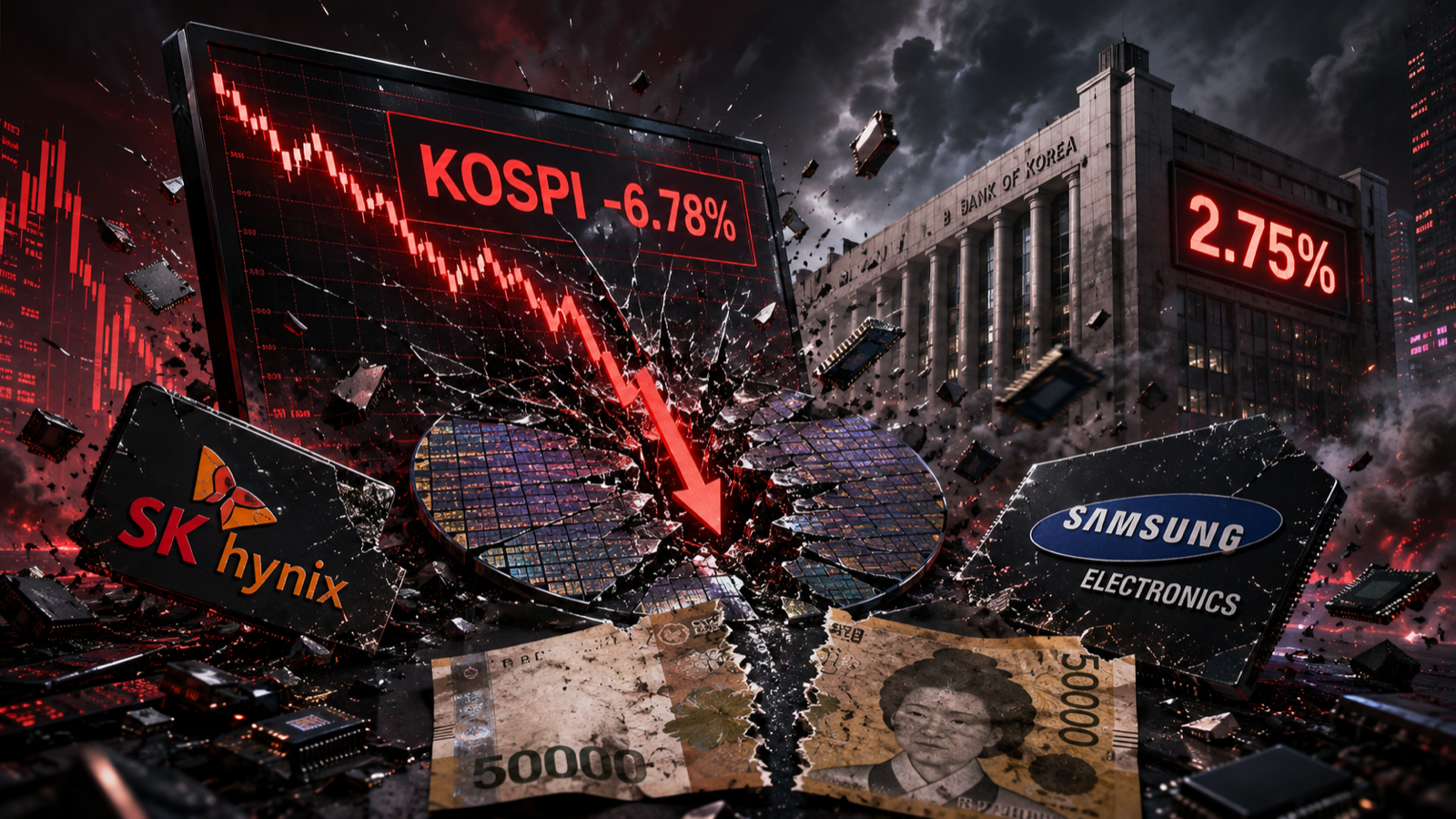
Korea's 10% SK Hynix crash + 6.78% Kospi decline + first BoK hike in three years is the cleanest stress test of the AI-memory trade outside the U.S.
SK Hynix shares tumbled over 9% in Seoul on July 16, 2026, according to CNBC's Lee Ying Shan reporting, reversing the prior session's 8% rally and confirming the headline 'plunge 10% as Asia sees tech rout.' The Kospi closed down 494.18 points at 6,790.23 (-6.78%) - the heaviest single-day decline since the 2024 cycle peak. Samsung Electronics dropped more than 7%, Seoul Semiconductor fell more than 5%, LG Innotek lost about 1%, and Samsung SDI was down over 2%. The Japan tape joined in: Advantest fell more than 6%, SoftBank Group slid nearly 7%, Tokyo Electron lost over 5%, and Renesas Electronics declined 4%.
The catalyst was the U.S. semiconductor sell-off overnight. Micron Technology sank 8%, Intel lost more than 4%, Lam Research fell about 3%, and Advanced Micro Devices fell about 3%. Rolf Bulk, Head of Semiconductor & Infrastructure Equity Research at Futurum Group, told CNBC that 'today's decline is largely a follow-on to the US session overnight,' pointing to the proposed New York data-center moratorium and reports that CoreWeave was exploring hedges against future declines in memory prices as marginally negative signals. New York Governor Kathy Hochul had ordered a temporary halt to new large-scale data center projects earlier this week.
The Bank of Korea's 25bp hike to 2.75% landed in the same session - the first hike since January 2023, against June CPI at a three-year high of 3.2% and a won that had touched a 17-year low of 1,561.5 on June 5. The combined tape - the memory sell-off, the AI-data-center moratorium, the memory-hedge reports, the BoK hike, and the still-depressed won - is the cleanest stress test of the AI-memory trade outside the U.S. since the 2024 cycle peak. For Micron, Nvidia, Broadcom, TSMC, and ASML, the read-through is that the cohort's biggest Asian proxy is now re-pricing in real time.
The trade that broke
The 'AI memory is the cleanest trade in semis' thesis is being split into 'AI memory has a U.S. data-center moat' and 'AI memory has a Korea funding-cycle ceiling'.
For most of 2024 and the first half of 2025, the AI-memory playbook was that HBM, DRAM, and wafer allocation were the cleanest trades in semiconductors. SK Hynix was the HBM leader. Samsung Electronics was the DRAM leader and the HBM challenger. Micron Technology was the U.S. proxy. The trade had a clean thesis: AI capex was rising, memory was the bottleneck, and the Korea tape was the cleanest equity expression. The July 16 tape broke that thesis into two pieces.
The first piece is the 'AI memory has a U.S. data-center moat' trade. Micron Technology's 8% drop on July 15 was driven by New York's data-center moratorium (Governor Hochul's order) and reports that CoreWeave was exploring hedges against future declines in memory prices. That is a U.S.-policy-driven repricing: the data-center buildout - the demand-side backbone of the AI-memory thesis - is now visibly subject to political friction at the state level. The Korea tape follows the U.S. tape because the demand for HBM and DRAM is concentrated in U.S. hyperscalers and U.S. AI labs.
The second piece is the 'AI memory has a Korea funding-cycle ceiling' trade. The Bank of Korea's 25bp hike to 2.75% - the first in over three years - raises the cost of capital for Korean chipmakers at the same moment the equity tape is rolling over. The won, which had touched a 17-year low of 1,561.5 on June 5, is still trading near 1,485 against the dollar. A higher domestic rate supports the won but raises the cost of capex for SK Hynix and Samsung Electronics. The trade used to be 'Korea benefits from a weak won and AI demand'; it is now 'Korea has to manage a stronger won, higher rates, and softer demand at the same time.'
| Name | Ticker | Move (Jul 15-16) | Read-through |
|---|---|---|---|
| SK Hynix | 000660.KS | -10% (Seoul Jul 16) | HBM leader: reversing the prior session's 8% rally on the U.S. sell-off |
| Samsung Electronics | 005930.KS | -7% (Seoul Jul 16) | DRAM leader and HBM challenger: same U.S. overnight tape as SK Hynix |
| Kospi | .KS11 | -6.78% (Jul 16) | Index at 6,790.23; heaviest single-day decline since 2024 cycle peak |
| Micron Technology | MU | -8% (Jul 15 U.S.) | U.S. proxy; catalyst was NY data-center moratorium + CoreWeave hedge reports |
| Tokyo Electron | 8035.T | -5%+ (Jul 16) | Japan semicap: tracking the U.S. sell-off overnight |
| Bank of Korea rate | BoK 7-day repo | +25bp to 2.75% | First hike since Jan 2023; June CPI at 3.2% three-year high |
What the numbers say
Korea is repricing the entire AI-memory thesis - and the BoK's first hike in three years means the funding cycle is also turning.
SK Hynix's 10% single-day decline is the largest of the post-Nasdaq-listing era. The stock had logged its steepest one-day decline on Monday (July 14) before staging an 8% rally on Tuesday (July 15) on the U.S. session; the 10% drop on July 16 reverses that rally in full. The cumulative move over the three sessions is a net negative, which tells you the cohort is no longer being supported by incremental buyers - it is being sold by marginal holders. The Kospi's 6.78% decline at 6,790.23 is the heaviest single-day move since the 2024 cycle peak; that is a tape-wide signal that the entire Korea equity complex is repricing, not just the chip stocks.
The Bank of Korea's 25bp hike to 2.75% is the first since January 2023. The accompanying statement cited June CPI at a three-year high of 3.2% and noted that large IT-sector performance bonuses could spread into broader wage increases, putting upward pressure on inflation. The won had touched a 17-year low of 1,561.5 on June 5, 2026, and was last trading at 1,484.86. BOK Governor Shin Hyun Song reportedly told Seoul's parliament there was 'ample room for the won to strengthen going forward,' but the tape on July 16 was not buying the strengthening thesis.
The Louis Kondratev quote from XFUNDs is the cleanest single-line summary of the macro thesis: 'Semiconductors alone now make up roughly 20% of the S&P 500, which is incredibly difficult to sustain. During the dot-com bubble of 2000, semiconductors were just over 8% of the index, and they have historically averaged between 2% and 5%.' That is the structural argument the tape is now pricing: semis concentration risk has hit a level that is hard to defend on fundamentals. Korea, which is the most concentrated single-country proxy for the AI-memory trade, is the cleanest place to watch the re-pricing in real time.
Korea's July 16 stress test: memory, rates, and the won
Reference points from CNBC reporting on the July 15-16, 2026 sessions. The chart documents the AI-memory sell-off, the BoK rate hike, and the won's position relative to its 17-year low.
Unidad: USD / percent / KRW
SK Hynix move Jul 16 (%)
Largest single-day decline of the post-Nasdaq-listing era
-10
Kospi move Jul 16 (%)
Closed at 6,790.23; heaviest single-day decline since 2024 cycle peak
-6.8
Samsung Electronics move Jul 16 (%)
DRAM leader and HBM challenger; tracking the U.S. tape overnight
-7
Bank of Korea rate (post-hike %)
First hike since Jan 2023; +25bp move
2.8
BoK June CPI YoY (%)
Three-year high; supporting the hike rationale
3.2
KRW/USD (current)
After touching 17-year low of 1,561.5 on Jun 5
1,484.9
Why it matters
If Korea re-prices the AI-memory thesis, the U.S. tape follows - because the demand-side backbone of the thesis is in U.S. hyperscalers.
The macro question underneath the SK Hynix tape is whether the AI-memory thesis is structural (demand outruns supply for years) or cyclical (the 2024-2025 tightness was a window that is now closing). The Korea tape's 10% move on the U.S. overnight sell-off tells you the market is no longer pricing the structural-only thesis. It is pricing a hybrid: structural demand, but cyclical funding cycles, cyclical policy friction, and cyclical concentration risk.
For Micron Technology, Nvidia, Broadcom, TSMC, and ASML, the read-through is direct. The demand-side backbone of the AI-memory thesis is in U.S. hyperscalers (Microsoft, Alphabet, Amazon, Meta), and the U.S. hyperscalers' buildout pace is now visibly subject to state-level political friction. The NY data-center moratorium is the first concrete example of a state pushing back on the AI capex stack. If more states follow, the demand curve for memory shifts down. Korea is the first Asia tape to reprice that possibility.
The BoK hike is the second-order risk. Higher Korean rates raise the cost of capex for SK Hynix and Samsung Electronics at exactly the moment they need to spend aggressively to maintain the HBM lead. The trade used to be 'Korea is a cheap place to build memory'; it is now 'Korea has a central bank that has just hiked for the first time in three years, against a backdrop of sticky inflation and a weak currency.' The funding-cycle ceiling has just been raised, and the equity tape is repricing it in real time.
- SK Hynix's 10% single-day decline is the largest of the post-Nasdaq-listing era; the Kospi fell 6.78% on the same session.
- The Bank of Korea hiked 25bp to 2.75% - the first hike since January 2023 - against June CPI at a three-year high of 3.2%.
- The catalyst was the U.S. semiconductor sell-off overnight: Micron -8%, Intel -4%, Lam Research -3%, AMD -3%.
- NY Governor Hochul's data-center moratorium and CoreWeave's reported memory-price hedges are the new political and financial-engineering pressure points.
- The read-through is direct for MU, NVDA, AVGO, TSM, ASML: Asia is now repricing the AI-memory thesis in real time.
What to watch
Watch the U.S. semis tape for confirmation, the BoK's next move, the won's path, and the NY data-center moratorium's spread to other states.
The first tell is the U.S. semis tape. If Micron Technology, Nvidia, Broadcom, TSMC, and ASML confirm the Korea move with a similar drawdown on July 16, the repricing has gone from Asia-only to global. If the U.S. tape stabilizes, the Korea move looks like an over-shoot driven by time-zone flow and gets faded.
The second tell is the BoK's next move. A second hike in Q3 would confirm that the BoK is in a tightening cycle and would raise the cost-of-capital ceiling further. A hold would suggest the BoK is reacting to one-time FX pressure, not a durable inflation regime, and would be a re-rating catalyst for the Korean chip cohort.
The third tell is the won. If the won strengthens toward 1,450 against the dollar, the funding-cycle pressure eases for Korean chipmakers. If the won weakens back toward 1,560, the BoK hike narrative becomes more important and the equity tape reprices for a second hike. The fourth tell is the NY data-center moratorium's spread to other states - if Virginia, Texas, or California announce similar measures, the AI-memory demand curve shifts down further and the Asia tape's 10% move becomes the first chapter of a larger re-pricing.