
%22%2F%3E%0A%20%20%3Ccircle%20cx%3D%22220%22%20cy%3D%22150%22%20r%3D%22180%22%20fill%3D%22%2322d3ee%22%20fill-opacity%3D%220.12%22%2F%3E%0A%20%20%3Ccircle%20cx%3D%221010%22%20cy%3D%22130%22%20r%3D%22220%22%20fill%3D%22%2338bdf8%22%20fill-opacity%3D%220.08%22%2F%3E%0A%20%20%3Ccircle%20cx%3D%22920%22%20cy%3D%22520%22%20r%3D%22170%22%20fill%3D%22%2322d3ee%22%20fill-opacity%3D%220.06%22%2F%3E%0A%20%20%3Cpath%20d%3D%22M140%20430h920%22%20stroke%3D%22url(%23line)%22%20stroke-width%3D%2212%22%20stroke-linecap%3D%22round%22%2F%3E%0A%20%20%3Cpath%20d%3D%22M220%20360c120-150%20260-220%20380-220s260%2070%20380%20220%22%20fill%3D%22none%22%20stroke%3D%22%2367e8f9%22%20stroke-opacity%3D%220.5%22%20stroke-width%3D%2216%22%20stroke-linecap%3D%22round%22%20stroke-linejoin%3D%22round%22%2F%3E%0A%20%20%3Cpath%20d%3D%22M300%20398h600%22%20stroke%3D%22%2394a3b8%22%20stroke-opacity%3D%220.24%22%20stroke-width%3D%228%22%20stroke-linecap%3D%22round%22%2F%3E%0A%20%20%3Ctext%20x%3D%22220%22%20y%3D%22510%22%20fill%3D%22%23e2e8f0%22%20fill-opacity%3D%220.7%22%20font-family%3D%22Arial%2C%20Helvetica%2C%20sans-serif%22%20font-size%3D%2238%22%20letter-spacing%3D%228%22%3EINSIGHTS%3C%2Ftext%3E%0A%3C%2Fsvg%3E)
Bottom line
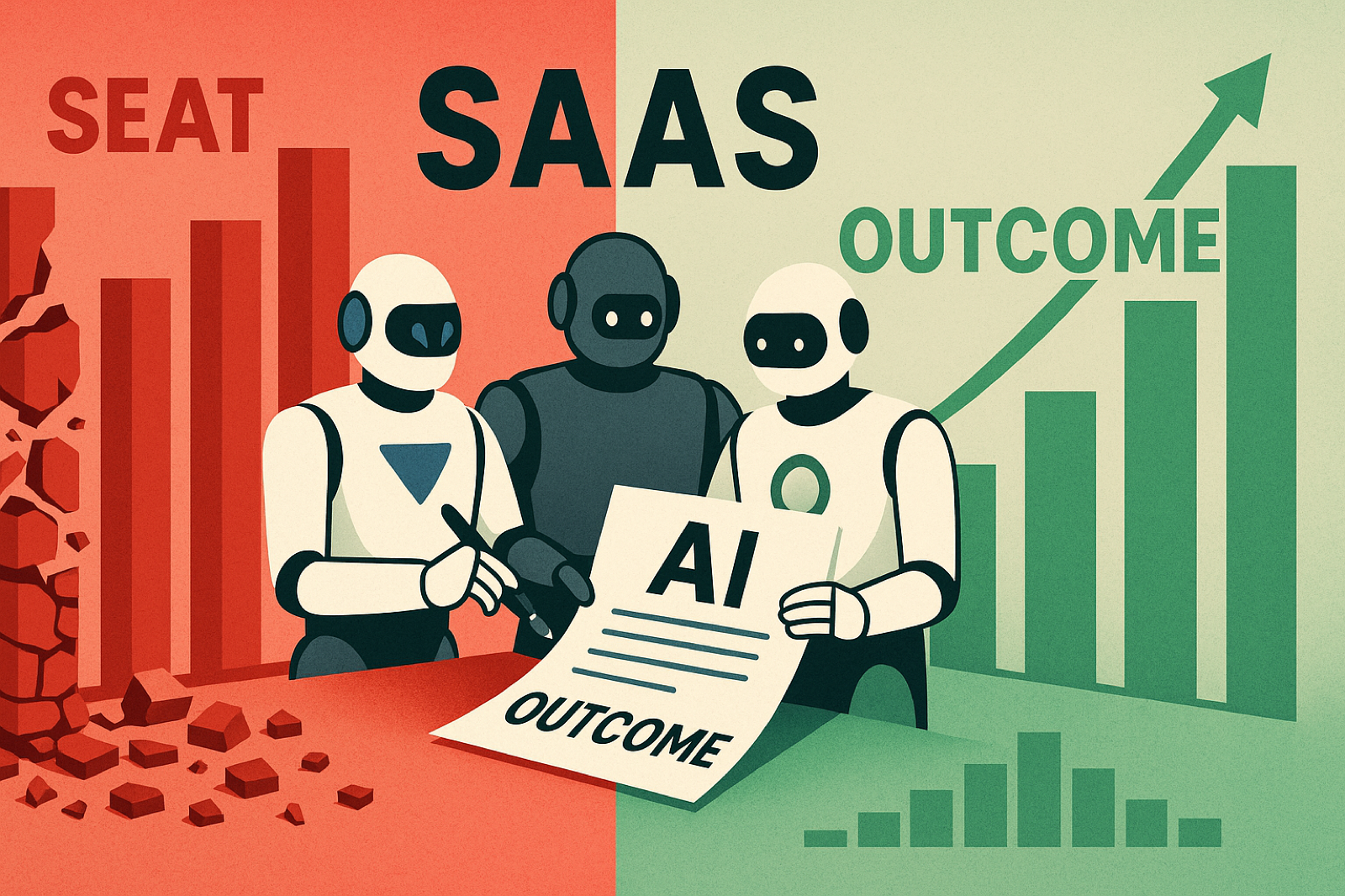
AI agents are about to break the SaaS seat-pricing model - and Sierra's outcome-pricing bet is the cleanest publicly-discussed example of the new contract.
CNBC's Arjun Kharpal reported on July 14, 2026 that Sierra co-founder Clay Bavor said AI agents are moving from demos into real business workflows - particularly customer service, sales, and support - and that outcome-based pricing could challenge the way software companies get paid. The Sierra model is the cleanest publicly-discussed example of the AI-agent outcome-pricing model: instead of charging per seat (the dominant SaaS model for two decades), the AI-agent vendor charges per outcome (resolved ticket, qualified lead, completed task). Bavor explained how Sierra builds and tests customer-facing AI agents before they go live, why companies want clearer ways to measure AI's return on investment, and how outcome-based pricing could challenge the seat-based SaaS model.
The reason the timing matters more than a normal AI-product cycle is that the seat-based SaaS model is the institutional foundation of the entire enterprise-software sector. Salesforce, ServiceNow, Snowflake, MongoDB, Datadog, Workday, Atlassian, HubSpot, and the broader SaaS cohort have all been priced on the assumption that customers pay per seat, per month, and that seat counts grow with customer headcount. The AI-agent outcome-pricing model breaks that assumption: instead of more seats, customers want outcomes - resolved tickets, qualified leads, completed workflows - and the per-outcome cost is typically a fraction of the per-seat cost. The seat-based SaaS cohort is being repriced.
For Salesforce, ServiceNow, Snowflake, MongoDB, Datadog, Workday, Atlassian, HubSpot, and the broader SaaS cohort, the read-through is direct. The AI-agent outcome-pricing model is a multiple-compression catalyst for the seat-based SaaS cohort, and a re-rating catalyst for the AI-vendor cohort that can build agent infrastructure. The trade split is short the seat-based SaaS cohort, long the AI-agent infrastructure cohort. The cleanest single expression of the trade is long the AI-vendor cohort (Sierra, Salesforce Agentforce, ServiceNow AI Agents), short the legacy seat-based SaaS cohort.
The trade that broke
The 'AI agents are feature extensions of the SaaS suite' trade is being split into 'AI agents are a new pricing model' and 'seat-based SaaS is the legacy model that gets repriced'.
For most of 2023-2025, the playbook for AI agents was that they were feature extensions of the existing SaaS suite. Salesforce launched Agentforce as an extension of the Salesforce platform; ServiceNow launched AI Agents as an extension of the Now platform. The trade worked because the AI-agent revenue was layered on top of the existing seat-based revenue, and the SaaS cohort traded at a premium multiple for the AI-vendor differentiation. Sierra's outcome-pricing bet breaks that framework: the AI-agent vendor is not an extension of the SaaS suite; it is a new pricing model that competes with the SaaS suite on price-per-outcome.
The first piece of the new framing is 'AI agents are a new pricing model.' Sierra's outcome-pricing model charges per resolved ticket or per qualified lead, not per seat. The unit-economics are fundamentally different: a Sierra agent that resolves a customer-service ticket costs a fraction of what a Salesforce Service Cloud seat costs over the same period. The per-outcome pricing is the new competitive lever, and the seat-based SaaS cohort is being repriced into a multiple-compression event. The next 12-24 months will tell which vendor wins the per-outcome pricing war.
The second piece is 'seat-based SaaS is the legacy model that gets repriced.' Salesforce, ServiceNow, Snowflake, MongoDB, Datadog, Workday, Atlassian, HubSpot have all been priced on the seat-based model. The AI-agent outcome-pricing model is a direct threat to the per-seat revenue model. The trade is no longer 'AI agents are a feature of the SaaS suite'; it is 'AI agents are a new pricing model that competes with the SaaS suite on unit economics.' The seat-based SaaS cohort is being repriced into the multiple-compression event of the cycle.
| Name | Ticker | Outcome-pricing read-through |
|---|---|---|
| Sierra | private | Reference: outcome-pricing bet; per-resolved-ticket / per-qualified-lead model |
| Salesforce | CRM | Direct: Agentforce competes with Sierra; seat-based revenue at risk |
| ServiceNow | NOW | Direct: AI Agents compete with Sierra; per-seat workflow revenue at risk |
| Snowflake | SNOW | Indirect: data layer; outcome-based pricing changes data consumption patterns |
| MongoDB | MDB | Indirect: data layer; same dynamic |
| Datadog | DDOG | Indirect: observability layer; outcome-based changes the per-transaction model |
| Workday | WDAY | Direct: per-employee HCM revenue at risk from outcome-pricing alternatives |
| Atlassian | TEAM | Direct: per-seat project management revenue at risk |
| HubSpot | HUBS | Direct: per-seat marketing automation revenue at risk |
What the numbers say
The seat-based SaaS cohort is roughly $3T in market cap, and the outcome-pricing model is a direct threat to the per-seat revenue model.
The combined market cap of the seat-based SaaS cohort is roughly $3 trillion. Salesforce is the largest at ~$250B; ServiceNow is at ~$200B; Snowflake is at ~$60B; MongoDB is at ~$25B; Datadog is at ~$40B; Workday is at ~$70B; Atlassian is at ~$50B; HubSpot is at ~$30B. The cohort is priced on the assumption that customers pay per seat, per month, and that seat counts grow with customer headcount. The AI-agent outcome-pricing model is a direct threat to the per-seat revenue model.
The per-outcome cost is typically a fraction of the per-seat cost. A Sierra agent that resolves a customer-service ticket might cost $5-20 per resolution; a Salesforce Service Cloud seat costs $150-300 per user per month. The unit-economics difference is meaningful: for a customer running 50 service agents on Salesforce, the per-seat cost is $7,500-15,000 per month. The same workload on a Sierra agent fleet is $2,500-10,000 per month, depending on ticket volume. The per-outcome cost is roughly 1/3 to 2/3 of the per-seat cost.
Bavor's framing of the 'last mile of deployment' is the cleanest single read on the deployment risk. Building an AI agent is the easy part; deploying it in real customer workflows is the hard part. The deployment risk is what makes the AI-agent outcome-pricing model a credible threat to the seat-based SaaS model: the AI-agent vendor that can solve the last-mile deployment wins the outcome-pricing war, and the seat-based SaaS cohort reprices accordingly. Sierra is the cleanest publicly-discussed bet on the outcome-pricing model. The next 12-24 months will tell whether the bet pays off.
SaaS seat-pricing vs AI-agent outcome-pricing: the unit-economics gap
Reference points from CNBC reporting on the July 14, 2026 Sierra interview and the broader SaaS-cohort market cap. The chart documents the unit-economics gap and the SaaS-cohort at-risk.
단위: USD billions / USD per unit
Salesforce market cap ($B)
Largest seat-based SaaS; per-seat Service Cloud revenue
250
ServiceNow market cap ($B)
Per-seat workflow revenue; Now Platform
200
Workday market cap ($B)
Per-employee HCM revenue
70
Combined SaaS cohort at risk ($B)
Roughly $3T in market cap at risk from outcome-pricing
3,000
Salesforce seat cost ($/user/mo)
Midpoint of $150-300 range; 50 seats = $11,250/mo
225
Sierra per-outcome cost ($/ticket)
Midpoint of $5-20 range; 1/3 to 2/3 of per-seat cost
12
Why it matters
If Sierra's outcome-pricing bet scales, the seat-based SaaS cohort is the next leg of the multiple-compression trade - and the AI-agent infrastructure cohort is the long.
The macro question underneath the Sierra interview is whether the AI-agent outcome-pricing model is the new enterprise-software pricing standard. The seat-based SaaS model has been the institutional foundation of the enterprise-software sector for two decades. The AI-agent outcome-pricing model is a direct threat to that foundation, and the next 12-24 months will tell whether the new model scales. The trade is no longer 'AI agents are a feature of the SaaS suite'; it is 'AI agents are a new pricing model that competes with the SaaS suite on unit economics.'
For Salesforce and ServiceNow, the bet is the most direct. Both companies have launched AI-agent products (Agentforce and AI Agents) that are positioned as extensions of the SaaS suite. The Sierra outcome-pricing model is a direct competitor to those products, and the next 12-24 months will tell whether the Salesforce and ServiceNow AI-agent products can compete on outcome-pricing unit economics. If they can, the SaaS cohort holds its multiple; if they cannot, the SaaS cohort is the next leg of the multiple-compression trade.
For the broader market, the read-through is that the enterprise-software tape is being split into two cohorts: the AI-agent infrastructure cohort (long) and the seat-based SaaS cohort (short). The Sierra outcome-pricing bet is the cleanest single read on the new pricing model. The next binding data point is the Salesforce Agentforce revenue disclosure in the next earnings cycle - if Agentforce revenue is material, the AI-agent extension thesis holds; if it is immaterial, the seat-based cohort is being repriced.
- Sierra co-founder Clay Bavor: outcome-based pricing could challenge the seat-based SaaS model.
- AI agents moving from demos into real business workflows - customer service, sales, support.
- Per-outcome cost is roughly 1/3 to 2/3 of per-seat cost - direct threat to $3T seat-based SaaS cohort.
- Bavor: 'the hardest part of enterprise AI may be the last mile of deployment.'
- Read-through: short seat-based SaaS (CRM, NOW, SNOW, MDB, DDOG, WDAY, TEAM, HUBS); long AI-agent infrastructure.
What to watch
Watch the Sierra funding round, the Salesforce Agentforce revenue, the ServiceNow AI Agents adoption, and the next AI-agent IPO.
The first tell is the Sierra funding round. Sierra has been backed by Sequoia, Greenoaks, and Benchmark; the next round's valuation is the cleanest single read on whether the outcome-pricing thesis is being underwritten by the venture market. A premium valuation is a re-rating catalyst; a flat or down round is a multiple-compression event.
The second tell is the Salesforce Agentforce revenue disclosure. Salesforce's next earnings cycle will disclose Agentforce ARR; a material number is the cleanest single read on whether the AI-agent extension thesis is working. A $1B+ ARR is a re-rating catalyst; an immaterial number is a multiple-compression event.
The third tell is the ServiceNow AI Agents adoption. ServiceNow's Now Platform is the cleanest enterprise-software competitor to Sierra; the next earnings cycle will show whether the AI Agents product is winning the outcome-pricing war. The fourth tell is the next AI-agent IPO. Sierra is the cleanest publicly-discussed bet on the outcome-pricing model; a Sierra IPO at a premium valuation would validate the entire thesis. A delayed IPO is a multiple-compression event for the AI-vendor cohort.