
%22%2F%3E%0A%20%20%3Ccircle%20cx%3D%22220%22%20cy%3D%22150%22%20r%3D%22180%22%20fill%3D%22%2322d3ee%22%20fill-opacity%3D%220.12%22%2F%3E%0A%20%20%3Ccircle%20cx%3D%221010%22%20cy%3D%22130%22%20r%3D%22220%22%20fill%3D%22%2338bdf8%22%20fill-opacity%3D%220.08%22%2F%3E%0A%20%20%3Ccircle%20cx%3D%22920%22%20cy%3D%22520%22%20r%3D%22170%22%20fill%3D%22%2322d3ee%22%20fill-opacity%3D%220.06%22%2F%3E%0A%20%20%3Cpath%20d%3D%22M140%20430h920%22%20stroke%3D%22url(%23line)%22%20stroke-width%3D%2212%22%20stroke-linecap%3D%22round%22%2F%3E%0A%20%20%3Cpath%20d%3D%22M220%20360c120-150%20260-220%20380-220s260%2070%20380%20220%22%20fill%3D%22none%22%20stroke%3D%22%2367e8f9%22%20stroke-opacity%3D%220.5%22%20stroke-width%3D%2216%22%20stroke-linecap%3D%22round%22%20stroke-linejoin%3D%22round%22%2F%3E%0A%20%20%3Cpath%20d%3D%22M300%20398h600%22%20stroke%3D%22%2394a3b8%22%20stroke-opacity%3D%220.24%22%20stroke-width%3D%228%22%20stroke-linecap%3D%22round%22%2F%3E%0A%20%20%3Ctext%20x%3D%22220%22%20y%3D%22510%22%20fill%3D%22%23e2e8f0%22%20fill-opacity%3D%220.7%22%20font-family%3D%22Arial%2C%20Helvetica%2C%20sans-serif%22%20font-size%3D%2238%22%20letter-spacing%3D%228%22%3EINSIGHTS%3C%2Ftext%3E%0A%3C%2Fsvg%3E)
The event
Australia is trying to stop AI data centers from becoming a hidden tax on the grid, and that is the correct framing.
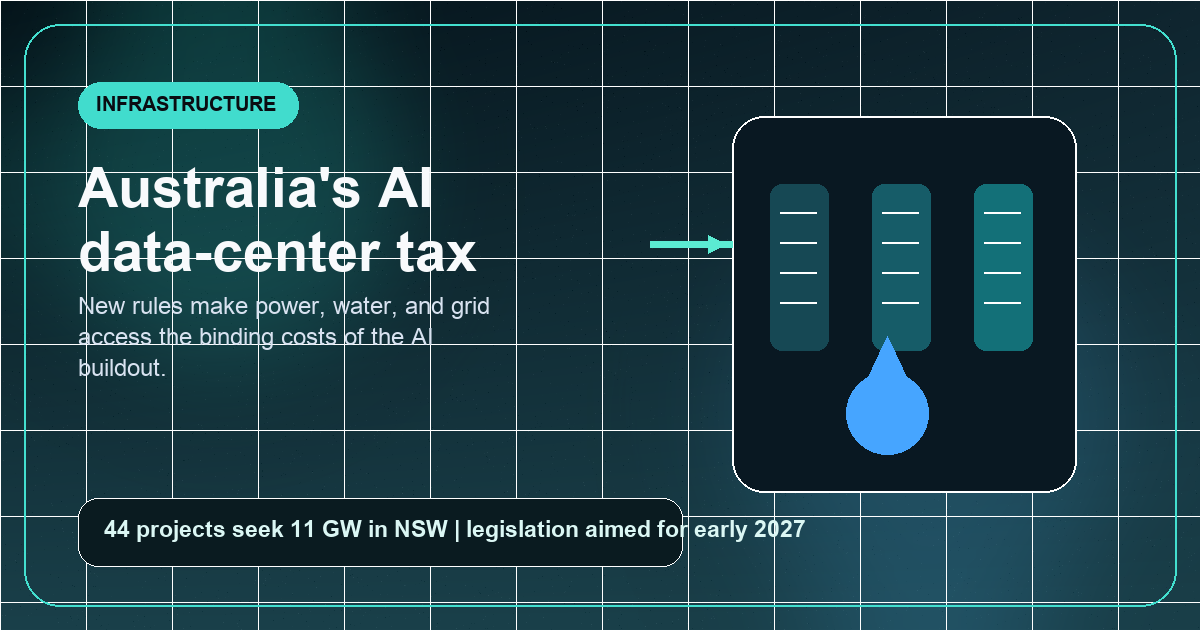
On July 15, 2026, Prime Minister Anthony Albanese said large AI data centers should operate under clear, mandatory national standards that force them to secure their own electricity supply, cover their connection costs, manage usage when the grid is strained, and use water efficiently. The official message is about governance, but the economic message is more important: the power and water costs of AI need to be internalized instead of pushed onto the public system.
That framing matters because Australia is not a niche story. The PM later said there are 44 projects seeking 11 gigawatts of capacity in New South Wales alone. That is not a software footnote. That is a utility buildout and a planning problem large enough to change how the market thinks about AI campus economics.
Why it matters
The policy is a leading indicator for every market where AI buildout runs into grid scarcity, water scarcity, or local political resistance.
This is why the read-through reaches Vertiv, Eaton, Equinix, Digital Realty, Amazon, Microsoft, and Alphabet. If regulators force campuses to bring their own power, pay full connection costs, and manage water use more tightly, then the winning vendors are the ones that can help data centers become more self-sufficient and more efficient at the edge of the grid.
The other implication is financial. AI capex is increasingly not just a GPU or server purchase. It is a permitting, cooling, backup-power, and water-management package. That means returns can be diluted by local constraints even if demand is strong. In other words, the bottleneck is shifting from silicon supply to site approval and utility interconnects.
The market usually underprices this at the start because the headline sounds procedural. It is not procedural. It is a cost-of-capital issue for the entire infrastructure stack.
Evidence table
The Australian framework is small in geography and large in implications because it codifies the hidden costs of AI campuses.
The table below captures the policy levers that matter. Taken together, they show that data centers are being treated less like generic industrial buildings and more like regulated grid assets.
| Policy lever | Evidence | Economic effect | Read-through |
|---|---|---|---|
| Own power supply | Large data centers must secure their own electricity | Raises self-generation and grid-interconnect costs | Good for power infrastructure and backup systems |
| Full connection cost | Centers should cover connection costs fully | Shifts capex from public utilities to project sponsors | Raises hurdle rates for marginal projects |
| Peak-load management | Usage should be managed during grid strain | Makes flexibility and demand response more valuable | Good for controls and energy-management vendors |
| Water efficiency | Mandatory water-efficiency expectations | Raises design complexity for cooling systems | Good for efficient cooling and liquid-loop solutions |
Australia turns AI infrastructure into a grid-and-water project
The scale markers show why this is a policy signal worth pricing globally.
단위: Projects / GW / year / framework
NSW projects
Large pipeline
44
GW sought
Grid scale
11
Policy year
Expected legislation
2,027
Rulebook
One national framework
1
Read-through
If Australia codifies this kind of self-supply rule, other markets will eventually do the same, and the AI infrastructure stack will have to be built for it.
For the listed names, the implication is not bearish across the board. It is selective. Vendors that sell power-management, UPS, switchgear, cooling, and grid-adjacent hardware can benefit because their products become part of the compliance solution. Purely speculative land banking or oversized campus claims become less attractive because the sponsor now has to prove it can carry the utility load itself.
That is why Vertiv and Eaton matter more than the headlines suggest. If the next phase of the AI cycle is about self-supplied power and water efficiency, then the winners are the companies that make the campus more resilient and more local-grid friendly. The regulation does not kill AI demand. It forces the demand to be paid for more honestly.
What to watch
The next test is whether the rule becomes a planning standard or just a political talking point.
Watch the National Cabinet discussion, the early-2027 legislative drafting, and whether the 44-project pipeline gets repriced. If the rules stick, Australia will become a proof point for a larger global trend: AI growth is still strong, but the market has to pay more for grid access, water, and local legitimacy.