%22%2F%3E%0A%20%20%3Ccircle%20cx%3D%22220%22%20cy%3D%22150%22%20r%3D%22180%22%20fill%3D%22%2322d3ee%22%20fill-opacity%3D%220.12%22%2F%3E%0A%20%20%3Ccircle%20cx%3D%221010%22%20cy%3D%22130%22%20r%3D%22220%22%20fill%3D%22%2338bdf8%22%20fill-opacity%3D%220.08%22%2F%3E%0A%20%20%3Ccircle%20cx%3D%22920%22%20cy%3D%22520%22%20r%3D%22170%22%20fill%3D%22%2322d3ee%22%20fill-opacity%3D%220.06%22%2F%3E%0A%20%20%3Cpath%20d%3D%22M140%20430h920%22%20stroke%3D%22url(%23line)%22%20stroke-width%3D%2212%22%20stroke-linecap%3D%22round%22%2F%3E%0A%20%20%3Cpath%20d%3D%22M220%20360c120-150%20260-220%20380-220s260%2070%20380%20220%22%20fill%3D%22none%22%20stroke%3D%22%2367e8f9%22%20stroke-opacity%3D%220.5%22%20stroke-width%3D%2216%22%20stroke-linecap%3D%22round%22%20stroke-linejoin%3D%22round%22%2F%3E%0A%20%20%3Cpath%20d%3D%22M300%20398h600%22%20stroke%3D%22%2394a3b8%22%20stroke-opacity%3D%220.24%22%20stroke-width%3D%228%22%20stroke-linecap%3D%22round%22%2F%3E%0A%20%20%3Ctext%20x%3D%22220%22%20y%3D%22510%22%20fill%3D%22%23e2e8f0%22%20fill-opacity%3D%220.7%22%20font-family%3D%22Arial%2C%20Helvetica%2C%20sans-serif%22%20font-size%3D%2238%22%20letter-spacing%3D%228%22%3EINSIGHTS%3C%2Ftext%3E%0A%3C%2Fsvg%3E)
What actually happened in late July
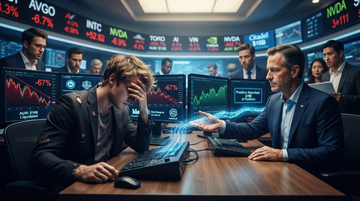
On July 30, 2026, Reuters, the Wall Street Journal and the Financial Times reported that Citadel had purchased the bulk of Situational Awareness LP's roughly $16 billion public stock portfolio. The fund, run by 24-year-old former OpenAI researcher Leopold Aschenbrenner, had been down about 67% in July and was forced to unwind most of its broker-financed positions. The deal was brokered through prime brokers including Goldman Sachs, JPMorgan Chase, Bank of America and Citigroup. Per the FT, Situational Awareness retained its private book — anchored by an estimated $5 billion Anthropic stake — and intends to keep managing money rather than wind down.
Citadel's move is structurally novel for this cycle. Through 2025 and the first half of 2026, the AI trade absorbed billions in retail, ETF and fundamental long-only flows without any high-profile forced buyer of last resort. The Aschenbrenner liquidation is the first episode where a marquee AI-thematic fund couldn't meet margin and a major prime broker-faciliated peer stepped in. Per HedgeWeek, Aschenbrenner's investor letter said the firm will stop using bank borrowing to finance positions and will rebuild — a tacit admission that the architecture, not the thesis, killed the trade.
The fund that wasn't: 439% up, 67% down, $35B gone
H1 2026 net return
+439%
FT-reviewed investor letter (Disruption Banking)
July 2026 drawdown
-67%
WSJ, as of late July
Peak AUM (mid-2026)
~$45B
CNBC; some sources cite $20B
Post-implosion AUM
~$10B
Primarily private holdings
Portfolio sold to Citadel
~$16B
Public equity long book
Anthropic stake retained
~$5B
Bloomberg via TechCrunch
Situational Awareness had roughly 42 positions in its Q1 2026 13F, weighted into AI infrastructure: Broadcom, Nvidia, Advanced Micro Devices, Oracle, Micron Technology, Taiwan Semiconductor, CoreWeave, Bloom Energy and Intel. The fund's 439% H1 return came almost entirely from this concentrated, leveraged long basket. The reversal was equally concentrated: when AI chip names sold off on China-process-progress headlines and a Broadcom Q2 print that, despite a beat, failed to reignite the bid, the same basket that printed 439% in six months gave it back in three weeks.
| Position | Ticker | Role in book | July 2026 move |
|---|---|---|---|
| Broadcom | AVGO | Largest AI-exposed long | Sold off post-Q2 (Jun 3) |
| Nvidia | NVDA | Core AI long + puts | Slipped below $200, near bear-market line |
| AMD | AMD | Compute challenger | Down ~8% intraday on Jul 28 |
| CoreWeave | CRWV | AI-cloud proxy | 52-wk low $60.55 vs high $153.20 |
| Micron | MU | HBM beneficiary | -13% pre-earnings (per WSJ) |
| TSMC | TSM | Wafer foundry | Dragged down by capex-disappointment chain |
| Oracle | ORCL | AI cloud infra | Caught in rotation |
| Bloom Energy | BE | Power-for-AI thesis | Beneficiary of power-grid narrative (held) |
Two structural features explain why the unwind was so violent. First, leverage: the fund used bank borrowing to magnify the long book, so a modest spot drawdown became a forced-seller drawdown. Second, crowding: per Forbes, the situation resembled a \"bank run\" — once the largest AI-thematic name started selling, every copycat positioning triggered the same liquidation reflex.
The buyer of last resort, and why this time is different
Citadel is not a strategic acquirer. The $67B firm (per Wikipedia, January 2026) is the world's second-largest multi-strategy hedge fund after Millennium ($87B). It runs pods across equities, credit, quant and commodities, and trades around 5–7% of US equity volume on a normal day through Citadel Securities. When Citadel buys a $16B public-stock block from a distressed seller, it isn't making an AI thesis call — it's running an inventory and pricing arbitrage against the bid-ask spread it controls. That makes it the ideal buyer of last resort: deep enough to absorb the position without forced selling, fast enough to price it against its own flow.
Multi-strategy AUM, mid-2026 (USD billions)
Citadel sits second globally; both shops are larger than nearly every hedge-fund acquirer in 2008-style rescue scenarios.
Unidad: USD billions
Millennium
May 2026
87
Citadel
Jan 2026
67
Point72
Early 2026
45.7
Situational Awareness (peak)
Mid-2026
45
What changes for AI-stock pricing power: the marginal long has been replaced with a market-maker's inventory. Citadel will run this book on a shorter horizon than a thematic fund would, which means price-insensitive demand has evaporated even as price-insensitive supply has been absorbed. The practical effect — chip names have a higher effective floor (because someone with capital and a market-making edge holds the float) but a lower ceiling on any rebound (because Citadel will not stick to a thesis if price disconnects).
The chip correction that triggered it
By July 28, 2026, the PHLX Semiconductor Index (SOX) had fallen 24.5% from its June peak — formally in bear-market territory — and the Nasdaq-100 was down 9.7% from its record, sitting on the edge of correction (MarketWatch, NBC News). Triggers stacked: a Broadcom fiscal Q2 print on June 3 that beat estimates but failed to extend the upside gap; reports of progress in Chinese advanced chipmaking; growing scrutiny of AI circular financing (Nvidia down nearly 5% in a single session per Yahoo); and TSMC/Netflix earnings that disappointed the bid for capex durability.
| Date | Catalyst | Affected names | Source |
|---|---|---|---|
| Jun 3, 2026 | Broadcom Q2 FY26 beat, AI rev $10.8B (vs guide $10.7B) but no upside surprise | AVGO, NVDA, AMD | Broadcom IR, CNBC |
| Late June 2026 | AI circular-financing concerns surface | NVDA, AVGO, CRWV | Yahoo Finance |
| Jul 17, 2026 | TSMC/Netflix earnings disappoint; tech-led global selloff | TSM, NFLX, semis | Fortune |
| Jul 28, 2026 | China chip progress headlines; SOX -4.5% that day; -24.5% from peak | SOX basket | MarketWatch, NBC |
| Jul 28, 2026 | Nasdaq-100 enters correction, -9.7% from peak | Nasdaq-100 | Bloomberg |
This is the first time since 2022 that a coordinated, broad-based chip selloff has coincided with a high-profile thematic-fund liquidation. The previous AI drawdowns (summer 2024, spring 2025) were absorbed by ETF and fundamental flows; this one runs through prime-broker financing lines.
Upstream and downstream: who Citadel's move actually touches
Upstream of the deal are the four prime brokers — Goldman Sachs, JPMorgan Chase, Bank of America and Citigroup — that intermediated the block sale. Their prime brokerage books are the financing pipes that powered Situational Awareness' leverage. Per Reuters (Jan 2026), all four reported double-digit prime-brokerage revenue gains through 2025, driven by exactly this kind of hedge-fund leverage. They didn't take the loss (Citadel did), but they also didn't lose the customer — the brokers continue to clear the surviving $10B book and the rebuilt fund.
Downstream, the named public-equity victims are the same names Situational Awareness held. The most leveraged of these structurally — CoreWeave — has the weakest fundamentals to absorb a marginal-long disappearance. Per FMP, CoreWeave trades at 11.4x EV/Sales with a -27% free-cash-flow yield, debt/equity of 7.4x, and interest coverage of -0.38x. Its float is dominated by insiders (18.3%) and institutions (58.5%). When the only thematic funds owning this name sell into Citadel's bid, the secondary market has fewer natural buyers.
- CoreWeave: lowest float-adjusted buffer; the cleanest short of the names in the basket
- Broadcom: largest cap, deepest liquidity; the trade Citadel is most likely to warehouse without moving the bid
- Nvidia: biggest beneficiary of the rotation thesis; still trades at 19x EV/Sales and ~40x FCF
- Goldman Sachs / JPMorgan Chase: winners on the financing pipe — neither took the loss, both kept the franchise
- Anthropic: the private name that came out unscathed; ~$5B stake retained, valued against a $965B round
What the survivors say about the next leg
Aschenbrenner's decision to keep the Anthropic stake and exit the public-equity book tells you where the smart money thinks the next dollar of conviction lives. Public AI names are now valued by a market-maker's inventory model, not a thematic-fund model. Private AI labs — where capital is locked up, where there is no daily mark-to-market, and where the only price is the last primary round — sit at the other end of the cycle. Per Cracking the Vault, Anthropic had raised $65B at a $965B valuation. Situational Awareness kept its slice rather than mark it down.
On the short-term horizon (days to quarters), the trade is mechanical. Citadel will likely distribute a portion of the block to its own pods and to other multi-strategy buyers over weeks, providing a soft landing. Any relief rally in chip names will be capped by Citadel's willingness to sell into strength. The Nasdaq-100 remains within 1% of correction; a 10% drop from peak is the line where forced-buyer demand historically accelerates.
On the long-term horizon (1–3 years), the structural takeaway is that AI-chip valuations will price more like other late-cycle commodity-correlated industries — bid-supported, thesis-light — and less like the 2023–2025 thematic regime. The new buyer of last resort is a $67B multi-strategy shop with a P&L-driven exit, not an AGI believer with a 13F. That compresses upside skew on the entire chip complex and re-rates the listed AI-trade toward cash-flow durability over thematic conviction.
The thesis, in one sentence
Citadel's absorption of Situational Awareness' $16B book replaces the marginal thematic long with a market-maker's inventory, leaving Broadcom, Nvidia, AMD and CoreWeave with firmer floors but capped rebounds — and signals that, in this AI correction, the only conviction left sits in private AI labs like Anthropic, where there is no price to mark down.
Investable names tied to this event
- Largest AI-exposed position in the basket Citadel bought; analyst target $527.88 vs spot $389 implies upside Citadel can monetize by selling into strength
- Fiscal Q2 2026 AI revenue of $10.8B beat guide $10.7B but failed to extend the upside gap — the original trigger for the rout
- Long-term: forward P/E of 20.75x makes AVGO the most durable listed AI trade even after the regime change
- Slipped below $200 in late July, approaching bear-market territory; Citadel absorption removes a leveraged marginal seller
- EV/Sales of 19.2x and FCF yield 2.4% remain rich for a name now priced off market-maker inventory, not thematic flows
- August 25 earnings (per TradingKey) is the next binary catalyst — beat-and-raise re-ignites the bid; flat print confirms the regime change
- Cleanest short of the basket: 7.4x debt/equity, -27% FCF yield, EV/Sales 11.4x — the lowest-quality name Citadel now warehouses
- Beta of 7.13 and 52-wk range $60.55–$153.20 mean Citadel's distribution of inventory can move the stock double-digits either way
- Long-term: when the marginal thematic long is gone, only data-center capex cycle supports the price — and that's the same cycle triggering the chip correction
- One of four prime brokers that intermediated the Citadel-Situational Awareness block trade without taking the loss
- Forward P/E 15.85x and operating margin 42.3% make GS the cleanest way to play the financing-pipe tailwind from AI-fund leverage
- Long-term: prime brokerage stays the highest-margin segment of Wall Street even if AI fund leverage compresses
- Down 8% intraday July 28 with no company-specific news — pure beta of the basket Citadel now controls
- Forward earnings yield of 6.9% (per FMP TTM) gives AMD a higher quality-of-earnings floor than the smaller-cap AI names
- Watch the August 25 Nvidia print: a beat lifts the whole basket; a miss triggers Citadel distribution
- Held (not sold) in the post-Citadel narrative as a power-for-AI beneficiary — survives the basket rotation
- Per FMP, zero dividend, $44B revenue base, but the power-grid thesis is the strongest non-AI-fundamental angle in the basket
- Long-term: if private AI capex keeps growing, BE is the cleanest listed exposure to the power side of the AI trade
- One of four prime brokers that cleared the deal; its prime services franchise (jpmorgan.com) benefits whenever AI-fund leverage is in use
- Per Reuters (Jan 2026), JPM saw double-digit prime-brokerage revenue gains in 2025 — the secular tailwind continues
- Long-term: AI-fund leverage is now a recurring revenue line for the prime four (GS, JPM, BAC, C), not a one-off