
%22%2F%3E%0A%20%20%3Ccircle%20cx%3D%22220%22%20cy%3D%22150%22%20r%3D%22180%22%20fill%3D%22%2322d3ee%22%20fill-opacity%3D%220.12%22%2F%3E%0A%20%20%3Ccircle%20cx%3D%221010%22%20cy%3D%22130%22%20r%3D%22220%22%20fill%3D%22%2338bdf8%22%20fill-opacity%3D%220.08%22%2F%3E%0A%20%20%3Ccircle%20cx%3D%22920%22%20cy%3D%22520%22%20r%3D%22170%22%20fill%3D%22%2322d3ee%22%20fill-opacity%3D%220.06%22%2F%3E%0A%20%20%3Cpath%20d%3D%22M140%20430h920%22%20stroke%3D%22url(%23line)%22%20stroke-width%3D%2212%22%20stroke-linecap%3D%22round%22%2F%3E%0A%20%20%3Cpath%20d%3D%22M220%20360c120-150%20260-220%20380-220s260%2070%20380%20220%22%20fill%3D%22none%22%20stroke%3D%22%2367e8f9%22%20stroke-opacity%3D%220.5%22%20stroke-width%3D%2216%22%20stroke-linecap%3D%22round%22%20stroke-linejoin%3D%22round%22%2F%3E%0A%20%20%3Cpath%20d%3D%22M300%20398h600%22%20stroke%3D%22%2394a3b8%22%20stroke-opacity%3D%220.24%22%20stroke-width%3D%228%22%20stroke-linecap%3D%22round%22%2F%3E%0A%20%20%3Ctext%20x%3D%22220%22%20y%3D%22510%22%20fill%3D%22%23e2e8f0%22%20fill-opacity%3D%220.7%22%20font-family%3D%22Arial%2C%20Helvetica%2C%20sans-serif%22%20font-size%3D%2238%22%20letter-spacing%3D%228%22%3EINSIGHTS%3C%2Ftext%3E%0A%3C%2Fsvg%3E)
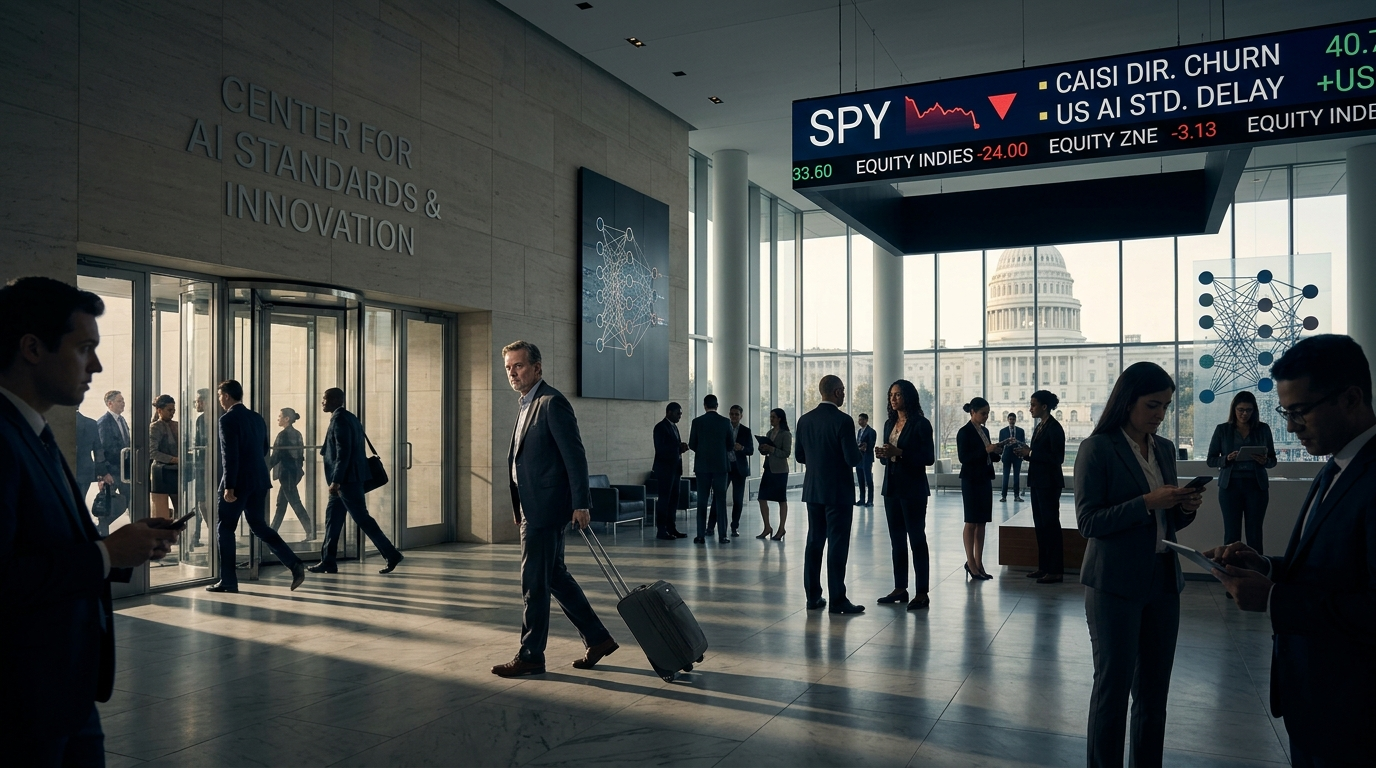
The CAISI director role is not ceremonial. It sits inside NIST, within the U.S. Department of Commerce, and the center’s mandate is to turn AI safety and security requirements into evaluations, voluntary standards, and industry-facing testing infrastructure.
What happened
Chris Fall’s July 20 exit makes CAISI the third revolving door in ~five months
| Director | Start (approx.) | End (date) | Reported reason/context |
|---|---|---|---|
| Chris Fall (director) | April 2026 (appointed) | July 20, 2026 | Resigned after ~3 months; CAISI leadership churn continues |
| Collin Burns (director) | April 2026 | April 2026 (served less than a week) | Reportedly pushed out due to prior Anthropic employment / conflict concerns |
| David Sacks (White House AI/crypto czar role) | Appointed earlier (tenure capped by SGE rules) | March 27, 2026 | Stepped down after “used up” 130-day special government employee limit; transitioned to advisory role |
- The key investor-relevant point is continuity risk: CAISI is responsible for evaluations and standards work, not just internal coordination.
- The pattern is consistent: short tenures reduce the ability to lock in repeatable test protocols, stakeholder agreements, and public guidance cycles.
Load-bearing mandate
CAISI exists to make AI evaluations and security standards operational—not to draft principles
CAISI’s mission is built around measurable evaluations and security-risk focus areas. That’s exactly what turnover disrupts: experiment design, benchmark selection, and the cadence of industry-facing convenings.
What CAISI is tasked to do (mandate-level evidence)
Where it sits
Inside NIST, within the U.S. Department of Commerce
CAISI is housed within NIST/Commerce
Primary function
Industry point of contact for testing and collaborative research
Facilitates testing agreements and evaluations with private developers/evaluators
Core outputs
Guidelines/best practices for measuring AI security + model capability risk evaluations
Includes unclassified evaluations and coordination across agencies
Risk scope
Cybersecurity, biosecurity, chemical weapons (CBRNE-related categories)
Explicitly called out risk focus areas
- If you assume CAISI leadership sets priorities, the director role becomes the “output scheduler” for standards-adjacent work: which models get evaluated, how evaluation reports are framed, and how quickly guidance becomes adoptable by industry.
- The White House AI Action Plan specifically assigns NIST / CAISI functions around evaluations, secure-by-design compute, and high-security standards—so a churn event is a governance process shock, not an HR-only story.
Policy execution link
The White House AI Action Plan makes CAISI a bottleneck—so leadership instability increases timing risk
The July 2025 “America’s AI Action Plan” assigns NIST tasks that explicitly connect AI risk frameworks, model evaluation, and secure compute standards. CAISI is named as the hub for evaluating frontier models and for coordinating national-security-related evaluation themes.
| Action Plan theme | What NIST / CAISI is asked to do | Why director continuity matters |
|---|---|---|
| Frontier model evaluation | CAISI tasked with researching/publishing evaluations of frontier models from the People’s Republic of China regarding alignment with CCP messaging/censorship | Evaluation programs require consistent leadership over benchmark selection, scoring, and publication timing |
| Adversarial robustness & national security evaluations | Collaboration across DoD/DoE/DHS/IC on interpretability, control systems, adversarial robustness, and national-security evaluation themes | Cross-agency interfaces depend on stable relationships and recurring governance cadence |
| AI standards & testing cadence | Convening evaluation meetings twice yearly and developing domain-relevant guidance/standards adoption pathways | A director churn disrupts the ability to lock-in the next meeting cycle and stakeholder commitments |
| Secure-by-design compute + high-security data center technical standards | Development of secure compute environments and technical standards for high-security AI data centers | These efforts depend on continuous iteration with vendors and government operators |
Non-obvious causal mechanism
The “standards lag” will hurt hardest the vendors selling compliance-ready AI security—because their sales cycle depends on predictable federal test signals
The most important causal chain isn’t political—it’s commercial. When the federal evaluator’s priorities and cadence wobble, customer procurement and risk committees struggle to translate policy intent into acceptance criteria.
Where CAISI continuity most affects private-sector execution (process map)
Director churn propagates through evaluation cadence → acceptance criteria → procurement timelines
단위: relative impact
Evaluation protocols & benchmark selection
Directly affected by director continuity
1
Published guidance/assessments become adoptable
Timing slips if leadership focus changes
0.8
Enterprise procurement & compliance acceptance criteria
Customers demand stability to buy tools
0.6
Vendor sales cycles & contract certainty
Risk committees delay decisions when benchmarks are unclear
0.5
- Standards work is path dependent: early choices about evaluation design create an interoperability expectation that later buyers treat like “the rules.” Churn makes that path less reliable.
- As a result, investors should expect higher near-term demand for tooling that can map to multiple evolving standards (and produce evidence quickly) rather than waiting on a single definitive federal benchmark regime.
Supply chain view
Upstream and downstream both feel CAISI churn—data center security and enterprise governance tighten, while “frontier model validation” gets cloudy
- Upstream beneficiaries (security + testing infrastructure): secure compute, evaluation/monitoring, and cyber controls providers that can be used regardless of which benchmarks CAISI releases next.
- Downstream beneficiaries (enterprise governance): platform vendors that help customers document risk controls and evidence for audits, procurement, and model deployment governance.
- Potential victims (lagging compliance tooling): companies whose differentiation assumes a stable federal test cadence or a singular standards framework becomes the “dominant reference.”
| Supply-chain layer | Example listed entities | Why they’re exposed to standards timing risk |
|---|---|---|
| AI security infrastructure (identity, threat detection, policy enforcement) | CrowdStrike, Palo Alto Networks, Zscaler | Security validation and continuous monitoring help enterprises satisfy evolving risk controls, which becomes more valuable when federal benchmarks are less predictable |
| Systems integrators / government-adjacent AI implementation partners | Booz Allen Hamilton, Science Applications International, Leidos | When governance signals shift, integrators play a bigger role in packaging controls, documentation, and deployment evidence |
| Cloud platforms / enterprise AI operating environments | Microsoft, Alphabet, Oracle, Amazon | Secure-by-design compute and governance tooling need to be robust even as external standards cadence changes; platform buyers expect multiple paths to compliance |
Management and governance signal
Three-directors-in-five-months is the real story: CAISI is under a policy regime that prioritizes political/role-fit over technical continuity
You can read the leadership turnover two ways: either it’s personnel churn with limited substantive impact, or it’s an explicit governance signal that the US wants faster policy pivoting. The CAISI mandate suggests the second interpretation is more costly for execution.
- If turnover is driven by perceived conflicts (reported in the case of Collin Burns’s prior Anthropic employment) then the organization’s output priorities may increasingly optimize for “acceptable provenance” rather than maximal continuity of evaluation methodology.
- Even when the interim structure preserves operations, investors should discount the probability that CAISI will deliver a stable, easily marketed standards roadmap on the first cycle.
What to watch (next 6–18 months)
The market will learn whether CAISI churn is survivable by watching cadence, publication content, and who signs off interim evaluation programs
- Whether CAISI (under NIST oversight) maintains a visible twice-yearly evaluation convening cadence referenced in the AI Action Plan.
- Whether published CAISI evaluations keep consistent scoring rubrics and benchmark definitions (continuity test).
- Whether secure-by-design / high-security AI data center technical standards progress without being rewritten at each director transition.
- Whether enterprise buyers adopt “evidence-first” governance tooling (documentation automation, monitoring, and audit trails) rather than waiting for a single federal standard.
Investor synthesis
CAISI churn raises the odds that “standards-compliance demand” shifts from roadmap-following to tooling-for-evidence
Chris Fall CAISI resignation date
Jul 20, 2026
Resigned after ~3 months
Leadership turnover velocity
3 directors in ~5 months
David Sacks (Mar), Collin Burns (Apr, <1 week), Chris Fall (Apr→Jul 20)
Execution-critical mandate
Evaluations + security standards
CAISI focuses on test/evaluation outputs and risk areas like cybersecurity and CBRNE categories
This is less about whether CAISI will “shut down” and more about whether the market can trust a stable reference framework. When the evaluation engine wobbles, enterprises buy systems that help them produce defensible evidence quickly—even if federal benchmarks change.
- Bull case: CAISI churn forces faster adoption of governance + security evidence tooling, benefiting monitoring and compliance workflow platforms.
- Bear case: policy instability chills frontier model validation procurement, delaying related projects and stretching budgets—hurting integrators and niche testing providers with narrow reliance on CAISI signals.