
Macro & Policy
Macro & Policy Insights
Research notes on earnings, market structure, and financial statements. Each piece starts with the conclusion, then lays out the evidence and implications.
2026-07-17
%22%2F%3E%0A%20%20%3Ccircle%20cx%3D%22220%22%20cy%3D%22150%22%20r%3D%22180%22%20fill%3D%22%2322d3ee%22%20fill-opacity%3D%220.12%22%2F%3E%0A%20%20%3Ccircle%20cx%3D%221010%22%20cy%3D%22130%22%20r%3D%22220%22%20fill%3D%22%2338bdf8%22%20fill-opacity%3D%220.08%22%2F%3E%0A%20%20%3Ccircle%20cx%3D%22920%22%20cy%3D%22520%22%20r%3D%22170%22%20fill%3D%22%2322d3ee%22%20fill-opacity%3D%220.06%22%2F%3E%0A%20%20%3Cpath%20d%3D%22M140%20430h920%22%20stroke%3D%22url(%23line)%22%20stroke-width%3D%2212%22%20stroke-linecap%3D%22round%22%2F%3E%0A%20%20%3Cpath%20d%3D%22M220%20360c120-150%20260-220%20380-220s260%2070%20380%20220%22%20fill%3D%22none%22%20stroke%3D%22%2367e8f9%22%20stroke-opacity%3D%220.5%22%20stroke-width%3D%2216%22%20stroke-linecap%3D%22round%22%20stroke-linejoin%3D%22round%22%2F%3E%0A%20%20%3Cpath%20d%3D%22M300%20398h600%22%20stroke%3D%22%2394a3b8%22%20stroke-opacity%3D%220.24%22%20stroke-width%3D%228%22%20stroke-linecap%3D%22round%22%2F%3E%0A%20%20%3Ctext%20x%3D%22220%22%20y%3D%22510%22%20fill%3D%22%23e2e8f0%22%20fill-opacity%3D%220.7%22%20font-family%3D%22Arial%2C%20Helvetica%2C%20sans-serif%22%20font-size%3D%2238%22%20letter-spacing%3D%228%22%3EINSIGHTS%3C%2Ftext%3E%0A%3C%2Fsvg%3E)

Kuwait's Desalination Strike Makes Gulf Utilities the Hidden Front Line of the Oil Shock
An Iranian strike on Kuwait's water-and-power infrastructure turns a crude-price headline into a utility and inflation problem. The deeper read is that Gulf desalination, not just shipping lanes, is now part of the market's geopolitical risk premium.
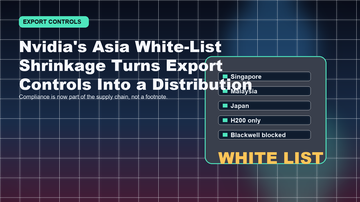
Nvidia's Asia White-List Shrinkage Turns Export Controls Into a Distribution Moat
By cutting the number of authorized Asian buyers by more than half, Nvidia is making compliance part of the supply chain. That sounds bureaucratic, but it is actually a moat: fewer customers, tighter verification, and a more controllable route to China.

TSMC's Record Earnings Selloff Exposes the Three Fault Lines the AI Trade Can No Longer Ignore
TSMC delivered a record quarter on July 16, 2026, but the stock still sold off. That disconnect is the story: the AI semiconductor cycle is still strong, yet the market is now pricing margin compression, higher capex, and a broader repricing of AI infrastructure risk.
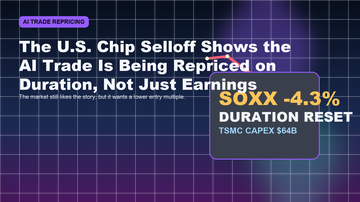
The U.S. Chip Selloff Shows the AI Trade Is Being Repriced on Duration, Not Just Earnings
Even after strong results from TSMC, the market started selling the names that had benefited most from the AI spend cycle. That is a duration reset, not an earnings collapse, and it changes how investors should size the entire semiconductor basket.

Wall Street's Red-Hot Trading Quarter Is Really an Asia Volatility Trade
The bank earnings boom is bigger than a rate story. It is a volatility story, and increasingly an Asia story, with AI-chip flows, IPOs, and cross-border risk all feeding the same trading machine.
2026-07-16
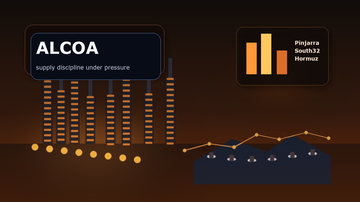
Alcoa Missed the Bar, But the Real Signal Is Supply Discipline: Pinjarra, South32, and Hormuz Are Repricing Aluminum
Alcoa reported Q2 2026 adjusted EPS of $2.12 and revenue of $3.97B, both below expectations, while cutting alumina production guidance after setbacks at the Pinjarra refinery. The stock slid despite better year-over-year profitability because the market is now focused on supply discipline, capital intensity, and how much of the aluminum chain is being shaped by Middle East risk and a major South32 acquisition.
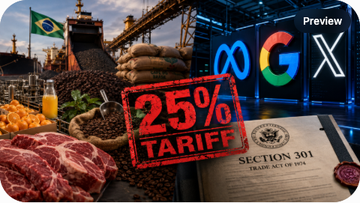
Trump 25% Section 301 Tariff on Most Brazilian Goods - Effective July 22 - The First-Ever US Tariff Targeting Foreign Government Censors of US Tech Platforms
CNBC reported on July 16, 2026 that Trump imposed a 25% Section 301 tariff on most Brazilian goods effective July 22, citing unfair trade practices including Brazil's orders to X, Meta, and Google to remove political content and suspend US users' accounts. The tariff is the first-ever US Section 301 action explicitly citing a foreign government's content moderation orders to US tech platforms. Brazil has $424.5B cumulative goods + services surplus with the US over 15 years; 2025 US goods surplus was $14.4B. The read-through is direct for Brazilian-exposed ADRs, US tech (META, GOOGL, X), US beef/orange juice importers, US aircraft (BA, RTX), and the entire Section 301 tariff regime as a 2026 trade weapon.
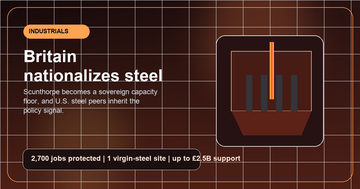
Britain's Nationalization of [British Steel] Is a Sovereign Put Option on Virgin Steel
On July 16, 2026, the UK government moved British Steel into public ownership, citing the public interest, thousands of jobs, and the need to protect a strategic steelmaking capability. The market significance is broader than one plant: when a government is willing to backstop virgin-steel capacity, industrial assets stop being simple commodity businesses and start looking like strategic infrastructure with a policy floor. That matters for Nucor, Steel Dynamics, Cleveland-Cliffs, and every investor who has to price industrial sovereignty risk.
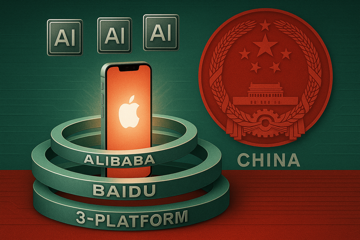
Apple's China AI Approval Is Now a 3-Platform Race - Alibaba, Baidu, and Huawei Just Became the Most Important AI Cohort in the World
CNBC reported on July 16, 2026 that Hong Kong-listed shares of Alibaba rose 5% and Baidu rose 4% after the Cyberspace Administration of China included Apple Intelligence on a list of seven approved AI service providers for iPhone users in China, alongside Huawei and homegrown AI models. The approval opens the door for Baidu's AI chip unit Kunlunxin - targeting a Hong Kong IPO at a $50B valuation - and creates a 3-platform China AI race. The read-through is direct for Apple, Baidu, Alibaba, Huawei, Tencent, and the entire China AI-cohort.
The July 16 Semiconductor Slide Shows the AI Trade Is Repricing Cash Discipline, Not Just Growth
Semiconductor stocks fell even after strong results from TSMC, which tells you the market is no longer rewarding AI growth in isolation. It now wants proof that the capex cycle, margin math, and export-control risk can all coexist without breaking returns.
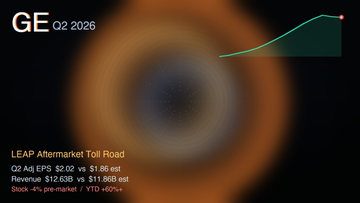
GE Aerospace Q2 2026 Beat-and-Raise, but Stock Drops 4% - Sell-the-News After 60%+ YTD Run Validates the Real-World Industrial Cash Flow Rotation
GE Aerospace reported Q2 2026 adjusted EPS of $2.02 vs. $1.86 consensus (~9% beat) and revenue of $12.63B vs. $11.86B consensus (~6.5% beat) on July 15-16, 2026, with raised FY guidance - but the stock dropped ~4% pre-market. The cleanest signal: the market has moved past 'beat-and-raise' on this name - the bar is now reacceleration of LEAP shop-visit cadence. The read-through is for FDX, UPS, XPO, CHRW, and the broader long-industrial cycle.
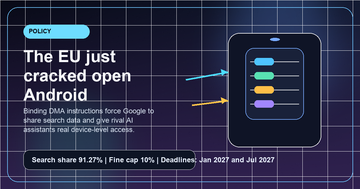
The EU Just Forced Alphabet to Open Android and Search Data to Rival AI Assistants
On July 16, 2026, the European Commission issued binding DMA guidance that forces Google to share certain search data with competitors and to give rival AI assistants equal access to Android features such as voice activation and background task execution. The immediate issue is regulatory, but the real issue is distribution: if Android stops being a closed assistant funnel, Google has to defend default behavior instead of assuming it. That changes the read-through for Alphabet, rival AI assistants, and every company trying to win the mobile entry point.
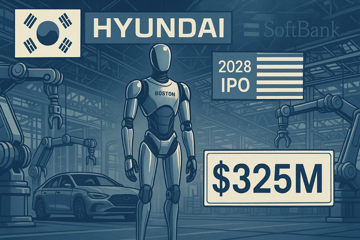
Hyundai Motor Just Bought Boston Dynamics for the Third Time - And the 2028 IPO Math Is Now the Whole Story
Hyundai Motor Group said on July 16, 2026 that it will acquire SoftBank Group's remaining 9.65% stake in Boston Dynamics for about $325M (~₩500B), making the U.S. humanoid-robotics pioneer a wholly owned subsidiary and clearing a fast-tracked Nasdaq IPO path by 2028. The deal is the third Hyundai-Boston Dynamics transaction in five years and the first time the Korean OEM has full operational control of the robotics platform - and the read-through is direct for the entire humanoid-robotics sector (Tesla, Figure AI, Agility Robotics, Apptronik, 1X), every Korean OEM's automation strategy, and the AI capex stack that the humanoid race is now joining.

IEA Warns 'Weeks, Not Months' to Reopen Strait of Hormuz - Brent Jumps 13% in 7 Days - The Cleanest Single Stagflation Catalyst of 2026
IEA Chief Fatih Birol warned on July 16, 2026 that the world has 'weeks, not months' to reopen the Strait of Hormuz, with Brent crude jumping 13% in 7 days to ~$84.60/barrel. The IEA warning + IMO Secretary General's declaration that Hormuz transit is 'too dangerous' for ship owners + the US naval blockade reinstatement + Iran's strikes on 5 Gulf countries and 2 UAE-operated supertankers have all combined to create the cleanest single stagflation catalyst of 2026. The read-through is direct for E&P (XOM, CVX, OXY), oilfield services (SLB, HAL, BKR), refiners (VLO, MPC, PSX), tankers (FRO, INSW, STNG), defense (LMT, RTX, NOC), and the cleanest single most direct headwind for airlines (UAL, DAL, AAL), consumer cyclicals, and the cleanest single Fed pause regime.

Morgan Stanley's Record Wealth Flows Turn the IPO Boom Into a Fee Machine
Morgan Stanley's second quarter showed that the bank is no longer just trading a volatile tape. It is converting IPO and M&A activity into durable wealth assets, and the scale of those inflows says the fee cycle still has room to run.

Nvidia's H200 China Carve-Out Shows AI Export Controls Are Becoming a Tiered Market
The latest H200 approvals do not reopen China. They make the AI chip war more granular: chip generation, named buyers, and compliance burden now define the market.
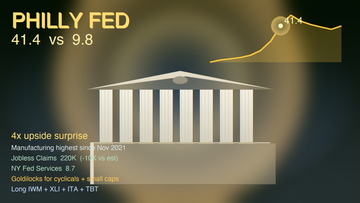
Philly Fed Manufacturing Surges to 41.4 vs. 9.8 Consensus - The 4x Upside Surprise Is the Goldilocks Confirmation for the 2026 Manufacturing + US-Exceptionalism Cycle
The Philadelphia Fed Manufacturing Index surged to 41.4 in July 2026, vs. consensus 9.8 (~4x upside surprise), the highest since November 2021. New orders, shipments, and employment all accelerated. Combined with jobless claims at 220K (-10K vs consensus) and a softer Retail Sales print (-0.2% MoM ex-autos), this is the cleanest goldilocks setup for the 2026 manufacturing + US-exceptionalism cycle. The read-through is for cyclicals + short duration + small caps.
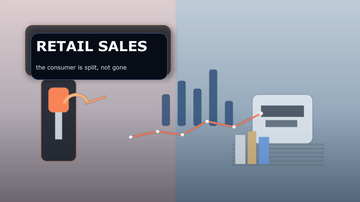
June Retail Sales Rose 0.2%, but the Real Signal Is a Split Consumer and a Fed That Still Cannot Relax
U.S. retail sales increased 0.2% in June, while ex-gas sales rose 0.7% and the control group gained 0.5%. The soft headline looks like consumer cooling, but the details say something more useful: spending is shifting, gas is masking strength, and the Fed still has to decide whether resilient demand or softer inflation is the bigger risk.

South Korea's AI Chip Boom Hit a Leverage Wall as SK Hynix and Samsung Electronics Drag the KOSPI Into a Bear Market
The July 16 selloff did not break AI memory demand. It exposed how crowded the trade had become after months of leverage, retail momentum, and rate-sensitive positioning.

Truth API Turns Trump Media Into a Market-Data Toll Booth - and That Changes the Incentives for Anyone Trading on Truth Social
Trump Media said it will launch Truth API, a licensed real-time feed of top Truth Social accounts for financial institutions. The obvious read is monetization. The deeper read is that the company is trying to turn political attention into a data product, which creates a new market structure risk for traders who already rely on Truth Social as an information source.
What to expect
Evidence-first notes with a visible point of view.
This section collects sharp takes on earnings, shareholder meetings, and market structure. Each new piece should make the thesis, the facts, and the implications obvious within the first few screens.
Expect direct analysis, not generic commentary.
Expect the data to be explicit and the argument to be easy to follow.