
%22%2F%3E%0A%20%20%3Ccircle%20cx%3D%22220%22%20cy%3D%22150%22%20r%3D%22180%22%20fill%3D%22%2322d3ee%22%20fill-opacity%3D%220.12%22%2F%3E%0A%20%20%3Ccircle%20cx%3D%221010%22%20cy%3D%22130%22%20r%3D%22220%22%20fill%3D%22%2338bdf8%22%20fill-opacity%3D%220.08%22%2F%3E%0A%20%20%3Ccircle%20cx%3D%22920%22%20cy%3D%22520%22%20r%3D%22170%22%20fill%3D%22%2322d3ee%22%20fill-opacity%3D%220.06%22%2F%3E%0A%20%20%3Cpath%20d%3D%22M140%20430h920%22%20stroke%3D%22url(%23line)%22%20stroke-width%3D%2212%22%20stroke-linecap%3D%22round%22%2F%3E%0A%20%20%3Cpath%20d%3D%22M220%20360c120-150%20260-220%20380-220s260%2070%20380%20220%22%20fill%3D%22none%22%20stroke%3D%22%2367e8f9%22%20stroke-opacity%3D%220.5%22%20stroke-width%3D%2216%22%20stroke-linecap%3D%22round%22%20stroke-linejoin%3D%22round%22%2F%3E%0A%20%20%3Cpath%20d%3D%22M300%20398h600%22%20stroke%3D%22%2394a3b8%22%20stroke-opacity%3D%220.24%22%20stroke-width%3D%228%22%20stroke-linecap%3D%22round%22%2F%3E%0A%20%20%3Ctext%20x%3D%22220%22%20y%3D%22510%22%20fill%3D%22%23e2e8f0%22%20fill-opacity%3D%220.7%22%20font-family%3D%22Arial%2C%20Helvetica%2C%20sans-serif%22%20font-size%3D%2238%22%20letter-spacing%3D%228%22%3EINSIGHTS%3C%2Ftext%3E%0A%3C%2Fsvg%3E)
The event
The European Commission is no longer talking about fairness in the abstract. It is now telling Google exactly how Android and Search must behave for competitors.
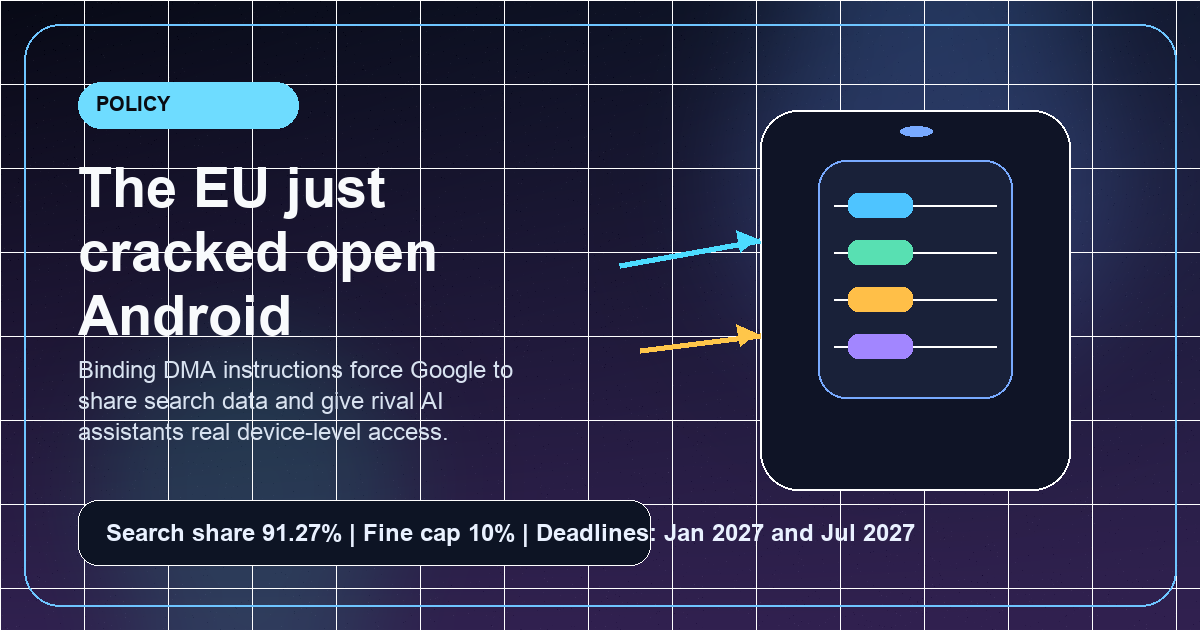
The Commission's July 16 guidance is important because it turns the DMA into an operating constraint, not a debate. Rival AI assistants must be able to interact with Android more directly, and Google must share certain search data with competitors under specific safeguards. That is a direct challenge to the logic of a closed ecosystem, because the gatekeeper no longer gets to own both the interface and the underlying access rules.
The biggest mistake would be to treat this as an ad-revenue story only. Ad revenue matters, but the deeper question is whether Android continues to be the default pathway into mobile behavior. If users can summon a rival AI assistant with the same privileges Google Assistant gets, then the value of default placement, not just search queries, is under pressure.
Why it matters
The moat at issue is not a model moat. It is a default-behavior moat.
This is why Alphabet matters more than the headline suggests. Alphabet still controls the world's dominant search gateway, and Android remains the largest consumer operating surface in mobile. Statcounter still puts Google search around 91% worldwide, which means any new rule that weakens the default funnel can change how search traffic, assistant traffic, and app discovery get monetized.
The implication for AI rivals is obvious: if the UI gate opens, the competitor with the best assistant experience can start fighting on product quality instead of waiting for a distribution miracle. That is good for Apple if it wants more bargaining power, good for Android rival assistants if they can actually execute, and bad for any assumption that Gemini can remain the invisible default layer forever.
It also matters for the long tail of mobile-software economics. App discovery, voice workflows, background tasks, and search suggestions are all part of the same behavioral funnel. Once the Commission ties those surfaces to interoperability rules, the burden shifts from 'can rivals build a model?' to 'can they become the default action?' That is a much harder question for Google to answer with capital alone.
Evidence table
The timeline matters as much as the rule itself, because the market has to price the change before the compliance dates hit.
The Commission gave the market a schedule, not just a warning. That lets investors map the regulatory shock into the product cycle, the legal cycle, and the 2027 assistant race.
| Item | Timing | Practical effect | Market implication |
|---|---|---|---|
| Search-data sharing | January 2027 | Competitors can request certain search data under safeguards. | Raises the quality floor for rival search and AI products. |
| Android interoperability | July 2027 | Rival AI assistants need equal access to key Android functions. | Weakens the closed default-assistant model. |
| Fine exposure | Immediate | DMA penalties can reach 10% of global annual turnover. | Makes delay expensive and compliance urgent. |
| Consumer choice | Ongoing | Users should be able to invoke rival assistants more easily. | Moves the battlefield to UX and product quality. |
Why the EU ruling matters to Alphabet's distribution moat
Illustrative operating and market-share markers that define the scale of the issue.
Unidad: Market share / users / penalty cap
Google search share
Worldwide, Statcounter
91.3
Google.com host share
Worldwide, Statcounter
89.8
Android user base (B)
DemandSage estimate
3.9
Fine cap (%)
DMA penalty ceiling
10
Read-through
If Android becomes open enough, the AI assistant race starts to look more like a browser war than a model war.
That is the second-order point. The open-model debate already made it obvious that models can be copied, compressed, or fine-tuned. The scarce asset is not the model alone; it is the user path into the model. If the EU forces Android to treat rival assistants more equally, then the cleanest moat becomes product habit, not model pride.
For Alphabet, that means the defense now has to happen at the product layer. Gemini has to win on usefulness, not just bundling. For Apple, the ruling increases the value of controlling the front door on iPhone even more. For the rest of the AI stack, it is a reminder that European regulation can turn a distribution advantage into a compliance cost very quickly.
What to watch
The next test is whether rival assistants actually get adopted, or whether the rule changes the interface without changing user behavior.
Watch the January 2027 data-sharing rollout, the July 2027 Android interoperability deadline, and any legal challenge from Google. If rival assistants begin to show real mobile share, then this ruling will have changed the economics of AI distribution. If they do not, the market will conclude that regulatory access is not the same thing as product demand.