
%22%2F%3E%0A%20%20%3Ccircle%20cx%3D%22220%22%20cy%3D%22150%22%20r%3D%22180%22%20fill%3D%22%2322d3ee%22%20fill-opacity%3D%220.12%22%2F%3E%0A%20%20%3Ccircle%20cx%3D%221010%22%20cy%3D%22130%22%20r%3D%22220%22%20fill%3D%22%2338bdf8%22%20fill-opacity%3D%220.08%22%2F%3E%0A%20%20%3Ccircle%20cx%3D%22920%22%20cy%3D%22520%22%20r%3D%22170%22%20fill%3D%22%2322d3ee%22%20fill-opacity%3D%220.06%22%2F%3E%0A%20%20%3Cpath%20d%3D%22M140%20430h920%22%20stroke%3D%22url(%23line)%22%20stroke-width%3D%2212%22%20stroke-linecap%3D%22round%22%2F%3E%0A%20%20%3Cpath%20d%3D%22M220%20360c120-150%20260-220%20380-220s260%2070%20380%20220%22%20fill%3D%22none%22%20stroke%3D%22%2367e8f9%22%20stroke-opacity%3D%220.5%22%20stroke-width%3D%2216%22%20stroke-linecap%3D%22round%22%20stroke-linejoin%3D%22round%22%2F%3E%0A%20%20%3Cpath%20d%3D%22M300%20398h600%22%20stroke%3D%22%2394a3b8%22%20stroke-opacity%3D%220.24%22%20stroke-width%3D%228%22%20stroke-linecap%3D%22round%22%2F%3E%0A%20%20%3Ctext%20x%3D%22220%22%20y%3D%22510%22%20fill%3D%22%23e2e8f0%22%20fill-opacity%3D%220.7%22%20font-family%3D%22Arial%2C%20Helvetica%2C%20sans-serif%22%20font-size%3D%2238%22%20letter-spacing%3D%228%22%3EINSIGHTS%3C%2Ftext%3E%0A%3C%2Fsvg%3E)
Bottom line
Europe's $40B+ drone ramp-up is the first institutional capital reallocation away from the legacy defense primes and toward the defense-tech startups - and Helsing's $18B is the new ceiling.
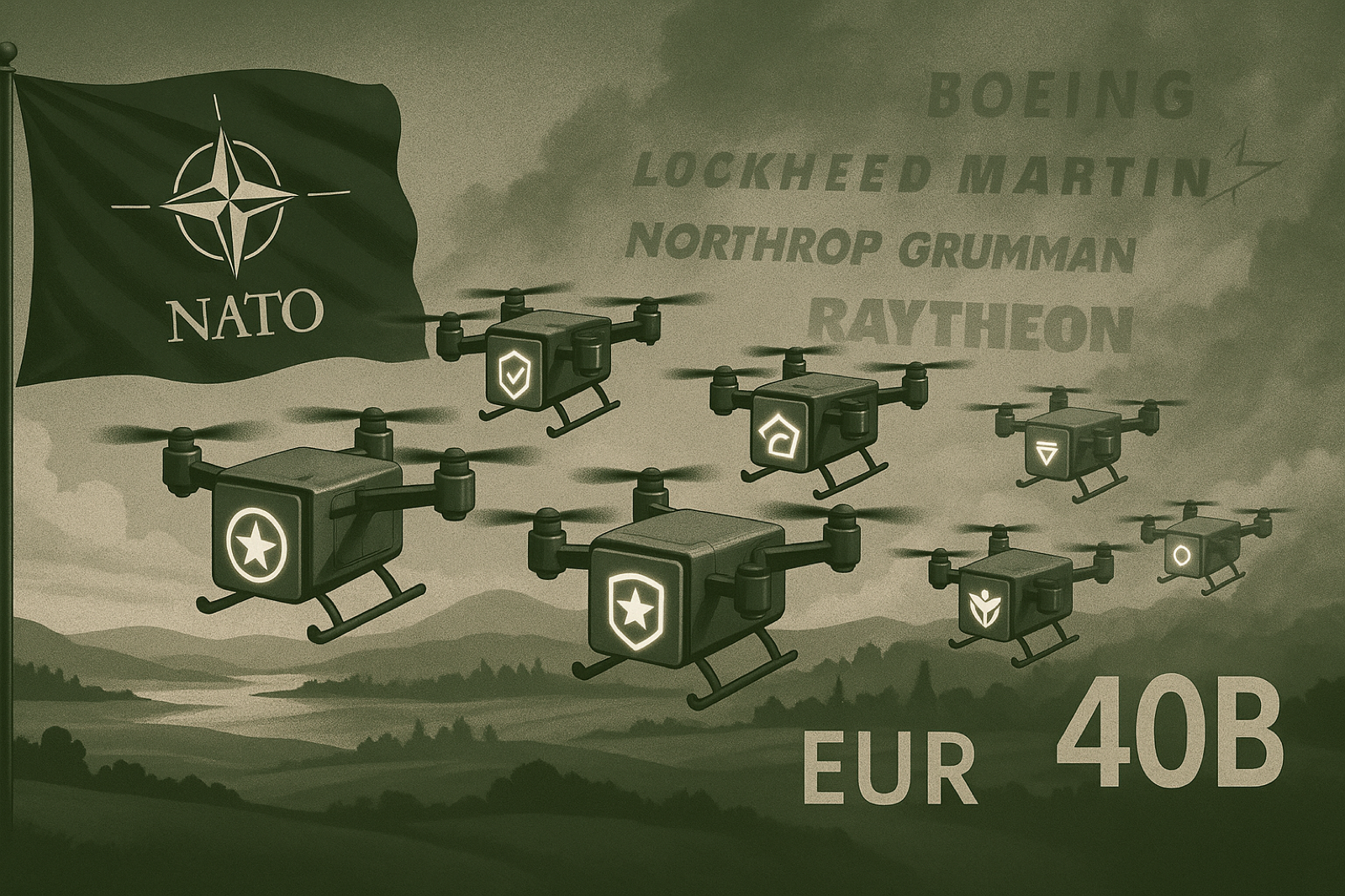
CNBC's Elsa Ohlen reported on July 15, 2026 that NATO Secretary General Mark Rutte unveiled a 'drone-ready' alliance plan, with allies committing to invest more than $40B in counter-drone capabilities over the next five years. The U.K. separately committed £5B ($6.7B) to a 'UK drone transformation' program under its Defence Investment Plan published in late June. Germany moved to procure 50,000 drones equipped with Auterion's operating system from Skyfall, in a 90M-euro order confirmed by CNBC to be from Germany for Ukraine. German defense-tech startup Helsing secured an $18B valuation - the largest defense-tech private mark in the European market.
The reason the timing matters more than a normal defense procurement cycle is that the $40B+ NATO commitment, the £5B UK commitment, the 50,000-drone German order, and the $18B Helsing valuation all landed in the same two-week window. The four signals are converging at the same moment: institutional capital is rotating away from the legacy defense primes and toward the drone and defense-tech startups. The trade is no longer 'European defense spending is up' (it has been up for three years); it is 'European defense spending is up AND the institutional architecture is being rebuilt around drone startups, not legacy primes.'
For Lockheed Martin, RTX, Northrop Grumman, General Dynamics, BAE Systems, Thales, Rheinmetall, Renk Group, Hensoldt, and the broader European defense cohort, the read-through is direct. The $40B NATO commitment, the £5B UK commitment, the German 50,000-drone order, and the Helsing $18B valuation are the institutional capital signal that the drone sector is now the primary beneficiary of the European defense spending cycle. The legacy primes are not out of the cycle - tanks, ships, and missiles still need to be built - but the drone sector is now the highest-multiple beneficiary, and the trade split is long drone startups and defense-tech, neutral on the legacy primes.
The trade that broke
The 'European defense is up = primes go up' trade is being split into 'European defense is up = drones and defense-tech go up faster' and 'legacy primes are the secondary beneficiary'.
For most of the post-2022 cycle, the playbook for European defense was that any defense-spending increase flowed primarily to the legacy primes: Lockheed Martin, Raytheon, Northrop Grumman, General Dynamics, BAE Systems, Thales, and Rheinmetall all benefited from the post-Ukraine spending cycle. The trade worked because the legacy primes had the installed base, the procurement relationships, and the multi-year delivery contracts. The $40B NATO commitment, the £5B UK commitment, the German 50,000-drone order, and the Helsing $18B valuation break that framework: the institutional capital is rotating to the drone and defense-tech startups, not flowing only to the legacy primes.
The first piece of the new framing is 'European defense is up = drones and defense-tech go up faster.' The NATO $40B commitment is explicitly for 'counter-drone capabilities,' which is the drone sector, not the legacy primes. The U.K. £5B commitment is for a 'UK drone transformation' program, which is the drone sector. The German 50,000-drone order is for Auterion-equipped drones, which is a defense-tech startup. The Helsing $18B valuation is a defense-tech startup. The institutional capital is going to the drone and defense-tech sector, and the trade is to be long the drones and defense-tech cohort.
The second piece is 'legacy primes are the secondary beneficiary.' The legacy primes are not out of the cycle. Rheinmetall and Renk Group make tank transmissions and munitions; BAE Systems makes combat vehicles; Thales makes radars and missile systems. The Ukraine cycle has driven multi-year backlogs at all of these primes. But the drone sector is now the highest-multiple beneficiary of the next leg of the cycle, and the trade split is long drone startups (Helsing, Auterion, Anduril) and defense-tech ETFs, neutral on the legacy primes that have already had their run.
| Name | Ticker | Drone ramp-up read-through |
|---|---|---|
| Helsing | private | Reference: $18B valuation; largest European defense-tech private mark |
| Auterion | private | Direct: operating system for the German 50,000-drone order; software layer |
| Skyfall | private | Direct: Ukrainian drone maker supplying 50,000 drones to Germany |
| Northrop Grumman | NOC | Indirect: legacy drone (Global Hawk); losing share to startups |
| Lockheed Martin | LMT | Indirect: legacy drone (Stalker); not the primary beneficiary of the $40B |
| BAE Systems | BAESY | Indirect: combat vehicles; secondary beneficiary |
| Rheinmetall | RHM.DE | Indirect: munitions and tank transmissions; secondary beneficiary |
| Thales | THLEF | Indirect: radars and missile systems; secondary beneficiary |
| Hensoldt | HAG.DE | Indirect: sensors; secondary beneficiary of the drone sector growth |
What the numbers say
$40B NATO + £5B UK + 50K German drones + Helsing $18B is the largest single reallocation of European defense capital in 30 years - and the drone sector is the primary beneficiary.
The $40B NATO counter-drone commitment over five years is the largest single defense spending line item that NATO has unveiled in the post-Cold War era. The commitment is explicit: drones and counter-drone capabilities are now a core part of the alliance's military planning, not a niche add-on. The $40B spread over five years is roughly $8B per year, which is a meaningful share of the European defense budget and a clean signal that the drone sector will be a primary beneficiary of the next leg of the spending cycle.
The U.K.'s £5B ($6.7B) UK drone transformation program is the largest single drone-specific commitment by a European NATO member. The commitment is for both offensive drones and counter-drone systems, and it is part of the broader Defence Investment Plan published in late June. The U.K. commitment is a clean signal that the drone sector is now a primary procurement category, not a niche add-on. The German 50,000-drone order via Auterion and Skyfall is the largest single drone order from a European NATO member to date, and it confirms that the procurement architecture is being rebuilt around drone startups.
The Helsing $18B valuation is the cleanest single signal of the institutional capital reallocation. Helsing is a German defense-tech startup that builds AI-enabled autonomous systems for the European defense market. The $18B valuation is a roughly 5x premium to the company's prior private mark, and it is the largest defense-tech private mark in the European market. The $18B valuation is a clean signal that institutional capital is willing to pay a software-multiple for the right defense-tech company. The legacy primes trade at 12-18x forward P/E; defense-tech startups trade at 25-40x forward revenue. The valuation differential is the institutional capital reallocation in real time.
Europe drone ramp-up: the $40B+ capital reallocation
Reference points from CNBC reporting on the July 15, 2026 NATO/U.K./Germany/Helsing drone news. The chart documents the four signal vectors and their relative magnitude.
Unidad: USD billions / percent / units
NATO drone investment ($B, 5yr)
Allied counter-drone capabilities commitment; largest NATO defense line item
40
UK drone plan (£B)
UK Drone Transformation program; £5B under Defence Investment Plan
5
Germany drone order (units)
50,000 drones via Auterion/Skyfall; 90M-euro order
50
Helsing valuation ($B)
Largest European defense-tech private mark; ~5x prior mark
18
NATO annual run-rate ($B/yr)
$40B over 5 years; primary beneficiary of next spending leg
8
Helsing valuation multiple (rev)
Defense-tech startups trade at 25-40x revenue vs 12-18x P/E for legacy primes
30
Why it matters
If $40B+ in European drone capital is the new ceiling, the legacy primes are not the highest-multiple beneficiaries anymore - and the defense-tech sector is now the institutional capital reallocation trade.
The macro question underneath the Europe drone ramp-up is whether the institutional capital reallocation is durable. For the past three years, the post-Ukraine spending cycle has flowed primarily to the legacy primes: Rheinmetall, BAE Systems, Thales, Lockheed Martin, Northrop Grumman, and General Dynamics all benefited from multi-year backlogs. The drone and defense-tech startups - Helsing, Anduril, Shield AI, Auterion, Skyfall - were a secondary beneficiary. The $40B NATO commitment, the £5B UK commitment, the German 50,000-drone order, and the Helsing $18B valuation flip that priority: the drone and defense-tech sector is now the primary beneficiary, and the legacy primes are secondary.
For Lockheed Martin, Northrop Grumman, and General Dynamics, the framework change is a multiple-compression catalyst. The legacy primes have had their run on the post-Ukraine cycle; the next leg of the cycle will be led by drone and defense-tech, not legacy prime, spending. The U.S. defense primes are not out of the cycle - the U.S. defense budget is still growing, and the F-35, the B-21, and the Columbia-class submarine programs all continue. But the next leg of multiple expansion will be in the drone and defense-tech sector, not the legacy primes.
For the broader market, the read-through is that the European defense sector is being rebuilt around drone and defense-tech, and the institutional capital reallocation is the cleanest single signal. Helsing at $18B is the new ceiling. The next round of European defense-tech IPOs - Helsing, Anduril, Shield AI - will be the cleanest single read on whether the institutional capital reallocation is durable. A clean round of IPOs at premium valuations is a re-rating catalyst for the entire drone and defense-tech sector. A messy round of IPOs is a multiple-compression event for the cohort.
- NATO allies committed $40B+ over 5 years to counter-drone capabilities - largest NATO defense line item in the post-Cold War era.
- U.K. committed £5B to a 'UK drone transformation' program; Germany ordered 50,000 drones via Auterion/Skyfall for Ukraine.
- Helsing secured an $18B valuation - largest European defense-tech private mark; ~5x prior mark.
- Battlefield lessons from Ukraine and Iran-Israel use of Shahed drones are reshaping European procurement around drone startups.
- Read-through: long drone startups (Helsing, Auterion, Anduril); neutral on legacy primes (LMT, NOC, GD, BAE, RHM).
What to watch
Watch the next Helsing capital round, the Anduril/Shield AI IPO timing, the German drone delivery cadence, and the legacy prime order book.
The first tell is the next Helsing capital round. The $18B valuation is roughly 5x the prior mark, which means institutional capital is willing to pay a software-multiple for the right European defense-tech company. A next round at a higher valuation is a re-rating catalyst for the entire European defense-tech sector. A flat or down round is a multiple-compression event.
The second tell is the Anduril and Shield AI IPO timing. Anduril has been rumored as a candidate for a 2026-2027 IPO; a formal announcement is a re-rating catalyst for the U.S. defense-tech sector. A delayed IPO is a multiple-compression event. The third tell is the German drone delivery cadence. The 50,000-drone order is the first wave; subsequent orders are the cleanest read on whether the German procurement architecture is being rebuilt around drone startups.
The fourth tell is the legacy prime order book. Rheinmetall, BAE Systems, Thales, Lockheed Martin, Northrop Grumman, and General Dynamics all report order book data quarterly. A clean order book growth is a signal that the legacy primes are still benefiting from the post-Ukraine cycle. A flat or declining order book is a signal that the institutional capital reallocation is accelerating.