
%22%2F%3E%0A%20%20%3Ccircle%20cx%3D%22220%22%20cy%3D%22150%22%20r%3D%22180%22%20fill%3D%22%2322d3ee%22%20fill-opacity%3D%220.12%22%2F%3E%0A%20%20%3Ccircle%20cx%3D%221010%22%20cy%3D%22130%22%20r%3D%22220%22%20fill%3D%22%2338bdf8%22%20fill-opacity%3D%220.08%22%2F%3E%0A%20%20%3Ccircle%20cx%3D%22920%22%20cy%3D%22520%22%20r%3D%22170%22%20fill%3D%22%2322d3ee%22%20fill-opacity%3D%220.06%22%2F%3E%0A%20%20%3Cpath%20d%3D%22M140%20430h920%22%20stroke%3D%22url(%23line)%22%20stroke-width%3D%2212%22%20stroke-linecap%3D%22round%22%2F%3E%0A%20%20%3Cpath%20d%3D%22M220%20360c120-150%20260-220%20380-220s260%2070%20380%20220%22%20fill%3D%22none%22%20stroke%3D%22%2367e8f9%22%20stroke-opacity%3D%220.5%22%20stroke-width%3D%2216%22%20stroke-linecap%3D%22round%22%20stroke-linejoin%3D%22round%22%2F%3E%0A%20%20%3Cpath%20d%3D%22M300%20398h600%22%20stroke%3D%22%2394a3b8%22%20stroke-opacity%3D%220.24%22%20stroke-width%3D%228%22%20stroke-linecap%3D%22round%22%2F%3E%0A%20%20%3Ctext%20x%3D%22220%22%20y%3D%22510%22%20fill%3D%22%23e2e8f0%22%20fill-opacity%3D%220.7%22%20font-family%3D%22Arial%2C%20Helvetica%2C%20sans-serif%22%20font-size%3D%2238%22%20letter-spacing%3D%228%22%3EINSIGHTS%3C%2Ftext%3E%0A%3C%2Fsvg%3E)
Bottom line
Apple is not fully in-sourcing connectivity, and that is the point.
The obvious reading of the Apple-Broadcom extension is that Apple is locking in supply. The deeper reading is that Apple still needs an external partner for a critical part of the device stack: wireless, RF, Wi-Fi, Bluetooth, and other connectivity components that sit close to the user experience but far from the consumer headlines.
That is strategically important because Apple has been bringing more silicon in-house elsewhere. The parts it still buys externally are exactly the parts where reliability, integration, and manufacturing execution matter most. In other words, the company is keeping the layers it cannot easily commoditize.
Concentration
Broadcom looks less like a neutral commodity vendor and more like a concentrated infrastructure dependency.
Broadcom's 2025 annual report says distributors accounted for 48% of semiconductor revenue and that sales to the top five end customers, through all channels, were about 40% of net revenue. MacRumors, citing Reuters, says Apple is believed to represent about 20% of annual revenue. That combination is not a wide-moat platform story; it is a high-dependence customer-stack story.
The practical implication is that Broadcom gets durability when the customer keeps building high-volume devices, but it also inherits concentration risk. If one major customer shifts an architecture or delays a product cycle, the earnings line can move before the market has time to re-underwrite the rest of the business.
Broadcom's revenue mix still shows high customer concentration
These are concentration indicators, not a single apples-to-apples metric. The point is how much of the business sits in a few channels and customers.
Unidad: % of revenue
Apple
Believed annual revenue share
20
Top five customers
Broadcom 2025 annual report
40
Distributors
Broadcom 2025 annual report
48
Supply chain
The chain runs from U.S. manufacturing to the RF layer to the next device cycle.
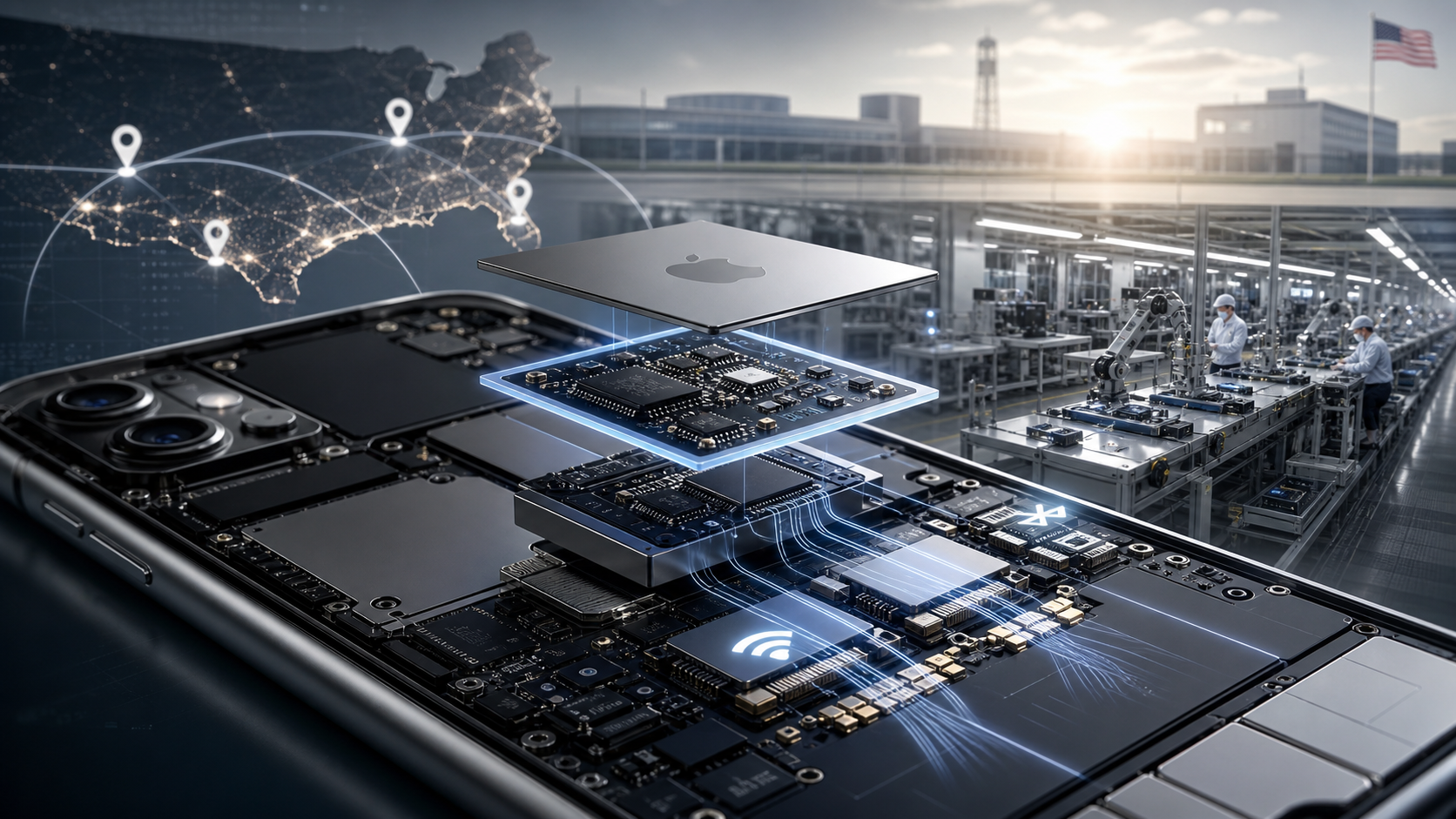
Apple's 2023 announcement said Broadcom would develop 5G radio frequency components and wireless connectivity parts in several U.S. manufacturing hubs, including Fort Collins, Colorado. The new extension says the relationship is still strategic, not legacy.
That matters for the broader supply chain because connectivity sits downstream of the modem story but upstream of the user experience. If Apple keeps its modem roadmap internal while keeping Broadcom on RF and wireless, the company is effectively splitting its stack between what it must own and what it still prefers to source from a specialist.
| Layer | What Broadcom supplies | Why Apple still needs it |
|---|---|---|
| RF front end | Filters and related components | Signal quality and device reliability |
| Wireless connectivity | Wi-Fi / Bluetooth chips | Low-power performance across the product line |
| Manufacturing footprint | U.S. build-out and partner capacity | Supply assurance and political signaling |
| Revenue model | Long-lived customer concentration | Predictability, but also hidden dependence |
My conclusion
The read-through is bigger than Apple: custom connectivity is still scarce, and scarcity still gets paid for.
If Apple still wants a long-term contract for this layer, that tells you the bottleneck is not over. It also tells you the broader semiconductor market should not confuse custom AI silicon with the only strategic custom-silicon game in town. Connectivity, RF, and networking remain structurally important even when the spotlight is on accelerators.
Disclosure: This article is personal analysis only. It is not investment advice, not a recommendation to buy or sell securities, and it may be wrong.