
%22%2F%3E%0A%20%20%3Ccircle%20cx%3D%22220%22%20cy%3D%22150%22%20r%3D%22180%22%20fill%3D%22%2322d3ee%22%20fill-opacity%3D%220.12%22%2F%3E%0A%20%20%3Ccircle%20cx%3D%221010%22%20cy%3D%22130%22%20r%3D%22220%22%20fill%3D%22%2338bdf8%22%20fill-opacity%3D%220.08%22%2F%3E%0A%20%20%3Ccircle%20cx%3D%22920%22%20cy%3D%22520%22%20r%3D%22170%22%20fill%3D%22%2322d3ee%22%20fill-opacity%3D%220.06%22%2F%3E%0A%20%20%3Cpath%20d%3D%22M140%20430h920%22%20stroke%3D%22url(%23line)%22%20stroke-width%3D%2212%22%20stroke-linecap%3D%22round%22%2F%3E%0A%20%20%3Cpath%20d%3D%22M220%20360c120-150%20260-220%20380-220s260%2070%20380%20220%22%20fill%3D%22none%22%20stroke%3D%22%2367e8f9%22%20stroke-opacity%3D%220.5%22%20stroke-width%3D%2216%22%20stroke-linecap%3D%22round%22%20stroke-linejoin%3D%22round%22%2F%3E%0A%20%20%3Cpath%20d%3D%22M300%20398h600%22%20stroke%3D%22%2394a3b8%22%20stroke-opacity%3D%220.24%22%20stroke-width%3D%228%22%20stroke-linecap%3D%22round%22%2F%3E%0A%20%20%3Ctext%20x%3D%22220%22%20y%3D%22510%22%20fill%3D%22%23e2e8f0%22%20fill-opacity%3D%220.7%22%20font-family%3D%22Arial%2C%20Helvetica%2C%20sans-serif%22%20font-size%3D%2238%22%20letter-spacing%3D%228%22%3EINSIGHTS%3C%2Ftext%3E%0A%3C%2Fsvg%3E)
What changed
Meta is no longer only spending like a hyperscaler. It is starting to think like one.
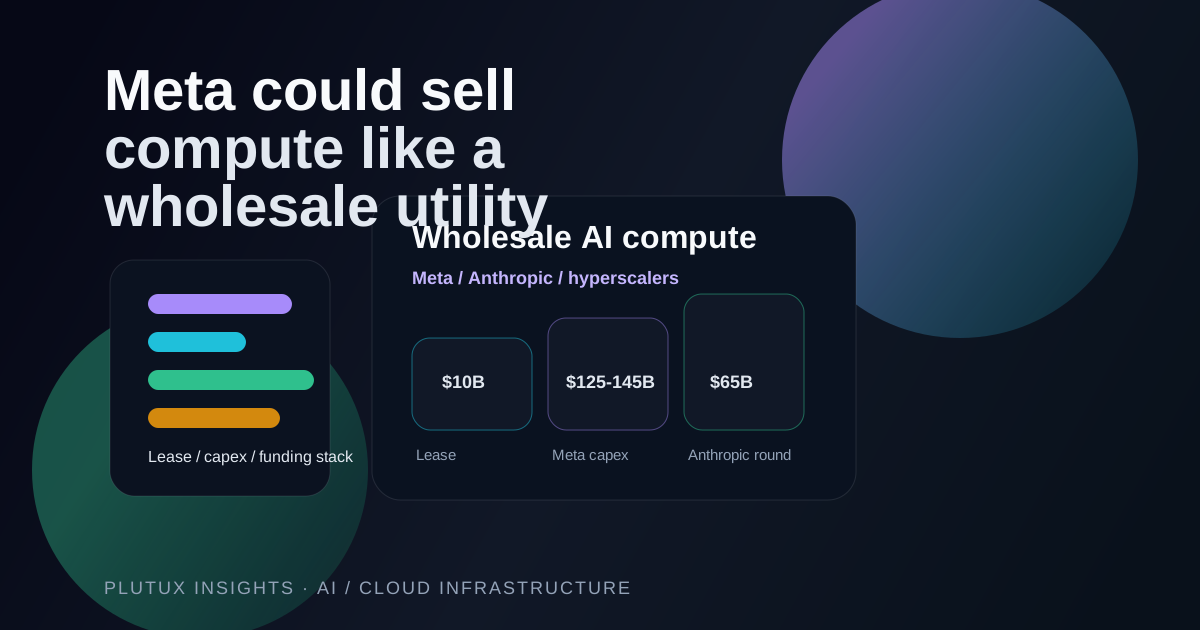
Reuters reported that Meta is in talks to lease computing power to Anthropic in a deal worth up to $10 billion over two years. The simple version of that story is that Meta wants to make money from spare capacity. The more important version is that the company is testing whether AI infrastructure can become a product line.
That matters because Meta's own capex guide is already enormous. The company said in its Q1 release that 2026 capital expenditures, including finance leases, should land in the $125 billion to $145 billion range. A $10 billion lease is not enough to change the scale of the spend, but it is large enough to change the logic of the balance sheet.
The market is therefore no longer just asking whether Meta is overinvesting. It is asking whether the company can turn the investment into a wholesale compute market.
Why it matters
The comparison set shifts from social media to cloud economics.
That creates a second-order read-through for the semiconductor stack. More leased capacity still needs GPUs, networking, and memory, which keeps Nvidia, SK Hynix, and Samsung Electronics in the frame even if the customer set changes.
It also matters for Hong Kong tech. A world where compute is a rented input rather than a tightly held internal asset makes the Asian platform giants think harder about how much infrastructure they need to own versus lease. Alibaba and Tencent are part of that comparison whether or not they are named in the deal.
| Dimension | Signal | Investor interpretation |
|---|---|---|
| Lease size | $10B | Large enough to validate the category |
| Term | 24 months | Long enough to matter for payback math |
| Monthly run-rate | $417M | Recurring revenue instead of one-off hardware sales |
| Capex base | $125B-$145B | The asset base is already hyperscale-sized |
Read-through
The market is starting to price AI compute like an industrial utility with tenants, not like a vanity project.
That is the deeper implication of the Reuters report. If frontier AI labs want to rent capacity rather than build every last rack, then the market will start comparing utilization rates, lease terms, and power costs across a much larger set of providers.
Meta's reported recruitment of AWS veteran Dave Brown, as covered by WSJ, reinforces the same direction of travel. This is no longer a purely internal infrastructure build. It is the beginning of a more explicit cloud strategy.
For investors, the key question is whether Meta can monetize the same assets twice: once internally through model training and product improvement, and once externally through wholesale leasing. If yes, the infrastructure bill is easier to underwrite. If no, the capex still looks like a giant internal optimization project.
The lease is small versus capex, but big enough to prove the model
This chart uses the reported lease value and Meta's own capex guidance alongside Anthropic's latest financing. The values are directly comparable only as capital-allocation signals.
단위: USD billions
Potential lease ($B)
Two-year contract value
10
Anthropic funding ($B)
Latest Series H
65
Meta capex low ($B)
Lower end of 2026 guide
125
Meta capex high ($B)
Upper end of 2026 guide
145
Bottom line
If Meta can lease compute, the company stops being just an ad business with expensive data centers.
It becomes a platform that can sell spare capacity to a rival frontier lab, and that would be a meaningful shift in how the market models the stock.
That is a much more interesting framework for the next round of Big Tech capex.