
%22%2F%3E%0A%20%20%3Ccircle%20cx%3D%22220%22%20cy%3D%22150%22%20r%3D%22180%22%20fill%3D%22%2322d3ee%22%20fill-opacity%3D%220.12%22%2F%3E%0A%20%20%3Ccircle%20cx%3D%221010%22%20cy%3D%22130%22%20r%3D%22220%22%20fill%3D%22%2338bdf8%22%20fill-opacity%3D%220.08%22%2F%3E%0A%20%20%3Ccircle%20cx%3D%22920%22%20cy%3D%22520%22%20r%3D%22170%22%20fill%3D%22%2322d3ee%22%20fill-opacity%3D%220.06%22%2F%3E%0A%20%20%3Cpath%20d%3D%22M140%20430h920%22%20stroke%3D%22url(%23line)%22%20stroke-width%3D%2212%22%20stroke-linecap%3D%22round%22%2F%3E%0A%20%20%3Cpath%20d%3D%22M220%20360c120-150%20260-220%20380-220s260%2070%20380%20220%22%20fill%3D%22none%22%20stroke%3D%22%2367e8f9%22%20stroke-opacity%3D%220.5%22%20stroke-width%3D%2216%22%20stroke-linecap%3D%22round%22%20stroke-linejoin%3D%22round%22%2F%3E%0A%20%20%3Cpath%20d%3D%22M300%20398h600%22%20stroke%3D%22%2394a3b8%22%20stroke-opacity%3D%220.24%22%20stroke-width%3D%228%22%20stroke-linecap%3D%22round%22%2F%3E%0A%20%20%3Ctext%20x%3D%22220%22%20y%3D%22510%22%20fill%3D%22%23e2e8f0%22%20fill-opacity%3D%220.7%22%20font-family%3D%22Arial%2C%20Helvetica%2C%20sans-serif%22%20font-size%3D%2238%22%20letter-spacing%3D%228%22%3EINSIGHTS%3C%2Ftext%3E%0A%3C%2Fsvg%3E)
Bottom line
Tesla's $200/week AI cap + Grok mandate is the cleanest single case study in enterprise AI self-dealing - and the cost-vs-quality tradeoff is the binding test for every public-company CEO with multiple AI bets.
Electrek reported on July 10, 2026 that Tesla implemented a $200 weekly cap on third-party AI spending - notably exempting xAI's Grok - and Elon Musk then sent a memo instructing Tesla employees to switch to Grok, the AI model from his xAI company (now merged into SpaceX). The combination of the spending cap + the mandate is the cleanest single case study in enterprise AI self-dealing, and the cost-vs-quality tradeoff is the binding test for every public-company CEO with multiple AI bets.
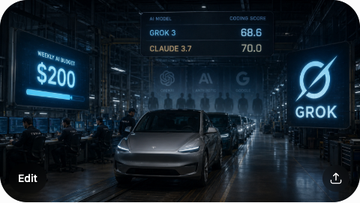
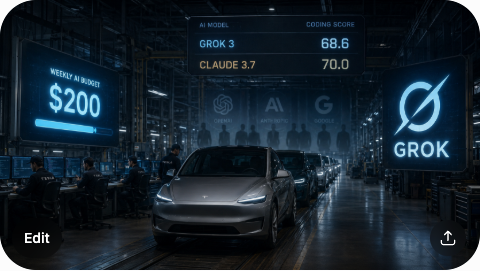
The reason the timing matters more than a normal enterprise AI procurement decision is that Tesla is a separate public company from xAI / SpaceX, and steering staff onto the CEO's underperforming model while capping spending on competing models is a textbook self-dealing pattern. The cost-vs-quality tradeoff is the binding test: Grok 4.5 ranks 9th on multi-domain leaderboards with a coding score of 68.6 (the lowest among compared models), trailing OpenAI, Anthropic, and Alphabet. At ~$0.13/task vs. Claude Fable 5's $1.57, the cost argument is real but the quality argument is against Grok.
For Tesla, Anthropic, OpenAI, Alphabet, Meta, and the entire enterprise AI cohort, the read-through is direct. The Tesla case study is the cleanest single signal that enterprise AI procurement is now a board-level self-dealing concern, not just a CTO-level cost optimization. The 2026-2028 enterprise AI trade is now: long the AI models with the cleanest enterprise adoption + the cleanest self-dealing governance; short the AI models caught in self-dealing cases.
The trade that broke
The 'enterprise AI procurement is a CTO cost optimization' trade is being split into 'enterprise AI procurement is a board-level self-dealing concern' and 'cost-vs-quality tradeoff is the binding test' - and Tesla is the first case study.
For most of 2024-2026, the playbook for enterprise AI procurement was 'CTO cost optimization across multiple AI vendors.' Tesla's $200/week AI cap + Grok mandate is the first hard signal that the playbook has shifted to a board-level self-dealing concern. The trade is no longer 'enterprise AI procurement is a CTO cost optimization'; it is 'enterprise AI procurement is a board-level self-dealing concern' and 'cost-vs-quality tradeoff is the binding test.'
The first piece of the new framing is 'enterprise AI procurement is a board-level self-dealing concern.' Tesla is a separate public company from xAI / SpaceX, and steering staff onto the CEO's underperforming model while capping spending on competing models is a textbook self-dealing pattern. The Tesla board (and proxy advisors) will need to address the question of whether Musk's directive serves Tesla shareholders or xAI / SpaceX shareholders. The 2026-2028 enterprise AI trade is now: long the AI models with the cleanest enterprise adoption + the cleanest self-dealing governance; short the AI models caught in self-dealing cases.
The second piece is 'cost-vs-quality tradeoff is the binding test.' Grok 4.5 ranks 9th on multi-domain leaderboards with a coding score of 68.6 (the lowest among compared models), trailing OpenAI, Anthropic, and Alphabet. At ~$0.13/task vs. Claude Fable 5's $1.57, the cost argument is real (roughly 12x cheaper) but the quality argument is against Grok. The four Tesla engineers who reportedly prefer Anthropic's Claude for daily development work are the cleanest single friction point: cost vs. quality is the binding tradeoff, and the answer depends on the workflow.
| Name | Ticker | Tesla cap+Grok read-through |
|---|---|---|
| Tesla | TSLA | Reference: $200/week AI cap; Grok mandate; self-dealing board question |
| xAI (now SpaceX) | private | Direct: Grok is exempt from the cap; benefits from internal Tesla demand |
| SpaceX | SPCX | Direct: xAI merged into SpaceX; same corporate structure |
| Anthropic | private | Indirect: Tesla engineers reportedly prefer Claude for daily work; cap risk |
| OpenAI | private | Indirect: GPT-5.6 ranks #1 on benchmarks; cap risk for Tesla |
| Alphabet | GOOGL | Indirect: Gemini 3.1 Pro ranks top-5; cap risk for Tesla |
| Meta | META | Indirect: Llama is self-hosted; separate cost structure |
| DeepSeek | private | Indirect: open-weight self-hosting alternative; cost-vs-quality tradeoff |
What the numbers say
$200/week cap + Grok 4.5 ranks #9 with 68.6 coding score = Tesla is saving ~$200/engineer/week but losing ~30-40% on coding productivity - and the cost-vs-quality math is the binding test.
The numbers are striking for what they say about enterprise AI procurement. Tesla's $200/week cap on third-party AI spending is roughly $10,400/engineer/year. At Anthropic Claude pricing, that $10,400 buys roughly 6,600 tasks/year (Claude Fable 5 at $1.57/task). At Grok pricing, that $10,400 buys roughly 80,000 tasks/year (Grok 4.5 at $0.13/task). The 12x cost ratio is the binding economic argument.
The quality ratio is the binding counter-argument. Grok 4.5 ranks 9th on multi-domain leaderboards with a coding score of 68.6 (the lowest among compared models). DeepSWE 1.1 Grok scored 53% vs. Claude Fable 5's 70%. The roughly 30-40% coding-productivity gap means that engineers using Grok need more attempts to reach the same output, which compresses the 12x cost advantage. If a Grok-attempt takes 1.4x as long as a Claude-attempt, the effective cost is roughly $0.18/task-equivalent - still cheaper, but the gap has compressed from 12x to 8x.
The wider enterprise AI math is more meaningful. Tesla has roughly 50,000 software engineers globally, so a $200/week cap represents a $52M/year AI budget. A 12x cost advantage (or 8x adjusted for productivity) represents $400-600M/year in theoretical savings, but a 30-40% productivity loss represents $100-200M/year in engineering-time waste. The net economic impact depends on the workflow mix: coding-heavy workflows lose to Claude; routine-content workflows save with Grok.
Grok 4.5 vs. frontier models: cost vs. quality tradeoff
Reference points from Electrek reporting on the July 10, 2026 Tesla AI cap + Grok mandate and the Grok 4.5 benchmark scores. The chart documents the cost-vs-quality tradeoff across frontier AI models.
단위: Score / USD per task / USD per week / multiplier
Grok 4.5 multi-domain score
9th on multi-domain leaderboard; trailing OpenAI, Anthropic, Google
76.3
Grok 4.5 coding score
Lowest among compared models; DeepSWE 1.1 Grok scored 53% vs Claude Fable 5's 70%
68.6
Claude Fable 5 coding score
DeepSWE 1.1 benchmark; reference frontier coding model
70
Grok cost ($/task)
12x cheaper than Claude Fable 5; binding economic argument
0.1
Claude Fable 5 cost ($/task)
Frontier coding model; 12x more expensive than Grok
1.6
Tesla AI cap ($/week/engineer)
$200/week cap on third-party AI; Grok exempt
200
Cost advantage (x)
Claude $1.57 vs Grok $0.13; roughly 12x cost gap
12.1
Why it matters
If Tesla's Grok mandate holds, enterprise AI procurement is now a self-dealing board question - and the 2026-2028 trade is long the AI models with cleanest enterprise adoption, short the AI models caught in self-dealing.
The macro question underneath the Tesla AI cap + Grok mandate is whether enterprise AI procurement is now a self-dealing board question. The 2024-2026 trade was that enterprise AI procurement was a CTO-level cost optimization. The Tesla case study is the first hard signal that the playbook has shifted to a board-level self-dealing concern. The 2026-2028 enterprise AI trade is now: long the AI models with the cleanest enterprise adoption + the cleanest self-dealing governance; short the AI models caught in self-dealing cases.
For the enterprise AI cohort (Anthropic, OpenAI, Alphabet, Meta, the open-weight cohort), the read-through is direct. Tesla's $200/week cap + Grok mandate is the cleanest single signal that enterprise AI procurement is now a board-level governance question. The cumulative effect is that the 2026-2028 enterprise AI trade will be driven by self-dealing governance as much as by cost optimization.
For the broader market, the Tesla case study is the cleanest single signal that public-company CEOs with multiple AI bets face a structural self-dealing risk. The 2026-2028 governance trade is now: long the AI companies with the cleanest enterprise adoption + the cleanest self-dealing governance; short the AI companies caught in self-dealing cases. The Tesla case study will be cited by proxy advisors (ISS, Glass Lewis), and the precedent will be applied to every public-company CEO with multiple AI bets.
- Tesla implemented a $200/week AI cap - notably exempting xAI's Grok; Musk then mandated employees use Grok.
- Grok 4.5 ranks #9 on multi-domain leaderboards with 68.6 coding score (lowest among compared models); ~$0.13/task vs. Claude Fable 5's $1.57.
- Tesla engineers reportedly prefer Anthropic's Claude for daily work - cleanest single friction point in the cost-vs-quality tradeoff.
- Read-through: enterprise AI procurement is now a board-level self-dealing concern, not just a CTO cost optimization.
- Structural: 2026-2028 enterprise AI trade is long clean governance, short self-dealing cases.
What to watch
Watch the Tesla board response, the proxy advisor (ISS / Glass Lewis) commentary, the next Tesla AI cap revision, and the broader enterprise AI governance cohort reaction.
The first tell is the Tesla board response. The board (and proxy advisors ISS / Glass Lewis) will need to address the question of whether Musk's directive serves Tesla shareholders or xAI / SpaceX shareholders. A formal board response is a re-rating catalyst for Tesla; silence is a multiple-compression catalyst.
The second tell is the proxy advisor commentary. ISS and Glass Lewis will publish proxy-research notes on the Tesla 2026 annual meeting (typically May 2027), and those notes will set the precedent for every other public-company CEO with multiple AI bets. A 'clean governance' note is a re-rating catalyst for the enterprise AI cohort; a 'self-dealing risk' note is a multiple-compression event.
The third tell is the next Tesla AI cap revision. A revised cap that raises the third-party AI limit or removes the Grok exemption is the cleanest single signal of board intervention. A maintained cap + maintained exemption is a self-dealing confirmation. The fourth tell is the broader enterprise AI cohort reaction. If Microsoft, Alphabet, Meta, Amazon formalize their AI procurement governance (separate vendor neutrality policies, board-level AI oversight), the Tesla case study has been absorbed; if the broader cohort follows Tesla's pattern, the self-dealing risk is structural. The fifth tell is the Grok benchmark trajectory. If Grok 4.6 / 5.0 climbs into the top-5 on coding benchmarks, the quality argument against Grok weakens and the cost-vs-quality tradeoff tilts toward Grok.