%22%2F%3E%0A%20%20%3Ccircle%20cx%3D%22220%22%20cy%3D%22150%22%20r%3D%22180%22%20fill%3D%22%2322d3ee%22%20fill-opacity%3D%220.12%22%2F%3E%0A%20%20%3Ccircle%20cx%3D%221010%22%20cy%3D%22130%22%20r%3D%22220%22%20fill%3D%22%2338bdf8%22%20fill-opacity%3D%220.08%22%2F%3E%0A%20%20%3Ccircle%20cx%3D%22920%22%20cy%3D%22520%22%20r%3D%22170%22%20fill%3D%22%2322d3ee%22%20fill-opacity%3D%220.06%22%2F%3E%0A%20%20%3Cpath%20d%3D%22M140%20430h920%22%20stroke%3D%22url(%23line)%22%20stroke-width%3D%2212%22%20stroke-linecap%3D%22round%22%2F%3E%0A%20%20%3Cpath%20d%3D%22M220%20360c120-150%20260-220%20380-220s260%2070%20380%20220%22%20fill%3D%22none%22%20stroke%3D%22%2367e8f9%22%20stroke-opacity%3D%220.5%22%20stroke-width%3D%2216%22%20stroke-linecap%3D%22round%22%20stroke-linejoin%3D%22round%22%2F%3E%0A%20%20%3Cpath%20d%3D%22M300%20398h600%22%20stroke%3D%22%2394a3b8%22%20stroke-opacity%3D%220.24%22%20stroke-width%3D%228%22%20stroke-linecap%3D%22round%22%2F%3E%0A%20%20%3Ctext%20x%3D%22220%22%20y%3D%22510%22%20fill%3D%22%23e2e8f0%22%20fill-opacity%3D%220.7%22%20font-family%3D%22Arial%2C%20Helvetica%2C%20sans-serif%22%20font-size%3D%2238%22%20letter-spacing%3D%228%22%3EINSIGHTS%3C%2Ftext%3E%0A%3C%2Fsvg%3E)
Korean memory makers are trading like the AI capex story just broke its financing logic.
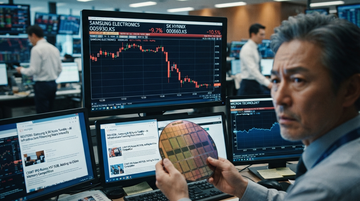
On July 28, 2026, Samsung Electronics fell as much as 9.5% and SK hynix fell as much as 11.1% in Seoul, with Reuters citing investors fearing financing risk for AI infrastructure capex while China tightens pricing pressure. The market reaction mattered because memory is not just a “semiconductor theme”—it’s a funding-and-velocity business where supply ramp timing and pricing power can change profits faster than demand narratives.
This article turns that day’s tape move into a supply-chain-aware question: if AI spending gets harder to fund (or slows at the margin), who absorbs the margin shock first—HBM leaders, DRAM generalists, or the lagging entrants?
Verified catalyst: what the market is responding to (and why it spreads)
The drawdown is being priced as a “capex payback” problem, not a pure demand problem
What Reuters said drove the move (July 28, 2026)
Samsung move
Fell nearly 10% intraday (as much as 9.5%)
Framed around AI infrastructure financing worries + China competition.
SK hynix move
Fell 11.1% intraday
Same framing: financing risks for AI capex and intensifying China competition.
Broader risk tone
KOSPI down ~8% as of 0120 GMT
Shows this wasn’t just stock-specific.
In a capital-intensive industry, financing fears act like a multiplier on uncertainty.
Even if end-demand remains strong, buyers (hyperscalers and integrators) may delay or re-schedule capex tranches when credit conditions or internal ROI gates get tighter. That can hit memory companies through two linked mechanisms: (1) price expectations soften because suppliers accelerate output while the buyer’s timing becomes less certain; and (2) the market discounts the value of future capacity because payback timelines stretch.
Data grounding: the financial ‘shock absorber’ question
Why Micron can re-rate differently: its cash generation has historically swung more with cycle pricing
Micron FY 2025 revenue
$37.38B
FY ending 2025-08-28 (FMP income statement).
Micron FY 2025 net income
$8.54B
FY ending 2025-08-28 (FMP income statement).
Micron FY 2025 operating cash flow
$17.53B
FY ending 2025-08-28 (FMP cash flow).
Micron FY 2025 free cash flow
$1.67B
FY ending 2025-08-28 (FMP cash flow).
Micron Technology is not “HBM-first” the way SK hynix is, but it sits in the same AI-memory economics: pricing for DRAM/HBM-adjacent memory and the speed at which suppliers can flex output.
In the most recent full-year data available through the data tools, Micron shows a cycle-like cash conversion pattern: FY 2025 had $17.53B operating cash flow and $1.67B free cash flow after heavy capex ($15.86B property/plant/equipment investment in the same FY). That profile makes Micron’s equity re-rate sensitive to what happens next to memory pricing and capex pacing—exactly the transmission channel implied by the Reuters framing.
Supply chain: upstream funding → memory pricing → downstream systems
The contagion path is: data-center finance → memory bid schedules → DRAM/HBM price expectations
- Financing worries shift hyperscalers from ‘build now’ to ‘re-time purchases’—even if AI workloads remain long-term bullish.
- That re-timing reduces near-term visibility on memory price floors, which is enough for market multiples to compress in memory-heavy indices.
- China competition raises the probability that supply grows while prices disappoint, amplifying the selloff beyond Korea.
| Stage | What changes when capex financing fears rise | Memory linkage | Investor signal |
|---|---|---|---|
| AI data-center spending (customers) | Delivery tranches get re-timed; fewer “blind” orders | Memory demand becomes less price-insensitive | Investors discount peak pricing durability |
| Memory fabs and output planning (suppliers) | Capacity stays sticky; output is costly to stop | If buyers slow, supply can outpace demand expectations | Equity moves reflect price uncertainty |
| Component/board ecosystems (downstream) | System builders price components assuming volatility | Memory ASP expectations flow into BOM costs | Broader semiconductor tape reacts |
China angle: why competition amplifies a ‘funding’ story
When China ramps, “financing fear” becomes “pricing fear” faster
Reuters also connects the selloff to intensifying competition from China. That matters because China entrants can sustain price pressure even when global demand is fine—so the market can’t assume “strong demand will lift all boats.”
One concrete market datapoint from the same supply ecosystem is CXMT’s Shanghai debut: Reuters reported the IPO raising 57.92 billion yuan (about $8.6B)—evidence of continued funding behind memory ambitions. (Even though this doesn’t quantify “HBM vs DRAM share” in the Reuters snippet we accessed, it does show capital is still flowing into the China memory buildout.)
Non-obvious angle: why the ‘contagion’ shows up first in Seoul pricing
Memory is bundling Korea into a single risk bucket—so local shocks export to US names
Korea’s equity plumbing creates mechanical correlation. When two dominant memory names (Samsung and SK hynix) drop sharply on a shared narrative, funds often hedge or de-risk across the same index exposure. Reuters’ framing of the selloff as both “financing risk” and “China competition” increases the likelihood the selloff is modeled as macro-repricing rather than earnings-only.
That’s why the US readthrough matters: when the market believes the next quarter’s memory pricing is less dependable, it tends to re-price the global AI-memory complex—not just the Korean equities.
Horizons: what to watch next in days–quarters vs 1–3 years
Short-term: watch guidance language for pricing confidence; long-term: watch which firms can keep capex ‘ROI-anchored’
- Days–quarters: monitor whether management commentary shifts from “AI demand is strong” to “visibility is lower / orders are re-timed”—that is the Reuters-style trigger the tape is already discounting.
- Days–quarters: look for evidence that capex plans are being defended with cash flow rather than external financing—because the scare is specifically about financing risk.
- 1–3 years: the winners are likely the producers that maintain pricing discipline without pausing critical process learning, because HBM/leading-edge DRAM involves compounding advantages.
Related listed stocks most tied to the financing→pricing contagion channel
- Micron’s FY 2025 cash profile shows it can generate operating cash in strong cycles (operating cash flow $17.53B), supporting re-rating when pricing risk clears (days–quarters).
- If the Reuters “financing fear” fades, Micron is positioned to benefit quickly because its earnings swing is closely tied to DRAM/NAND pricing (1–3 years).
- A rebound in memory price expectations should lift margin expectations even before capex ‘vision’ returns to favor.
- The stock fell 11.1% on July 28 (as much as), implying the market is discounting near-term pricing confidence (days).
- SK hynix’s recent financials show large swings around cycle turns; the market often extrapolates pricing weakness into forward cash flow (days–quarters).
- China competition raises the probability of persistent price pressure even in AI upcycles (1–3 years).
- Samsung dropped as much as 9.5% on July 28, signaling multiple compression tied to AI capex payback fears (days).
- If buyers re-time data-center capex, Samsung’s memory exposure implies the company faces faster repricing of unit-price expectations than volume disruption (days–quarters).
- Over 1–3 years, Samsung’s ability to sustain margins depends on process-cost discipline while China ramps capacity.
- Reuters-linked risk-off tone included NVIDIA down nearly 5% intraday, suggesting AI financing worries are spreading to data-center financiers (days).
- If “financing fear” remains, NVIDIA can face near-term sentiment drag even if GPU demand is intact (days–quarters).
- Longer term, NVIDIA’s AI ecosystem depth can offset memory volatility, but sustained capex slowdown would still pressure the whole chain (1–3 years).