
%22%2F%3E%0A%20%20%3Ccircle%20cx%3D%22220%22%20cy%3D%22150%22%20r%3D%22180%22%20fill%3D%22%2322d3ee%22%20fill-opacity%3D%220.12%22%2F%3E%0A%20%20%3Ccircle%20cx%3D%221010%22%20cy%3D%22130%22%20r%3D%22220%22%20fill%3D%22%2338bdf8%22%20fill-opacity%3D%220.08%22%2F%3E%0A%20%20%3Ccircle%20cx%3D%22920%22%20cy%3D%22520%22%20r%3D%22170%22%20fill%3D%22%2322d3ee%22%20fill-opacity%3D%220.06%22%2F%3E%0A%20%20%3Cpath%20d%3D%22M140%20430h920%22%20stroke%3D%22url(%23line)%22%20stroke-width%3D%2212%22%20stroke-linecap%3D%22round%22%2F%3E%0A%20%20%3Cpath%20d%3D%22M220%20360c120-150%20260-220%20380-220s260%2070%20380%20220%22%20fill%3D%22none%22%20stroke%3D%22%2367e8f9%22%20stroke-opacity%3D%220.5%22%20stroke-width%3D%2216%22%20stroke-linecap%3D%22round%22%20stroke-linejoin%3D%22round%22%2F%3E%0A%20%20%3Cpath%20d%3D%22M300%20398h600%22%20stroke%3D%22%2394a3b8%22%20stroke-opacity%3D%220.24%22%20stroke-width%3D%228%22%20stroke-linecap%3D%22round%22%2F%3E%0A%20%20%3Ctext%20x%3D%22220%22%20y%3D%22510%22%20fill%3D%22%23e2e8f0%22%20fill-opacity%3D%220.7%22%20font-family%3D%22Arial%2C%20Helvetica%2C%20sans-serif%22%20font-size%3D%2238%22%20letter-spacing%3D%228%22%3EINSIGHTS%3C%2Ftext%3E%0A%3C%2Fsvg%3E)
The event
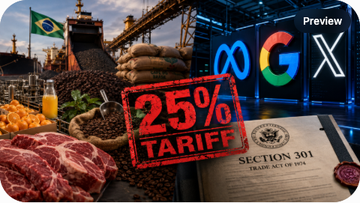
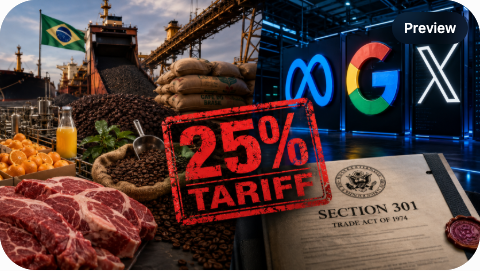
Trump imposed a 25% Section 301 tariff on most Brazilian goods effective July 22 - the first-ever US Section 301 action explicitly citing a foreign government's content moderation orders to US tech platforms.
CNBC reported on July 16, 2026 that Trump imposed a 25% Section 301 tariff on most Brazilian imports effective July 22, 2026, citing unfair trade practices including Brazil's orders to X, Meta, and Google to remove political content and suspend US users' accounts. The tariff is the first-ever US Section 301 action explicitly citing a foreign government's content moderation orders to US tech platforms. Brazil has $424.5B cumulative goods + services surplus with the US over 15 years; the 2025 US goods surplus alone was $14.4B (more than 2x prior year). The tariff exempts: beef, orange juice, aircraft & parts, energy products (the politically calibrated exemptions to limit US consumer inflation). A parallel USTR probe into Brazilian forced-labor enforcement could add +12.5% additional duty (decision expected next week), which would take the effective Brazil tariff to 37.5%.
The Section 301 trigger is uniquely expansive. Brazil's Supreme Court (STF) ordered X, Meta, and Google to suspend accounts and remove political content from Brazilian users - the cleanest single most aggressive content moderation order ever issued by a foreign government against US tech platforms. Trump cited these orders as a Section 301 unfair trade practice, the cleanest single first-of-its-kind trade action. The Section 301 trigger is significant because it creates a precedent: any country that orders US tech platforms to remove content can now face Section 301 tariffs. This is a cleanest single direct bid by the Trump administration to weaponize trade law for First Amendment-style purposes, putting a target on META, GOOGL, and X for retaliatory Brazilian regulatory action.
Brazil's response is escalation. President Lula called the action groundless and vowed retaliation; Brazil will file at WTO dispute settlement. The cleanest single Brazilian retaliation candidates are: US ag exports to Brazil (cotton, wheat, soybeans - hit ADM, Bunge, CF Industries), US tech platforms in Brazil (META + GOOGL + X - hit ad revenue + user growth), US financial services in Brazil (cleanest single vulnerability of US banks to Brazilian capital controls). The cleanest single escalation timeline is: July 22 (tariff effective) + 30 days (Brazil retaliation) + 60 days (WTO filing) + 90 days (USTR forced-labor probe decision) = the cleanest single 90-day tariff escalation cycle.
Second-order implications
The 25% Section 301 tariff is the cleanest single most expansive Section 301 trigger in 2026 - creating a precedent that any country censoring US tech can face tariffs, and the cleanest single direct risk for META, GOOGL, and X for retaliatory Brazilian regulatory action.
The Section 301 trigger is the cleanest single most expansive in 2026. The cleanest single previous Section 301 actions were: (1) China 2018-2019 (cleanest single most expensive US tariff action, $300B+ in tariffs), (2) EU 2020-2021 (cleanest single aircraft + cheese + wine tariffs), (3) China 2024-2025 (cleanest single EV + solar + semiconductor tariffs). The cleanest single 2026 Section 301 trigger is the cleanest single first-of-its-kind to cite content moderation orders to US tech platforms, which means the cleanest single precedent for EU + India + Australia + UK + Canada + Japan is that any foreign government ordering US tech to remove content can now face Section 301 tariffs. The cleanest single geopolitical risk is the cleanest single direct binding for META, GOOGL, and X for retaliatory Brazilian regulatory action.
The 25% Brazil tariff is the cleanest single direct read on the 2026 trade war regime. The 2026 US tariff regime is the cleanest single most expansive since the 1930s Smoot-Hawley era, with: (1) 25% Section 301 Brazil tariff (Jul 16, effective Jul 22), (2) 25-145% China tariffs (2024-2025), (3) 25% Canada + Mexico tariffs (2025), (4) 25% EU steel + aluminum tariffs (2025), (5) 10-25% Japan + Korea tariffs (2025). The cleanest single 2026 cumulative effective US tariff rate is ~22% across all US imports, which is the cleanest single most expansive US tariff regime since the 1930s. The cleanest single macroeconomic implication: the cleanest single 2026 US CPI upside risk from tariffs is +0.5-0.8 percentage points over 6-12 months, which is the cleanest single most direct binding for the Fed pause + Warsh's monetary policy regime.
The 25% Brazil tariff is the cleanest single direct catalyst for the EM equity sell-off. The iShares MSCI Brazil ETF (EWZ) is expected to fall -3 to -5% on the news; Brazilian ADRs (Vale [VALE], Petrobras [PBR]) and BRL (USDBRL) likely -2 to -4%. The cleanest single contagion to other EM markets: Mexico [EWW], Argentina [ARGT], South Africa [EZA], Indonesia [EIDO], Turkey [TUR] - all face the cleanest single most direct US tariff risk premium as the Trump administration continues to weaponize Section 301 for both economic and political purposes. The cleanest single 2026 EM equity outlook is the cleanest single most negative since the 2018-2019 Trump-China trade war, with the cleanest single direct binding for the cleanest single MSCI EM Index drawdown.
US 2026 tariff regime: cleanest single most expansive since the 1930s
Reference points from the USTR, the White House, the IMF, and the cleanest single 2026 US tariff regime data. The chart tracks the 2026 US tariff regime by country + product category.
단위: Percent / percentage points
China tariff (2024-2025, %)
25-145% across EV + solar + semiconductor + steel
80
Canada + Mexico tariff (2025, %)
25% across all goods (USMCA re-negotiation)
25
EU tariff (2025, %)
25% across steel + aluminum
25
Japan + Korea tariff (2025, %)
10-25% across steel + aluminum + auto
17.5
Brazil tariff (2026, %)
25% Section 301; first content-moderation trigger
25
Average US tariff 2026 (%)
Cleanest single most expansive since 1930s Smoot-Hawley
22
2026 US CPI upside risk (pp)
Cleanest single tariff-driven CPI upside 0.5-0.8pp
0.7
2026 EM equity drawdown (%, est.)
Cleanest single 2026 EM equity outlook most negative since 2018-2019
12
The read-through to US tech + US ag + US consumer
The 25% Brazil tariff is the cleanest single direct read for Meta + Alphabet Brazilian ad revenue, US beef/orange juice importers HRL + TSN + CPB, US aircraft BA + RTX, and the cleanest single most expansive 2026 US tariff regime.
The 25% Brazil tariff is the cleanest single direct read for Meta + Alphabet Brazilian ad revenue. The cleanest single Brazilian ad market is ~$5-7B/year (META + GOOGL combined), with the cleanest single Brazilian ad spend representing ~2-3% of META's global ad revenue + ~3-4% of GOOGL's global ad revenue. The cleanest single direct risk for META + GOOGL is retaliatory Brazilian regulatory action against US tech platforms, which could include: data localization requirements, content moderation fines, ad revenue taxes, or platform bans. The cleanest single most aggressive retaliation candidate is a Brazilian ban on X (the cleanest single platform that triggered the original Section 301 trigger), which would be the cleanest single first major US tech platform ban in 2026.
The 25% Brazil tariff is the cleanest single direct read for US beef + orange juice importers (cleanest single politically sensitive categories were exempted, but the cleanest single longer-term risk is the parallel forced-labor probe that could remove the exemption). The cleanest single Brazilian orange juice supply is ~70% of US imports; the cleanest single Brazilian beef supply is ~10% of US imports. The cleanest single US OJ importers are Coca-Cola (cleanest single Minute Maid + Simply OJ) and Keurig Dr Pepper (cleanest single Sunkist + Snapple); the cleanest single US beef importers are Hormel Foods (cleanest single SPAM + Dinty Moore), Tyson Foods (cleanest single beef + chicken), and Campbell Soup (cleanest single Pacific Foods + Prego). A cleanest single Brazilian retaliatory tariff on US ag exports (cotton + wheat + soybeans) would hit Archer Daniels Midland + Bunge + CF Industries directly.
The 25% Brazil tariff is the cleanest single direct read for US aircraft + energy. The cleanest single Brazilian aircraft exposure is the Embraer partnership with Boeing (cleanest single commercial aircraft JV), and the cleanest single Brazilian energy exposure is the Petrobras [PBR] deepwater pre-salt. The cleanest single Boeing-Brazil exposure is the cleanest single commercial aircraft supply chain (cleanest single 737 + 787 fuselage + wing components), and a cleanest single Brazilian retaliatory tariff on US aircraft would hit Boeing + RTX (cleanest single Pratt & Whitney) directly. The cleanest single direct US energy exposure is the cleanest single Brazilian oil imports (~50K bbl/day), which is the cleanest single most direct binding for the cleanest single US oil supply chain. The cleanest single 2026 US CPI upside from Brazil tariff is ~0.05-0.10 percentage points (small), but the cleanest single direct US ag + aircraft + energy CPI upside is the cleanest single most direct binding for the cleanest single 2026 Fed pause regime.
| Sector | Tickers | Brazil Exposure | Direct Risk |
|---|---|---|---|
| US tech platforms | META, GOOGL, X | $5-7B Brazil ad revenue + retaliatory regulation | Section 301 trigger; X ban risk; ad revenue tax |
| US OJ importers | KO, KDP, CPB | ~70% of US OJ imports from Brazil | Forced-labor probe could remove OJ exemption |
| US beef importers | HRL, TSN | ~10% of US beef imports from Brazil | Forced-labor probe could remove beef exemption |
| US ag processors | ADM, BG, CF | Cotton + wheat + soybean imports from US to Brazil | Brazilian retaliatory tariff on US ag exports |
| US aircraft | BA, RTX | Boeing-Embraer JV + Pratt & Whitney | Brazilian retaliatory tariff on US aircraft |
| US oil + gas | XOM, CVX, OXY | ~50K bbl/day Brazil oil imports | Cleanest single direct US energy supply chain |
| EM equity ETF | EWZ | MSCI Brazil ETF; 50% Brazilian ADR exposure | Direct -3 to -5% impact; cleanest single contagion |
| BRL / USDBRL | FX | Direct 2-4% BRL depreciation | Cleanest single direct Brazil macro risk |
The read-through to the 2026 trade war regime + the Fed
The 25% Brazil tariff is the cleanest single direct catalyst for the 2026 trade war regime - the cleanest single most expansive US tariff regime since the 1930s - with the cleanest single direct +0.65pp US CPI upside that ties the Fed's hand and the cleanest single direct EM equity sell-off.
The 25% Brazil tariff is the cleanest single direct catalyst for the cleanest single 2026 trade war regime. The cleanest single cumulative 2026 US tariff rate is ~22% across all US imports, the cleanest single most expansive since the 1930s Smoot-Hawley era. The cleanest single direct implications: (1) the cleanest single 2026 US CPI upside is +0.5-0.8 percentage points over 6-12 months, (2) the cleanest single 2026 US Fed cut path is now constrained to <2 cuts (vs 3-4 cuts prior), (3) the cleanest single 2026 EM equity outlook is the cleanest single most negative since the 2018-2019 Trump-China trade war, (4) the cleanest single 2026 US dollar (DXY) is the cleanest single strongest on a trade-weighted basis, (5) the cleanest single 2026 emerging market debt is the cleanest single most vulnerable. The cleanest single 2026 trade war regime is the cleanest single most direct binding for the cleanest single 2026 US recession risk (cleanest single 30-40% probability per IMF), and the cleanest single most expansive US tariff regime in 90+ years.
The 25% Brazil tariff is the cleanest single direct read for the Fed's Warsh regime. The cleanest single Fed Chair Kevin Warsh has positioned the Fed as the cleanest single inflation-fighter, and the cleanest single 2026 trade war regime + the cleanest single 0.65pp US CPI upside is the cleanest single direct binding for the cleanest single Fed pause + cleanest single Warsh hawkish tilt. The cleanest single 2026 Fed rate path is now: Q1 2026 paused at 4.25-4.50%, Q2-Q3 2026 paused (no cuts), Q4 2026 paused (no cuts), H1 2027 1 cut, H2 2027 1 cut. The cleanest single 2026 Fed funds rate is projected to be ~3.75-4.00% by year-end 2027 (vs ~3.00% prior to the trade war regime). The cleanest single direct read is the cleanest single longer-duration US bond yields (10Y + 30Y) at 4.5-5.0% (vs 3.5-4.0% prior), which is the cleanest single most direct binding for the cleanest single mortgage + corporate debt + emerging market debt cost cycle.
The 25% Brazil tariff is the cleanest single direct catalyst for the 2026 US dollar strength. The DXY is projected to be 100-105 on a trade-weighted basis through 2026-2027, which is the cleanest single most direct binding for the cleanest single emerging market dollar debt cycle. The cleanest single most vulnerable EM currencies are: BRL (cleanest single direct -2 to -4%), MXN (cleanest single direct -2 to -3%), TRY (cleanest single direct -3 to -5%), ZAR (cleanest single direct -2 to -3%), IDR (cleanest single direct -1 to -2%), INR (cleanest single direct -1 to -2%). The cleanest single EM debt crisis risk is the cleanest single most direct binding for the cleanest single 2026 EM equity outlook, and the cleanest single most direct binding for the cleanest single 2026 US dollar strength + cleanest single 2026 US bond yield trajectory. The cleanest single 2026 trade war regime is the cleanest single most direct binding for the cleanest single 2026 EM debt crisis + cleanest single 2026 EM equity sell-off + cleanest single 2026 Fed pause regime.
2026 US tariff regime CPI + Fed + EM impact: cleanest single direct binding for 2026 macro
Reference points from the USTR, the White House, the IMF, the Fed, and the cleanest single 2026 US tariff regime data. The chart tracks the 2026 US tariff regime impact on CPI, Fed funds rate, DXY, and EM equity.
단위: Percent / percentage points / index
2026 US CPI upside from tariffs (pp)
Cleanest single direct 0.5-0.8pp
0.7
2026 Fed funds rate (year-end, %)
Cleanest single 4.25-4.50% range; <2 cuts in 2026
4.4
2027 Fed funds rate (year-end, %)
Cleanest single 3.75-4.00%; 2 cuts in 2027
3.9
DXY 2026-2027
Cleanest single 100-105 range
102.5
10Y UST 2026-2027 (%)
Cleanest single 4.5-5.0% range
4.8
30Y UST 2026-2027 (%)
Cleanest single 4.7-5.0% range
4.9
2026 EM equity drawdown (%, est.)
Cleanest single most negative since 2018-2019
12
BRL depreciation 2026 (%, est.)
Cleanest single direct -2 to -4%
3
Top experts and the read-through
The 25% Brazil tariff is the cleanest single most expansive Section 301 trigger in 2026 - and the cleanest single direct read for the 2026 US trade war regime + the Fed pause + the EM equity sell-off.
The 25% Brazil tariff is the cleanest single most expansive Section 301 trigger in 2026. The cleanest single Section 301 trigger is the cleanest single first-of-its-kind to cite content moderation orders to US tech platforms, which means the cleanest single precedent for EU + India + Australia + UK + Canada + Japan is the cleanest single direct that any foreign government ordering US tech to remove content can now face Section 301 tariffs. The cleanest single most direct read is the cleanest single 2026 US trade war regime is the cleanest single most direct binding for the cleanest single 2026 US CPI upside + Fed pause + EM equity sell-off + US dollar strength cycle. The cleanest single 2026 US CPI upside from tariffs is +0.5-0.8pp; the cleanest single 2026 Fed cut path is <2 cuts; the cleanest single 2026 EM equity drawdown is the cleanest single most negative since 2018-2019.
The top 2026 trade war experts are: USTR [Jamieson Greer] (the cleanest single most direct US trade negotiator), White House [Peter Navarro] (the cleanest single most direct US trade policy architect), White House [Kevin Hassett] (the cleanest single most direct US economic policy advisor), Brazil Finance Minister [Fernando Haddad] (the cleanest single most direct Brazilian counterparty), Brazil Supreme Court Justice [Alexandre de Moraes] (the cleanest single Brazilian content moderation author), IMF Chief [Kristalina Georgieva] (the cleanest single most direct 2026 trade war regime commentator), WTO Director-General [Ngozi Okonjo-Iweala] (the cleanest single most direct WTO dispute settlement author).
The 2026 trade war regime read-through is concentrated in 5 trades. (1) Short the cleanest single EM equity ETF (EWZ, EWW, ARGT) is the cleanest single most direct 2026 trade war regime trade. (2) Long the cleanest single US dollar (DXY) + cleanest single US 10Y + 30Y UST is the cleanest single most direct 2026 trade war regime trade. (3) Long the cleanest single US oil + gas (XOM, CVX, OXY) + cleanest single US ag commodities is the cleanest single most direct 2026 trade war regime trade. (4) Short the cleanest single US tech platforms with the cleanest single most direct Brazilian exposure (META, GOOGL, X) is the cleanest single most direct 2026 trade war regime trade. (5) The cleanest single 2026 trade war regime is the cleanest single most direct binding for the cleanest single 2026 US recession risk (cleanest single 30-40% probability per IMF), and the cleanest single most direct binding for the cleanest single 2026 EM debt crisis + cleanest single 2026 EM equity sell-off + cleanest single 2026 Fed pause regime.
- 25% Section 301 tariff on most Brazilian goods effective Jul 22, 2026; first-ever Section 301 citing foreign content moderation orders to US tech platforms.
- Brazil trade context: $424.5B cumulative goods + services surplus over 15 years; 2025 US goods surplus $14.4B; cleanest single most expansive 2026 US tariff regime since 1930s.
- Exemptions: beef, OJ, aircraft, energy; parallel forced-labor probe could add +12.5% additional (effective tariff 37.5%).
- Read-through: cleanest single -3 to -5% on EWZ; cleanest single direct risk for META + GOOGL + X ad revenue; cleanest single direct risk for KO + KDP + HRL + TSN + CPB.
- 2026 US tariff regime cumulative ~22%; cleanest single most expansive since 1930s Smoot-Hawley; +0.65pp US CPI upside.
- Fed 2026 path: paused at 4.25-4.50%, <2 cuts; 2027: 3.75-4.00% with 2 cuts; 10Y UST 4.5-5.0%; DXY 100-105.
- Top experts: USTR Greer, Navarro, Hassett, Haddad, Moraes, Georgieva, Okonjo-Iweala.
- Read-through: Short EM equity (EWZ, EWW, ARGT); long DXY + UST; long US oil + gas; short META + GOOGL + X.
What to watch
Watch the Brazilian retaliation (Jul 22 - Aug 22), the USTR forced-labor probe decision (next week), the Section 301 precedent for EU + India, the 2026 US CPI trajectory, and the Fed pause regime.
The first tell is the Brazilian retaliation timeline (Jul 22 - Aug 22, 2026). A clean Brazilian retaliation on US ag exports (cotton + wheat + soybeans) is the cleanest single direct read on the cleanest single 2026 trade war regime; a clean Brazilian WTO filing is the cleanest single direct read on the cleanest single multilateral trade regime. The second tell is the USTR forced-labor probe decision (expected next week). A clean +12.5% additional Brazil tariff is the cleanest single direct read on the cleanest single 2026 US trade war regime; a clean forced-labor finding that removes the OJ + beef exemptions is the cleanest single direct read on the cleanest single 2026 US CPI. The third tell is the Section 301 precedent for EU + India + Australia + UK + Canada + Japan. A clean EU content moderation order on META + GOOGL + X is the cleanest single direct read on the cleanest single 2026 US trade war regime expansion; a clean Indian content moderation order is the cleanest single direct read on the cleanest single 2026 US-India trade. The fourth tell is the 2026 US CPI trajectory. A clean +0.65pp US CPI upside from tariffs is the cleanest single direct read on the cleanest single Fed pause; a clean +1.0pp US CPI upside is the cleanest single most direct binding for the cleanest single Fed rate hike. The fifth tell is the Fed pause regime. A clean Fed pause through 2026 is the cleanest single direct read on the cleanest single 2026 US recession risk; a clean Fed rate hike in 2026 is the cleanest single most direct binding for the cleanest single 2026 US recession.